![Free Bill of Sale Template PDF, Word [United States]](https://billofsaletemplate.us/wordpress/wp-content/uploads/2024/06/bill-of-sale-Logo-1-189x74.png)
A Business Bill of Sale is a written document used to record the sale and transfer of a business or specified business assets from a seller to a buyer. It identifies the parties, describes what is being sold, states the agreed purchase price, and records the date and terms of the transaction.
When a business is sold, the transaction may involve much more than the business name. Depending on the agreement, the assets may include equipment, furniture, inventory, vehicles, intellectual property, customer records, websites, domain names, goodwill, and other property.
A Business Bill of Sale helps create a clear record of what the buyer is receiving and what the seller is transferring. However, it is important to understand that a bill of sale may not be the only document needed to complete a business transaction. A separate purchase agreement, assignment documents, title documents, licenses, permits, lease transfers, or other paperwork may also be necessary.
Free Business Bill of Sale PDF
Use our free printable Business Bill of Sale Template to document the transfer of a business or its specified assets.
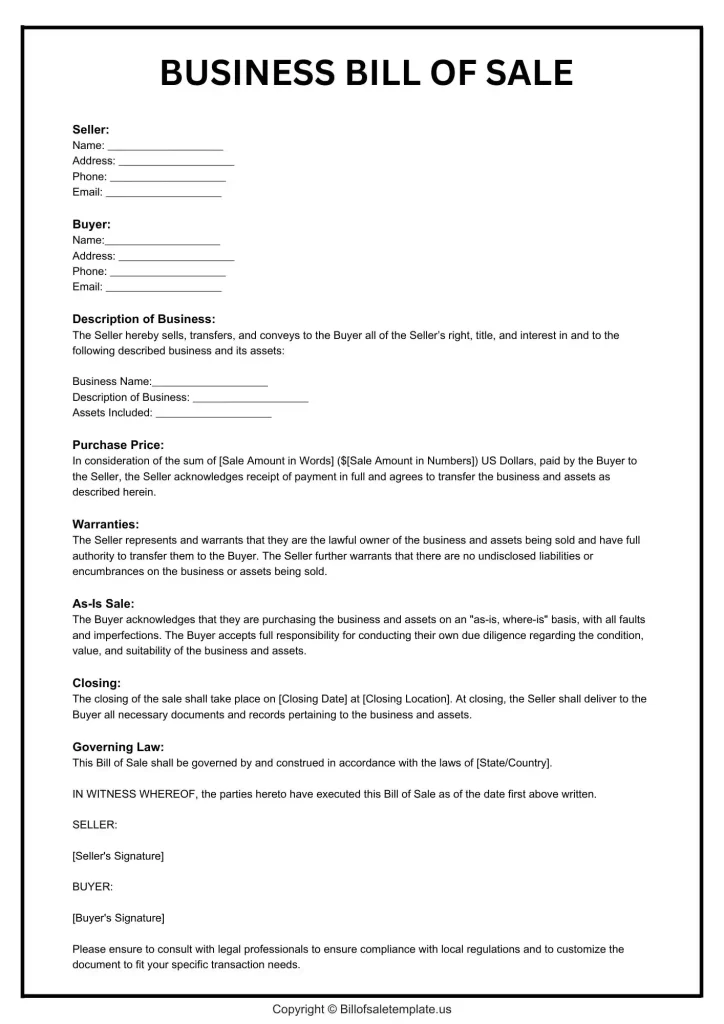
Before signing, both parties should review the assets, purchase price, payment terms, liabilities, representations, and any documents required to complete the transaction.
What Is a Business Bill of Sale?
A Business Bill of Sale is a transaction document that records the sale of a business or identified business property.
It can be used to document items such as:
- Business equipment
- Furniture and fixtures
- Inventory
- Business vehicles
- Machinery
- Tools
- Computers and electronics
- Trade names, where transferable
- Websites and domain names
- Intellectual property, where transferable
- Customer lists, subject to applicable law
- Goodwill
- Other assets specifically identified in the transaction
The document can also record the purchase price, payment arrangements, transfer date, and signatures of the parties.
Important distinction
A Business Bill of Sale should not automatically be treated as proof that every aspect of a business has been legally transferred.
For example, a transaction involving the sale of business assets can be different from the sale of an entire corporation, LLC, partnership interest, or other business entity. The documents and legal steps required depend on how the transaction is structured.
Why Use a Business Bill of Sale?
A carefully prepared bill of sale can provide a useful written record for both sides of a transaction.
Clearly Identifies What Is Being Sold
Listing the assets included in the transaction helps prevent disagreements about what the buyer purchased.
Records the Agreed Price
The document can state the purchase price and explain whether payment was made in full, partially paid, financed, or subject to another arrangement.
Documents the Transfer
The bill of sale provides a dated record of the transaction and the property covered by it.
Helps Organize Business Records
Both parties can retain the signed document with their accounting, tax, and transaction records.
Reduces Confusion
Clearly identifying the assets, payment terms, and other conditions can reduce misunderstandings after the transaction.
Supports Related Paperwork
A bill of sale may be used alongside other documents needed for asset transfers, vehicle transfers, licensing, registration, or other administrative requirements.
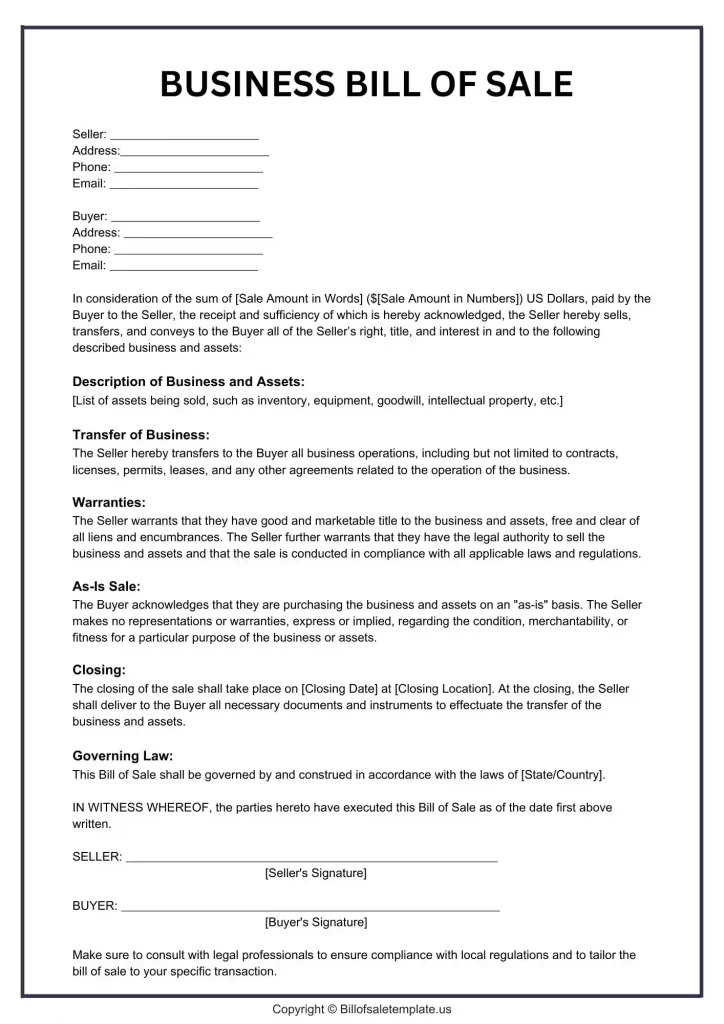
What Should a Business Bill of Sale Include?
A good Business Bill of Sale should contain enough information to identify the parties, describe the transaction, and specify the property being transferred.
Seller Information
Include:
- Full legal name
- Business name, if applicable
- Address
- Phone number
- Email address
- Entity information, if relevant
Buyer Information
Include:
- Full legal name
- Business name, if applicable
- Address
- Phone number
- Email address
- Entity information, if relevant
Business Information
Depending on the transaction, record:
- Business name
- Business address
- Type of business
- State or jurisdiction
- Business registration information, where applicable
- Description of the business activity
Assets Included in the Sale
Clearly identify the property being transferred.
For example:
- Equipment
- Inventory
- Furniture
- Machinery
- Computers
- Vehicles
- Tools
- Fixtures
- Website
- Domain names
- Intellectual property
- Goodwill
- Other specifically identified property
A separate asset schedule can be attached when the list is extensive.
Purchase Price
State:
- Total purchase price
- Deposit
- Amount paid at closing
- Remaining balance
- Payment method
- Installment terms, if applicable
Transfer Date
Specify the date on which the transaction or applicable asset transfer is intended to take place.
Liabilities and Obligations
Clearly identify which liabilities or obligations, if any, are included in or excluded from the transaction.
Do not assume that a general statement automatically transfers a debt, contract, lease, tax obligation, or other liability. Some obligations may require separate agreements or third-party consent.
Representations and Disclosures
The parties may include appropriate statements about ownership, authority to sell, condition of assets, outstanding claims, or other matters relevant to the transaction.
Signatures
The buyer and seller should sign and date the document. Witnesses or notarization may be included when required or considered appropriate.
Free Business Bill of Sale Template
BUSINESS BILL OF SALE
This Business Bill of Sale is made on [Date] between the following parties:
Seller
Name: ___________________________________________
Business Name: __________________________________
Address: ________________________________________
Phone: __________________________________________
Email: ___________________________________________
Buyer
Name: ___________________________________________
Business Name: __________________________________
Address: ________________________________________
Phone: __________________________________________
Email: ___________________________________________
Business Information
Business Name: __________________________________
Business Address: ________________________________
Business Type: ___________________________________
State/Jurisdiction: ________________________________
Additional Business Information:
Assets Included in the Sale
The following business assets are included in the transaction:
Equipment and Machinery
Inventory
Furniture and Fixtures
Vehicles
Website, Domain Names, and Digital Assets
Intellectual Property
Other Assets
Purchase Price and Payment
Total Purchase Price: $____________________________
Deposit: $________________________________________
Balance Due: $____________________________________
Payment Method: __________________________________
Payment Date: ____________________________________
Additional Payment Terms
Date and Terms of Transfer
Effective Transfer Date: ___________________________
The parties agree that the assets identified in this document will be transferred according to the following terms:
Liabilities and Excluded Property
The following liabilities, debts, contracts, assets, or other obligations are excluded from the transaction unless separately agreed in writing:
The following liabilities or obligations, if any, are included:
Condition of Assets
The condition of the assets included in the sale is described below:
Any known defects, damage, limitations, or other disclosures:
Seller’s Representations
The seller represents, subject to the terms of this document and applicable law, that the seller has the authority to sell the property identified in this Bill of Sale.
Additional representations:
Buyer’s Acknowledgment
The buyer acknowledges that the buyer has had an opportunity to review the business and/or assets included in the transaction and accepts the terms stated in this document.
Additional acknowledgments:
Additional Terms
Signatures
Seller Signature: _________________________________
Printed Name: ____________________________________
Date: ____________________________________________
Buyer Signature: __________________________________
Printed Name: ____________________________________
Date: ____________________________________________
Witness/Notary, if applicable: ______________________
Date: ____________________________________________
Printable Business Bill of Sale
A printable Business Bill of Sale is useful when the buyer and seller want a physical record of a completed business or asset transaction.
The form can be printed and completed with information about:
- Buyer and seller
- Business details
- Assets
- Purchase price
- Payment arrangements
- Transfer date
- Liabilities
- Conditions
- Additional terms
- Signatures
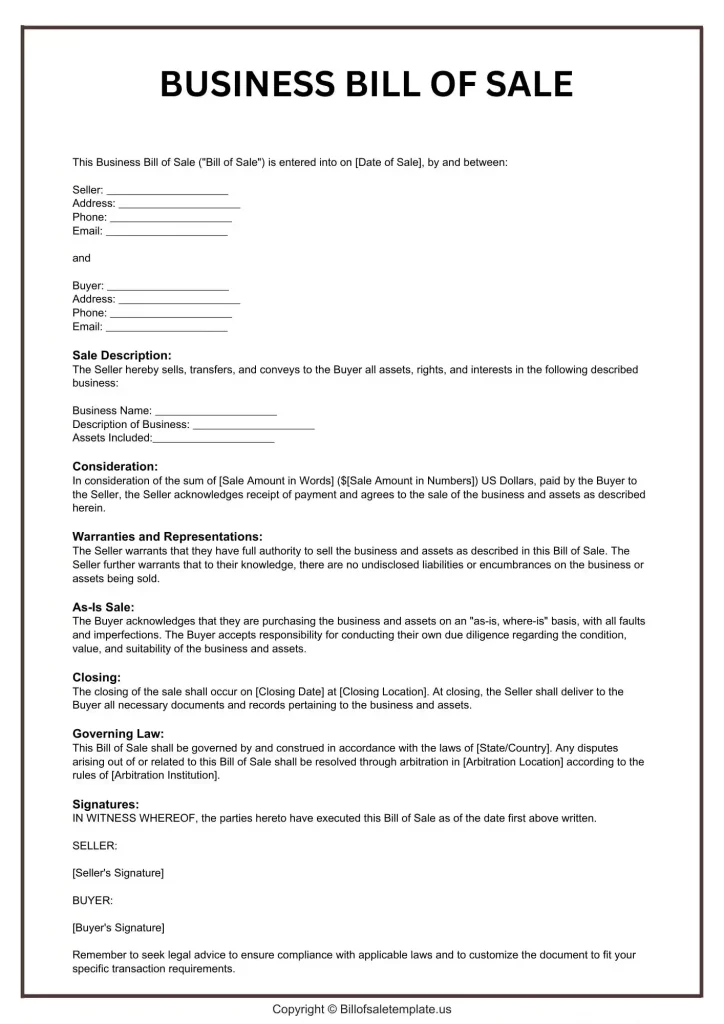
For transactions involving a large number of assets, an itemized inventory or asset schedule can be attached to the bill of sale.
Business Bill of Sale for Assets
A business does not always have to be sold as an entire entity. In some transactions, the parties agree to transfer only selected business assets.
An asset-focused bill of sale can identify exactly what is included, such as:
- Office furniture
- Manufacturing equipment
- Tools
- Inventory
- Computers
- Business vehicles
- Machinery
- Website and domain assets
- Certain intellectual property
- Other tangible or intangible property that can legally be transferred
This approach can make the transaction easier to document because the assets being transferred are specifically listed.
However, some assets may require separate transfer procedures, registrations, assignments, or third-party approval.
Business Bill of Sale vs. Purchase Agreement
A Business Bill of Sale and a Business Purchase Agreement can serve different purposes.
A purchase agreement generally establishes the broader terms of the transaction. It may address:
- Purchase price
- Payment schedule
- Assets and liabilities
- Representations and warranties
- Conditions of closing
- Non-compete provisions, where lawful
- Confidentiality
- Employee matters
- Contracts
- Taxes
- Indemnification
- Closing obligations
The bill of sale can then serve as a record of the transfer of specified assets.
For a simple transaction involving limited assets, a bill of sale may be useful by itself. For a complex business acquisition, additional contracts are commonly needed.
Business Bill of Sale vs. Asset Purchase Agreement
An Asset Purchase Agreement is generally a more detailed contract that establishes the terms under which selected business assets will be purchased.
A Business Bill of Sale is typically more focused on documenting the actual transfer of the identified property.
For a substantial business acquisition, the bill of sale should not be viewed as a replacement for a comprehensive purchase agreement when one is needed.
What Assets Can Be Listed on a Business Bill of Sale?
The assets included depend on the transaction and what can legally be transferred.
Common examples include:
Physical Assets
- Machinery
- Equipment
- Furniture
- Computers
- Tools
- Vehicles
- Inventory
- Fixtures
Digital Assets
- Websites
- Domain names
- Certain software rights
- Digital files
- Business social-media accounts, where transferable
Intangible Assets
- Goodwill
- Trademarks or other intellectual property, where transferable
- Certain customer or vendor relationships
- Other contractual or proprietary rights
Not every right or asset can be transferred simply by listing it on a bill of sale. Contracts, licenses, permits, intellectual property, leases, and regulated assets may have separate transfer requirements.
Does a Business Bill of Sale Transfer the Business Name?
Not necessarily.
A business name may be registered separately, and transferring a business name can involve state, local, or registry-specific procedures.
If the transaction includes a trade name, DBA, trademark, or other name-related right, the parties should identify the specific asset and complete any required transfer documentation.
Does a Business Bill of Sale Transfer Licenses and Permits?
Not automatically.
Many licenses and permits are issued to a specific person or business entity and may not be transferable to a buyer.
The buyer should verify each applicable license or permit with the issuing authority before assuming it will continue after the transaction.
Can Inventory Be Included in a Business Bill of Sale?
Yes. Inventory can be included when it is part of the agreed transaction.
For a large inventory, it is better to attach a separate schedule identifying the items, quantities, condition, or valuation method rather than attempting to describe everything in one paragraph.
Can Business Equipment Be Included?
Yes. Equipment can be listed individually or described in an attached inventory.
Useful information may include:
- Equipment name
- Manufacturer
- Model number
- Serial number
- Quantity
- Condition
- Location
This level of detail can help the parties identify exactly what was included in the sale.
What About Business Debts and Liabilities?
A Business Bill of Sale should clearly distinguish between assets being transferred and liabilities being assumed.
A buyer should not assume that simply mentioning a debt in the bill of sale automatically transfers legal responsibility for it.
Debts, loans, leases, employee obligations, taxes, contracts, and other liabilities may require separate agreements or creditor or third-party approval.
Business Sale Record-Keeping
Both parties should retain a completed copy of the signed bill of sale and any supporting documents.
Depending on the transaction, useful records may include:
- Purchase agreement
- Bill of sale
- Asset inventory
- Payment records
- Tax documents
- Title documents
- Lease assignments
- License-transfer records
- Intellectual-property assignments
- Closing documents
The appropriate retention period depends on the nature of the transaction and applicable requirements.
Buyer Checklist for Purchasing a Business
Before completing a business purchase, a buyer should consider reviewing:
- Seller’s identity and authority to sell
- Business ownership records
- List of included assets
- Inventory
- Equipment and machinery
- Business vehicles
- Existing contracts
- Leases
- Licenses and permits
- Intellectual property
- Website and domain ownership
- Financial records
- Known debts and liabilities
- Tax obligations
- Employee-related obligations
- Purchase price and payment terms
- Required third-party approvals
- Closing documents
Seller Checklist for Selling a Business
Before completing the transaction, the seller should consider:
- Confirming the buyer’s identity
- Confirming authority to sell the business or assets
- Preparing an accurate asset list
- Identifying excluded assets
- Disclosing relevant information required by the agreement or law
- Confirming the purchase price
- Documenting payment terms
- Preparing required transfer documents
- Addressing contracts and leases
- Addressing licenses and permits
- Completing applicable title transfers
- Signing the bill of sale
- Keeping a copy of the completed transaction documents
Is a Business Bill of Sale Legally Binding?
A signed bill of sale can serve as an important written record of the transaction, but its legal effect depends on the document’s terms, the type of transaction, applicable law, and the surrounding circumstances.
Signing the document does not automatically resolve every issue associated with a business acquisition.
For example, separate requirements may apply to contracts, employees, leases, intellectual property, regulated licenses, vehicles, taxes, or business entities.
Does a Business Bill of Sale Need to Be Notarized?
Not every Business Bill of Sale requires notarization.
Whether notarization is required depends on the jurisdiction, the assets involved, the transaction structure, and any requirements imposed by another agreement or authority.
If notarization is required, the parties should complete it according to the applicable rules.
Is a Lawyer Required to Create a Business Bill of Sale?
A lawyer is not necessarily required simply to create a bill of sale.
However, buying or selling an operating business can involve substantial legal and financial issues. A qualified attorney, accountant, or other appropriate professional may be useful when the transaction involves significant assets, financing, employees, contracts, intellectual property, liabilities, tax considerations, or other complex terms.
Legal and Tax Considerations
Business transactions can have legal, accounting, and tax consequences.
Depending on the transaction, the parties may need to consider:
- Business structure
- Asset ownership
- Purchase-price allocation
- Sales or use taxes
- Income-tax reporting
- Depreciation
- Inventory valuation
- Existing debt
- Employee obligations
- Contracts and leases
- Intellectual property
- Licenses and permits
- Government filings
- Third-party approvals
The appropriate requirements depend on the transaction and jurisdiction.
This template is provided for general informational and record-keeping purposes. It is not legal, tax, or accounting advice. For a significant business purchase or sale, professional advice can help identify obligations that a basic bill of sale may not address.
Frequently Asked Questions
What is a Business Bill of Sale?
A Business Bill of Sale is a document used to record the sale or transfer of a business or specified business assets from a seller to a buyer.
What should a Business Bill of Sale include?
It should generally identify the buyer and seller, describe the business or assets involved, state the purchase price and payment terms, specify the transfer date, and include signatures and other relevant conditions.
Can I use a Business Bill of Sale to sell business assets?
Yes. The document can be used to identify specific assets being transferred, provided the transaction and assets are legally transferable and any required additional documentation is completed.
Can equipment and inventory be included?
Yes. Equipment, machinery, furniture, inventory, vehicles, and other eligible assets can be listed individually or in an attached schedule.
Does a Business Bill of Sale transfer ownership of an LLC or corporation?
Not necessarily. A sale of ownership interests in an LLC, corporation, partnership, or other entity can involve different legal documents and procedures from an asset sale.
Is a Business Bill of Sale the same as an Asset Purchase Agreement?
No. An Asset Purchase Agreement generally contains detailed contractual terms governing an asset acquisition, while a bill of sale primarily documents the transfer of identified property.
Does a Business Bill of Sale transfer business debts?
Not automatically. The treatment of debts and liabilities depends on the transaction terms and applicable law. Some obligations may require separate agreements or third-party consent.
Can a Business Bill of Sale include intellectual property?
Potentially, yes, when the relevant intellectual-property rights are transferable. Specific assignment documents may be required for certain rights.
Can licenses and permits be transferred with the business?
Not always. Many licenses and permits are issued to a particular entity or individual and may require approval or a new application.
Does the document need to be notarized?
Not in every transaction. Notarization requirements depend on the circumstances and applicable rules.
Should both parties keep a copy?
Yes. The buyer and seller should retain a signed copy along with the purchase agreement and supporting transfer documents.
Can I modify the template?
Yes. The form can be adapted to the specific transaction, including additional assets, payment terms, conditions, disclosures, and other relevant provisions.
Download the Free Business Bill of Sale
A clear written record can help buyers and sellers document what was included in a business or asset transaction.
Our Free Business Bill of Sale Template provides sections for the parties, business information, assets, purchase price, payment terms, transfer date, liabilities, disclosures, and signatures.
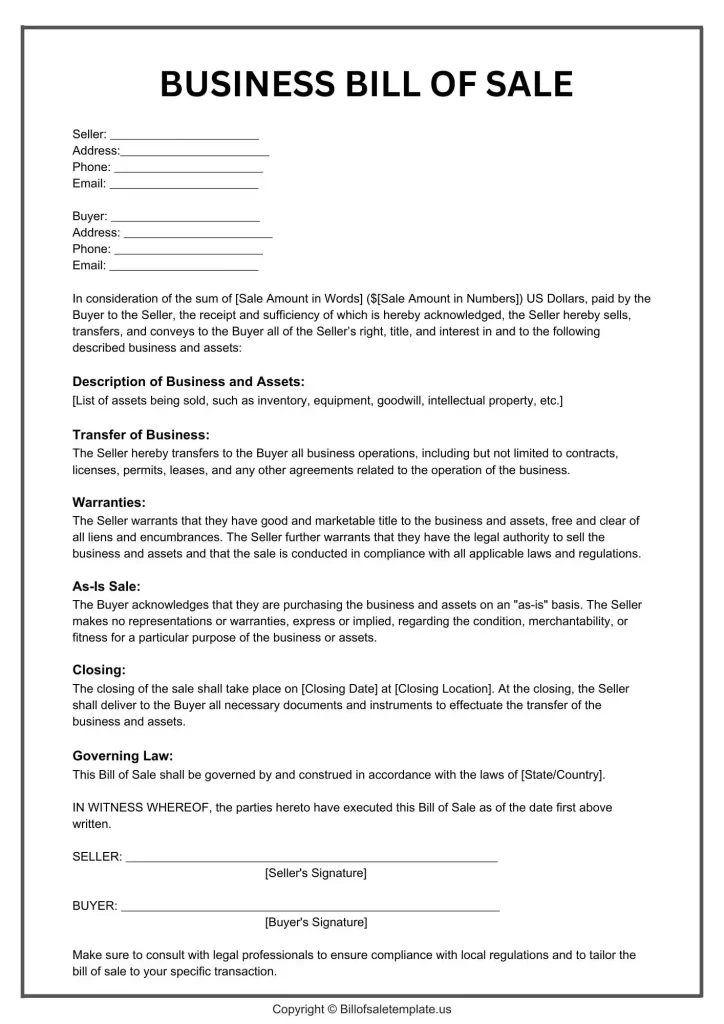
Review the completed document carefully before signing and make sure any additional documents required for the particular transaction are completed.

Ted Cruz is the founder and driving force behind BillofSaleTemplate.us, a comprehensive resource for free bill of sale templates tailored to meet a variety of needs. With a keen understanding of the importance of accurate and legally sound documentation, Ted has dedicated his expertise to providing accessible and user-friendly templates for all types of transactions, from vehicle sales to personal property exchanges.
Recognizing the diverse legal requirements across different states, Ted has meticulously crafted state-specific bill of sale templates to ensure compliance and ease of use for users nationwide. His commitment to simplifying the process of creating reliable and legally binding documents has made BillofSaleTemplate.us a trusted platform for individuals and businesses alike.