![Free Bill of Sale Template PDF, Word [United States]](https://billofsaletemplate.us/wordpress/wp-content/webp-express/webp-images/uploads/2024/06/bill-of-sale-Logo-1.png.webp)
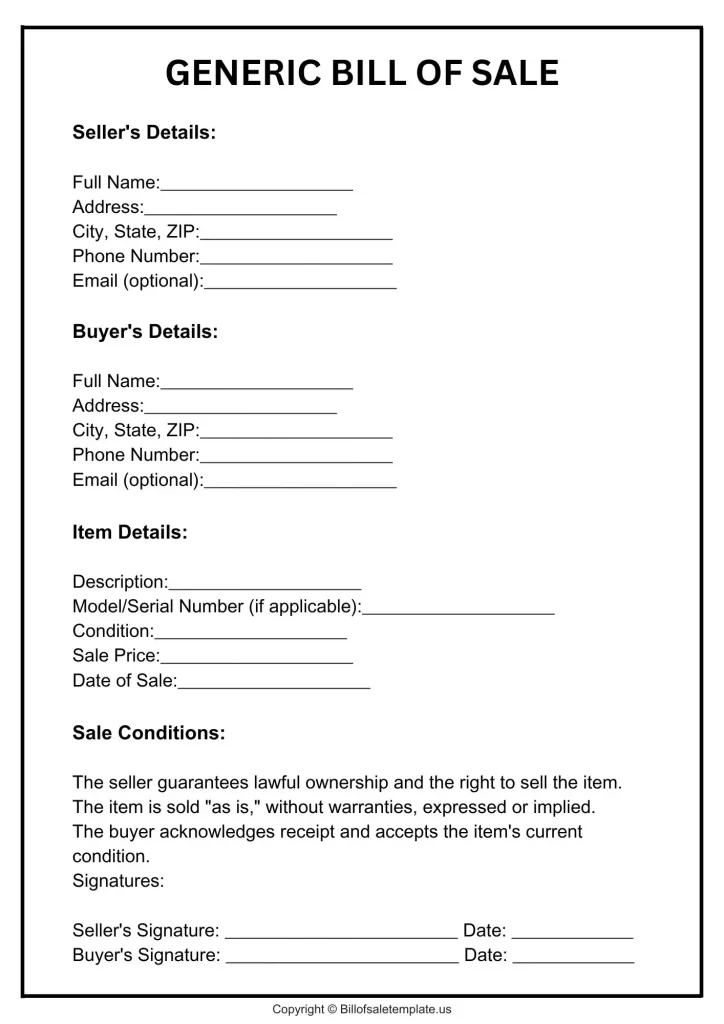
A Generic Bill of Sale is a written document used to record the sale and transfer of personal property from a seller to a buyer. It provides a clear record of what was sold, who sold it, who purchased it, how much was paid, and when the transaction took place.
Unlike specialized bills of sale designed specifically for automobiles, boats, motorcycles, or other regulated property, a generic bill of sale can be adapted for many types of personal property. It may be used for furniture, electronics, appliances, tools, equipment, collectibles, computers, bicycles, and other valuable items.
Although a bill of sale may not be legally required for every private transaction, putting the agreement in writing can help both parties maintain accurate records and reduce the possibility of future disagreements.
Free Printable Generic Bill of Sale Template
Use our Generic Bill of Sale Template to document a private sale or transfer of personal property. The form can be printed and completed by hand or filled out digitally, depending on the format you use.
Template: Generic Bill of Sale
Format: Printable / PDF
Best for: Personal property and private sales
What Is a Generic Bill of Sale?
A generic bill of sale is a written record of a transaction between a buyer and seller. It confirms that the seller has agreed to transfer an identified item to the buyer in exchange for an agreed amount of money or other consideration.
A well-prepared bill of sale normally includes:
- Date of the transaction
- Full name and contact information of the seller
- Full name and contact information of the buyer
- Detailed description of the property
- Purchase price
- Payment method
- Condition of the property
- Warranty or “as-is” terms
- Seller’s ownership statement
- Signatures of the buyer and seller
- Witness or notary information, when appropriate
The document should accurately describe the transaction and should be signed by both parties after reviewing all of its terms.
Why Use a Generic Bill of Sale?
A bill of sale creates a written record that can be useful after the transaction has been completed. Verbal agreements can be difficult to prove if a disagreement occurs later, while a signed document provides evidence of what the parties agreed to at the time of sale.
A generic bill of sale can help:
- Document the transfer of personal property
- Confirm the agreed purchase price
- Identify the buyer and seller
- Describe the exact property being sold
- Record the item’s condition
- Document the method of payment
- Clarify whether the item is sold with a warranty or “as-is”
- Reduce misunderstandings between the parties
- Maintain a record for personal, accounting, or tax purposes
- Provide supporting evidence if a dispute later arises
A bill of sale is especially useful when the item has significant value or when the transaction is between people who do not have an existing business relationship.
Free Generic Bill of Sale Form
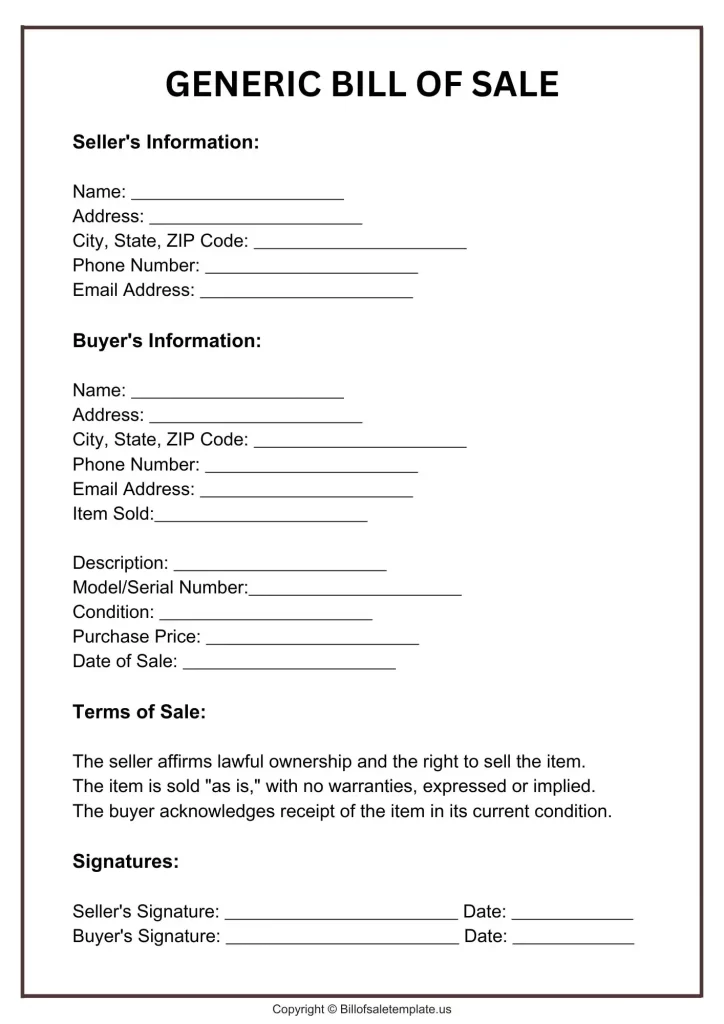
This blank generic bill of sale form can be used for a variety of personal-property transactions. Before signing, both parties should make sure that all important information is complete and accurate.
Seller Information
The seller section identifies the person or business transferring the property.
Include:
- Full legal name
- Address
- Phone number
- Email address, if appropriate
The seller should make sure that the information provided is accurate and that they have the legal right to sell the property.
Buyer Information
The buyer section identifies the person or business receiving the property.
Include:
- Full legal name
- Address
- Phone number
- Email address, if appropriate
Correct buyer information helps establish who purchased the property and who received ownership or possession under the terms of the agreement.
Property Description
A detailed description of the item is one of the most important parts of a bill of sale. The description should make it easy to identify the property involved in the transaction.
Depending on the type of item, include:
- Item name
- Brand or manufacturer
- Model
- Serial number
- Identification number
- Color
- Size
- Year
- Quantity
- Condition
- Accessories included
- Other identifying characteristics
For example, instead of writing only “laptop,” a better description might include the manufacturer, model, serial number, color, storage capacity, and condition.
The more clearly the property is identified, the less room there is for confusion later.
Sale Price and Payment Information
The bill of sale should clearly state the amount agreed upon by the buyer and seller.
Include:
- Total purchase price
- Currency
- Payment method
- Deposit amount, if applicable
- Remaining balance, if applicable
- Payment date
- Other agreed payment terms
Common payment methods include cash, check, bank transfer, electronic payment, or another mutually agreed method.
If the buyer has not paid the full amount at the time of signing, the bill of sale should clearly state the outstanding balance and the agreed payment terms.
Condition of the Property
The condition of the item should be described honestly before the transaction is completed.
Depending on the situation, the form may state that the property is:
- New
- Used
- Refurbished
- In working condition
- Sold with known defects
- Sold “as-is”
If there are known defects, damage, missing parts, or other important issues, they should be disclosed in writing.
What Does “As-Is” Mean?
An “as-is” provision generally means that the buyer accepts the property in its existing condition, subject to applicable law and any terms specifically agreed upon by the parties.
For example, a seller may state that the buyer has inspected the item and accepts it in its present condition.
An “as-is” clause should not be treated as a guarantee that every possible legal claim is eliminated. Consumer-protection laws, fraud laws, disclosure requirements, express promises, and other applicable laws may still apply.
Warranty Information
The bill of sale should state whether the property is being sold:
- With a warranty
- Without a warranty
- “As-is”
- Subject to a separate written warranty
If a warranty is included, its important terms should be clearly described.
If there is no warranty, the agreement should accurately reflect that understanding rather than relying on vague language.
Seller’s Ownership and Authority
A useful bill of sale can include a statement that the seller is the lawful owner of the property or otherwise has the authority to sell it.
The seller may also confirm, where appropriate, that the property is not subject to an undisclosed lien or ownership claim.
This provision can give the buyer additional information about the seller’s right to transfer the property.
However, the exact wording should be appropriate for the type of property and the laws governing the transaction.
Signatures
Both parties should carefully review the document before signing it.
The signature section generally includes:
- Seller’s signature
- Seller’s printed name
- Date
- Buyer’s signature
- Buyer’s printed name
- Date
Each party should receive a copy of the completed and signed bill of sale for their records.
Electronic signatures may be acceptable in many situations, but the applicable law and circumstances of the transaction should be considered.
Witness or Notary Section
A witness or notary section may be included when the parties want additional verification of the signing process or when applicable law or an institution requires it.
Notarization generally involves a notary verifying the identity of the person signing and acknowledging or witnessing the signature according to the applicable notarial procedure.
Importantly, notarization does not automatically make every bill of sale legally required or guarantee that every term of the agreement is enforceable. Whether notarization is required depends on the jurisdiction and the type of property involved.
When Should a Bill of Sale Be Notarized?
Not every generic bill of sale needs to be notarized.
Notarization may be appropriate or required when:
- State or local law requires it
- A government agency requires a notarized document
- The property is subject to registration requirements
- The parties want additional identity verification
- The transaction involves significant value
- A lender, title company, institution, or other organization requests notarization
Requirements can differ substantially by state and by property type. For vehicles, boats, trailers, and other registered property, buyers and sellers should check the requirements of the appropriate state or local authority before relying on a generic form.
General Bill of Sale Template
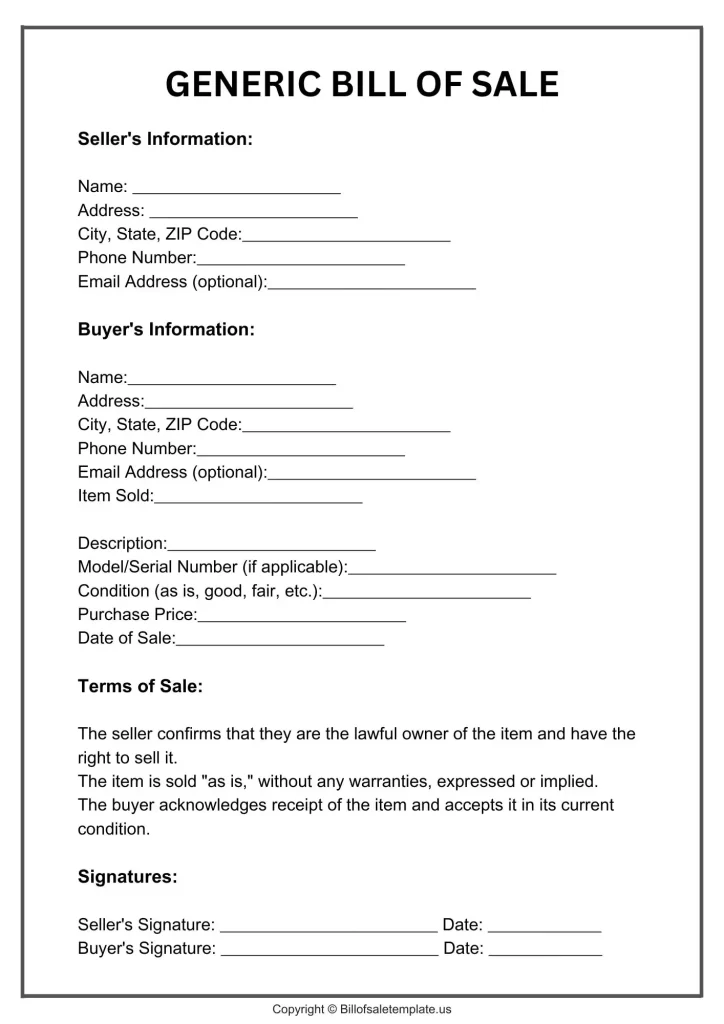
A general bill of sale is similar to a generic bill of sale and can be used to document the sale of many types of personal property.
Essential Sections of a General Bill of Sale
1. Document Title
Use a clear title such as General Bill of Sale or Generic Bill of Sale.
This immediately identifies the purpose of the document.
2. Date of Sale
Enter the date on which the transaction is completed or the date specified by the parties.
The date can be important when maintaining ownership, payment, warranty, accounting, or other records.
3. Seller Details
Provide the seller’s complete identifying and contact information.
4. Buyer Details
Provide the buyer’s complete identifying and contact information.
5. Description of Property
Clearly identify the item being sold using its model, serial number, condition, color, quantity, or other relevant details.
6. Purchase Price
State the total amount agreed upon by the buyer and seller.
7. Payment Method
Identify whether payment was made by cash, check, bank transfer, electronic payment, or another method.
8. Property Condition
Explain whether the item is new, used, damaged, refurbished, or sold in another stated condition.
9. Warranty or As-Is Terms
Clearly state whether the item comes with a warranty or is sold without a warranty and subject to applicable law.
10. Ownership Statement
Where appropriate, include a statement confirming that the seller has the right or authority to transfer the property.
11. Additional Terms
Add any important agreements between the parties, such as included accessories, delivery arrangements, outstanding balances, or other conditions.
12. Signatures
Have both parties sign and date the document after reviewing its contents.
13. Witness or Notary
Add this section when appropriate or required.
What Can You Use a Generic Bill of Sale For?
A generic bill of sale can be adapted for many types of personal property, including:
- Furniture
- Computers
- Laptops
- Mobile phones
- Appliances
- Tools
- Machinery
- Electronics
- Bicycles
- Musical instruments
- Collectibles
- Cameras
- Office equipment
- Sports equipment
- Household goods
- Other personal property
For regulated property such as motor vehicles, boats, trailers, firearms, or other items subject to specific registration or transfer rules, a specialized form or additional documentation may be required.
Generic vs. Specialized Bill of Sale
A generic bill of sale is designed to be flexible and can be adapted to many types of personal property.
A specialized bill of sale is created for a particular type of property and usually contains additional information required for that transaction.
For example:
| Type | Typical Use |
|---|---|
| Generic Bill of Sale | General personal property |
| Vehicle Bill of Sale | Cars, trucks, and other motor vehicles |
| Boat Bill of Sale | Boats and watercraft |
| Motorcycle Bill of Sale | Motorcycles |
| Equipment Bill of Sale | Machinery and equipment |
| Horse Bill of Sale | Horses and equine transactions |
| Firearm Bill of Sale | Firearm transactions, subject to applicable law |
The appropriate form depends on what is being sold and the requirements of the applicable jurisdiction.
How to Fill Out a Generic Bill of Sale
Completing a generic bill of sale is straightforward when all transaction details are available.
Step 1: Enter the Date
Write the date of the sale or transfer.
Step 2: Identify the Seller
Enter the seller’s full name and contact information.
Step 3: Identify the Buyer
Enter the buyer’s full name and contact information.
Step 4: Describe the Property
Provide enough information to clearly identify the item, including its brand, model, serial number, condition, and other relevant details.
Step 5: Enter the Purchase Price
Write the total agreed purchase price.
Step 6: Record the Payment Method
Specify how the buyer paid or will pay the seller.
Step 7: Describe the Condition and Warranty
State whether the property is sold as-is or subject to a warranty or other agreed terms.
Step 8: Add Additional Terms
Include any important conditions that are part of the agreement.
Step 9: Review the Document
Both parties should verify names, amounts, property descriptions, dates, and other important information.
Step 10: Sign and Exchange Copies
The buyer and seller should sign the document and keep a copy of the completed bill of sale.
Tips for Using a Bill of Sale
To make the document more useful and reduce the possibility of disputes:
- Use complete and accurate names.
- Describe the property in sufficient detail.
- Include serial or identification numbers when available.
- Record the exact purchase price.
- State the payment method.
- Disclose known defects.
- Clearly explain warranty or “as-is” terms.
- Do not leave important sections blank.
- Make sure both parties understand the terms before signing.
- Give each party a completed copy.
- Keep proof of payment when appropriate.
- Retain the document with other ownership or transaction records.
- Check local requirements for regulated or registered property.
What Information Should a Generic Bill of Sale Include?
A comprehensive generic bill of sale generally includes:
| Section | Information |
|---|---|
| Date | Date of the transaction |
| Seller | Full name and contact information |
| Buyer | Full name and contact information |
| Property | Detailed description of the item |
| Identification | Model, serial number, or other identifier |
| Condition | Current condition and known defects |
| Price | Agreed purchase amount |
| Payment | Method and payment terms |
| Warranty | Warranty or as-is provisions |
| Ownership | Seller’s authority to transfer the property |
| Additional Terms | Other agreed conditions |
| Signatures | Buyer and seller signatures and dates |
| Notary/Witness | When required or desired |
Free Generic Bill of Sale
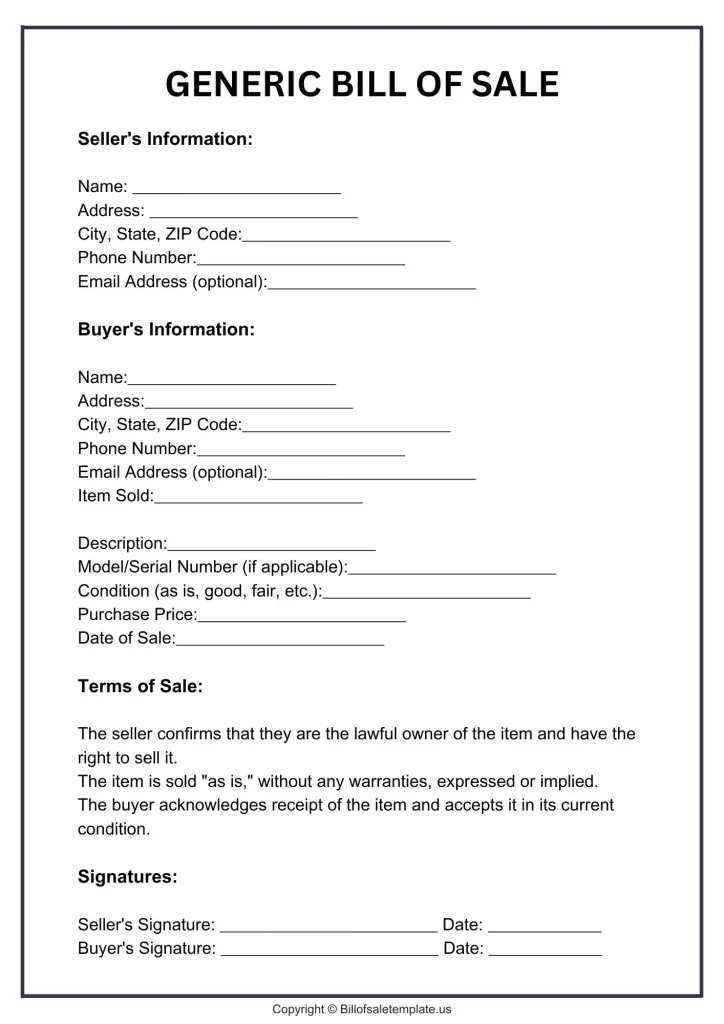
A free generic bill of sale template can provide a convenient starting point for documenting a private sale. You can print the form, enter the required information, and have both parties review and sign it.
A template should be treated as a starting point rather than a substitute for checking applicable legal requirements. Certain transactions may require additional forms, disclosures, title documents, registration paperwork, or government-issued forms.
Benefits of a Generic Bill of Sale
Using a bill of sale offers several practical benefits.
Creates a Written Record
It provides a record of the transaction, including the property sold, purchase price, date, and parties involved.
Reduces Misunderstandings
Written terms make it easier for both parties to understand what was agreed upon.
Documents Payment
The purchase price and payment method can be recorded in one place.
Identifies the Property
A detailed description helps distinguish the item sold from other similar property.
Records the Condition
The parties can document the item’s condition and any known issues at the time of sale.
Supports Future Recordkeeping
A completed bill of sale can be retained with receipts, payment records, ownership documents, or other transaction paperwork.
May Help in a Dispute
If a disagreement occurs, a signed document may provide useful evidence of the parties’ agreement, subject to applicable law.
What a Bill of Sale Does Not Do
A bill of sale is useful, but it does not necessarily replace every other document required for a transaction.
For example, depending on the property and jurisdiction, you may also need:
- Title documents
- Registration documents
- Transfer forms
- Government-issued forms
- Lien-release documents
- Tax documents
- Inspection records
- Warranty documents
- Other legally required disclosures
For registered or regulated property, always check the requirements of the relevant government agency before completing the transaction.
Generic Bill of Sale vs. Receipt
A bill of sale and a receipt are not always the same thing.
A receipt generally confirms that payment was made for a particular item or service.
A bill of sale generally provides broader information about the transaction, including the parties, property, purchase price, condition, warranties, and transfer terms.
A bill of sale may therefore provide a more complete record of a private property transaction.
Do You Need a Bill of Sale?
A bill of sale may not be legally required for every sale, but it can still be useful.
It is particularly helpful when:
- The item has significant value.
- The transaction is between private individuals.
- The property has a serial number or unique identifier.
- The buyer and seller want written proof of the agreement.
- The item is being sold “as-is.”
- Payment is made through multiple installments.
- The parties want a record of the item’s condition.
- Local law or an organization requires documentation.
For certain property types, however, a bill of sale may be only one part of the required transfer process.
Important Legal Considerations
A bill of sale should accurately reflect the actual transaction. Neither party should knowingly provide false information or conceal material facts that must be disclosed under applicable law.
Laws governing bills of sale differ between jurisdictions and may also depend on the type and value of the property.
Before using a generic form for a vehicle, boat, trailer, business asset, regulated item, or other property subject to special rules, check the applicable state and local requirements.
If a transaction is unusually complex, high-value, disputed, or legally sensitive, consider obtaining advice from a qualified attorney or other appropriate professional.
Frequently Asked Questions
What is a generic bill of sale?
A generic bill of sale is a written document that records the sale and transfer of personal property between a seller and a buyer. It typically identifies the parties, describes the property, states the purchase price and payment terms, and includes signatures.
Is a generic bill of sale legally binding?
A signed bill of sale can serve as evidence of an agreement and transaction, but whether it is legally enforceable depends on the circumstances and applicable law. A bill of sale should accurately reflect the agreement between the parties and comply with any applicable legal requirements.
What is a free generic bill of sale?
A free generic bill of sale is a template that can be used without paying a template fee. It provides standard fields for recording information about the buyer, seller, property, price, payment, condition, and signatures.
Can I use a generic bill of sale for a car?
You may be able to use a bill of sale for a vehicle, but vehicle-transfer requirements vary by state. Some jurisdictions require specific government or DMV forms and additional documents. Always check the requirements of the state where the vehicle is being titled or registered.
Does a generic bill of sale need to be notarized?
Not necessarily. Many ordinary private-property transactions do not require notarization. However, certain jurisdictions, property types, government agencies, or institutions may require or request notarization.
Does notarizing a bill of sale make it legally binding?
Notarization generally verifies the identity of the signer and the execution or acknowledgment of the document. It does not automatically make every provision legally enforceable or replace other legal requirements.
What should I include in a generic bill of sale?
At minimum, consider including the date, buyer information, seller information, detailed property description, purchase price, payment method, condition, warranty or as-is terms, and signatures. Additional information may be appropriate depending on the transaction.
Can I write my own bill of sale?
Yes, in many ordinary private transactions, the parties can create their own bill of sale. The document should clearly describe the transaction and include all important terms. However, specialized or regulated transactions may require specific forms or additional documentation.
Can a bill of sale be handwritten?
A bill of sale can generally be handwritten if the applicable law does not require a particular format. It should be clear, complete, readable, and signed by the parties. Using a typed or printable form can make the document easier to read and preserve.
Should both the buyer and seller keep a copy?
Yes. Both parties should keep a completed copy of the signed bill of sale along with relevant payment records and other transaction documents.
What if the item has a serial number?
Include the serial number whenever possible. A serial number can help uniquely identify the property and reduce confusion about which item was sold.
Can a bill of sale include an “as-is” clause?
Yes, an “as-is” provision can be included when appropriate. It should accurately describe the parties’ agreement and should not be assumed to override consumer-protection laws, fraud rules, disclosure requirements, warranties, or other applicable legal protections.
Can I use a generic bill of sale in every U.S. state?
A generic bill of sale may be useful for many private-property transactions, but requirements vary by state and by property type. Some transactions require state-specific forms or additional documents. Check the applicable state and local requirements before completing the sale.
Final Checklist Before Signing
Before completing a generic bill of sale, both parties should verify:
- The date is correct.
- The buyer’s information is accurate.
- The seller’s information is accurate.
- The property is clearly described.
- Serial or identification numbers are included when available.
- The condition of the property is accurately stated.
- Known defects are disclosed where required or appropriate.
- The purchase price is correct.
- The payment method is recorded.
- Any outstanding balance is clearly stated.
- Warranty or “as-is” terms are clear.
- Additional conditions are included if necessary.
- Both parties have reviewed the document.
- Required signatures and dates are completed.
- Witness or notarization requirements have been checked.
- Both parties receive a copy of the completed document.
Conclusion
A Generic Bill of Sale is a simple and practical way to document the sale and transfer of personal property. By recording the buyer and seller information, property description, purchase price, payment terms, condition, warranties, and signatures, the document creates a clear written record of the transaction.
A generic template is suitable for many ordinary personal-property sales, but it should not automatically be used as a substitute for specialized forms required for vehicles, boats, trailers, or other regulated property. Because legal requirements can vary by state and transaction type, checking the applicable requirements before signing is an important final step.
For ordinary private sales, a properly completed bill of sale can give both the buyer and seller a convenient record of what was agreed upon and what was transferred.

Ted Cruz is the founder and driving force behind BillofSaleTemplate.us, a comprehensive resource for free bill of sale templates tailored to meet a variety of needs. With a keen understanding of the importance of accurate and legally sound documentation, Ted has dedicated his expertise to providing accessible and user-friendly templates for all types of transactions, from vehicle sales to personal property exchanges.
Recognizing the diverse legal requirements across different states, Ted has meticulously crafted state-specific bill of sale templates to ensure compliance and ease of use for users nationwide. His commitment to simplifying the process of creating reliable and legally binding documents has made BillofSaleTemplate.us a trusted platform for individuals and businesses alike.