![Free Bill of Sale Template PDF, Word [United States]](https://billofsaletemplate.us/wordpress/wp-content/webp-express/webp-images/uploads/2024/06/bill-of-sale-Logo-1.png.webp)
A Horse Bill of Sale is a written document that records the sale and transfer of a horse from a seller to a buyer. It identifies the horse, documents the purchase price and payment terms, records important disclosures, and provides both parties with a copy of the agreed terms.
Free Horse Bill of Sale PDF Template
Use our free printable Horse Bill of Sale Form to document your horse purchase or sale. Complete the form with accurate information about the buyer, seller, horse, purchase price, health disclosures, and transfer of ownership.
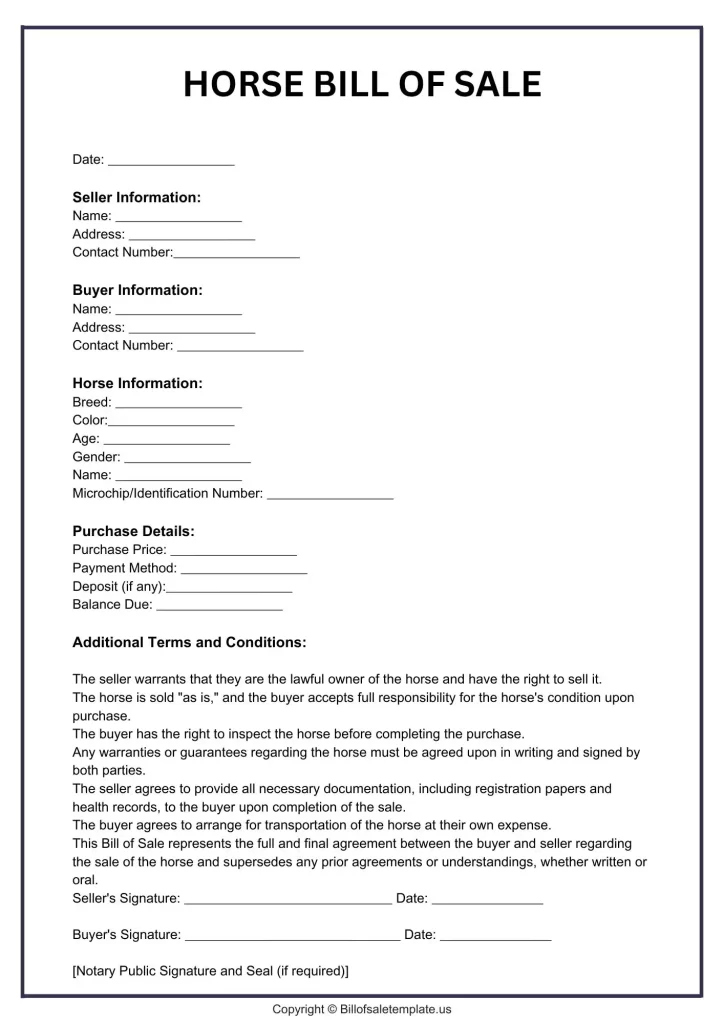
What Is a Horse Bill of Sale?
A Horse Bill of Sale is a written record of a transaction involving the sale of a horse. It typically identifies the buyer and seller, describes the horse, states the purchase price, explains payment terms, and documents any conditions or disclosures agreed upon by the parties.
A properly completed bill of sale can help reduce misunderstandings by putting the important terms of the transaction in writing. Depending on the jurisdiction and circumstances of the sale, additional documents may also be required to establish or register ownership.
What Should a Horse Bill of Sale Include?
A comprehensive Horse Bill of Sale should include the following information:
1. Seller Information
Include:
- Full legal name
- Address
- Phone number
- Email address
2. Buyer Information
Include:
- Full legal name
- Address
- Phone number
- Email address
3. Horse Identification
Provide enough information to clearly identify the horse being sold:
- Horse’s registered or commonly used name
- Breed
- Sex
- Age or date of birth
- Color
- Height, if applicable
- Distinctive markings
- Brands or tattoos
- Microchip number, if applicable
- Registration number, if applicable
- Breed association or registry
- Other identifying information
A recent photograph or copies of relevant registration documents may also be attached when appropriate.
4. Health and Veterinary Information
The bill of sale can document information known and disclosed by the seller, such as:
- Current or known health conditions
- Previous injuries or illnesses
- Vaccination information
- Current medications
- Veterinary records
- Known behavioral concerns
- Special care requirements
- Recent veterinary examination, if applicable
The buyer may also want to arrange an independent pre-purchase veterinary examination before completing the transaction.
5. Purchase Price
Clearly state:
- Total purchase price
- Currency
- Deposit amount
- Remaining balance
- Payment date
- Payment method
If payment will be made in installments, include the amount and due date for each installment.
6. Conditions of Sale
Document any special conditions agreed upon by the buyer and seller, including:
- Trial period
- Pre-purchase veterinary examination
- Return conditions
- Transportation arrangements
- Boarding arrangements
- Training or performance representations
- Registration transfer
- Other special agreements
Any important verbal agreement should be put in writing rather than relying only on a conversation.
7. Warranties and Disclosures
The bill of sale should clearly state whether the horse is being sold with specific warranties or subject to an “as-is” provision.
If the seller makes specific representations about the horse’s health, training, temperament, breeding, competition history, or abilities, those representations should be accurately documented.
An “as-is” provision may have different legal effects depending on applicable law and the wording of the agreement. It should not be used to conceal known problems or override applicable legal requirements.
8. Transfer of Ownership
Specify:
- Date of sale
- Date ownership is intended to transfer
- Delivery date
- Registration documents to be transferred
- Other ownership records to be provided
The buyer and seller should verify any registration or ownership-transfer requirements applicable to the horse and its registry.
9. Risk of Loss
The agreement can specify when responsibility for the horse’s loss, injury, or care transfers from the seller to the buyer.
This should be clearly stated, particularly when the horse will remain with the seller temporarily after the sale or when transportation is arranged separately.
10. Signatures
The completed document should generally be signed and dated by:
- Seller
- Buyer
- Witness, if appropriate or required
Each party should receive a copy of the signed document.
Horse Bill of Sale Template
HORSE BILL OF SALE
This Horse Bill of Sale is made on [Date] between:
Seller:
Name: ______________________________
Address: ____________________________
Phone: ______________________________
Email: ______________________________
and
Buyer:
Name: ______________________________
Address: ____________________________
Phone: ______________________________
Email: ______________________________
Horse Description
Horse Name: _________________________
Breed: ______________________________
Sex: ________________________________
Age/Date of Birth: ___________________
Color: ______________________________
Height: _____________________________
Markings: ___________________________
Brand/Tattoo: _______________________
Microchip Number: ___________________
Registration Number: ________________
Registry/Association: ________________
Additional Identification Information:
Health Information
Known health conditions, injuries, illnesses, medications, behavioral concerns, or other relevant disclosures:
Veterinary examination completed before sale:
☐ Yes
☐ No
If yes, examination date: __________________________
Purchase Price and Payment
Total Purchase Price: $____________________________
Deposit Paid: $____________________________________
Remaining Balance: $________________________________
Payment Method: ___________________________________
Payment Date: _____________________________________
Additional Payment Terms:
Conditions of Sale
The buyer and seller agree to the following conditions:
Warranties and Disclosures
The horse is sold subject to the following warranties, representations, disclosures, or conditions:
If the horse is being sold “as-is,” the parties should state the applicable terms clearly and ensure that the provision complies with applicable law.
Transfer of Ownership
The parties agree that the intended transfer of ownership will occur on:
Date: _________________________________________
Registration papers and other ownership documents to be transferred:
Delivery and Risk of Loss
Delivery Date: ____________________________________
Delivery Location: _________________________________
The parties agree that responsibility for the horse’s care and risk of loss will transfer according to the following terms:
Seller’s Representations
The seller represents that the information provided in this Bill of Sale is accurate to the best of the seller’s knowledge, subject to the terms and disclosures stated above.
Additional representations:
Buyer’s Acknowledgment
The buyer acknowledges that the buyer has had the opportunity to inspect the horse, ask questions, review available records, and obtain an independent veterinary examination where appropriate.
Additional buyer acknowledgments:
Signatures
Seller’s Signature: _____________________________
Printed Name: __________________________________
Date: _________________________________________
Buyer’s Signature: ______________________________
Printed Name: __________________________________
Date: _________________________________________
Witness Signature (if applicable): _______________
Printed Name: __________________________________
Date: _________________________________________
Simple Horse Bill of Sale
If you need a basic document for a straightforward horse sale, a simple Horse Bill of Sale can include the buyer and seller’s information, horse identification, purchase price, payment terms, sale conditions, and signatures.
For higher-value horses or transactions involving breeding rights, competition records, health guarantees, installment payments, trial periods, or other special conditions, consider using a more detailed agreement and obtaining appropriate professional advice.
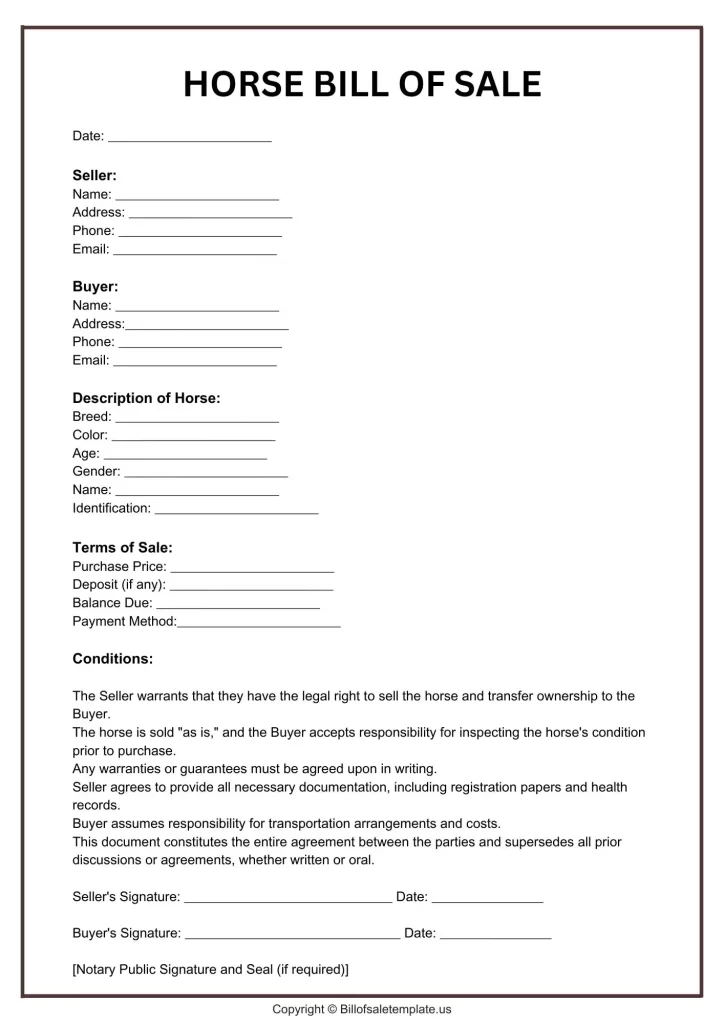
How to Fill Out a Horse Bill of Sale
- Enter the seller’s information. Use the seller’s legal name and current contact information.
- Enter the buyer’s information. Include the buyer’s full name and contact details.
- Identify the horse. Include as many identifying details as possible, including registration or microchip information when applicable.
- Enter the purchase price. State the total price and any deposit or remaining balance.
- Document payment terms. Specify when and how payment will be made.
- Record health disclosures. Include known health conditions, injuries, medications, and other relevant information.
- Add special conditions. Document trial periods, veterinary examinations, transportation, or other agreements.
- Review warranties and disclosures. Make sure both parties understand what is and is not being represented.
- Specify delivery and risk terms. Clearly state when responsibility for the horse is intended to transfer.
- Sign and date the document. Give both parties a completed copy.
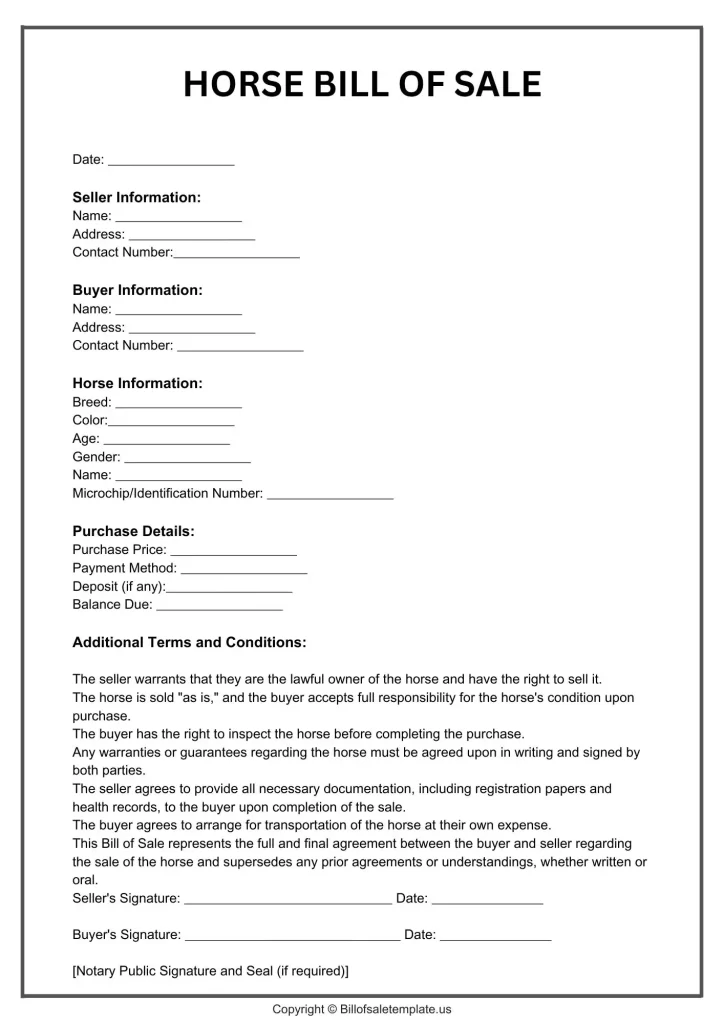
Horse Bill of Sale vs. Horse Purchase Agreement
A Horse Bill of Sale generally serves as a written record of the completed or agreed sale and identifies the horse and transaction terms.
A Horse Purchase Agreement may provide more detailed terms governing the transaction before or at the time of purchase, particularly when the sale involves conditions, warranties, inspections, installment payments, or other obligations.
For a straightforward transaction, a bill of sale may be sufficient for the parties’ needs. More complicated transactions may require a more detailed agreement.
Do You Need a Bill of Sale When Buying or Selling a Horse?
A written bill of sale is useful because it creates a record of the transaction and the terms agreed upon by the buyer and seller. Requirements can vary depending on the location, the horse’s registration, and the circumstances of the transaction.
Before completing a sale, check the requirements applicable to your jurisdiction and any relevant breed or registration organization.
Does a Horse Bill of Sale Transfer Ownership?
A bill of sale can document the parties’ agreement to transfer ownership, but the legal requirements for establishing or registering ownership may vary by jurisdiction and registry.
If the horse is registered, the buyer and seller should also complete any required registration or ownership-transfer paperwork.
Does a Horse Bill of Sale Need to Be Notarized?
Not every Horse Bill of Sale requires notarization. Whether notarization is required or advisable depends on applicable law, the transaction, and any requirements imposed by a registration organization or other authority.
If you are unsure, check the requirements applicable to your location or consult an appropriately qualified professional.
Should a Horse Have a Veterinary Examination Before Purchase?
A pre-purchase veterinary examination can help a buyer make a more informed purchasing decision. The scope of an examination can depend on the horse, its intended use, age, value, and the buyer’s concerns.
The results of the examination should be documented separately or referenced in the transaction documents when appropriate.
Can a Horse Be Sold “As-Is”?
A horse may be sold subject to an “as-is” provision in some circumstances, but the legal effect of such language depends on applicable law and the specific agreement.
Buyers and sellers should clearly document known conditions and representations rather than relying on a general phrase to address every possible issue.
Tips for Buyers and Sellers
For Buyers
- Verify the seller’s identity and ownership.
- Carefully identify the horse in the paperwork.
- Review available veterinary and registration records.
- Consider an independent pre-purchase veterinary examination.
- Ask about known health and behavioral issues.
- Confirm all important promises in writing.
- Keep a signed copy of the bill of sale.
For Sellers
- Provide accurate horse identification information.
- Disclose known material health or behavioral issues.
- Clearly state the purchase price and payment terms.
- Document any warranties or representations.
- Keep copies of signed transaction documents.
- Complete applicable registration-transfer paperwork.
Legal Considerations
Horse-sale laws and documentation requirements can vary by state, country, jurisdiction, registration organization, and transaction type.
This template is provided as a general document for recording a horse sale and is not a substitute for legal advice. For high-value transactions or sales involving significant warranties, breeding rights, financing, disputes, or unusual conditions, consider consulting a qualified attorney familiar with the applicable law.
Why Use a Horse Bill of Sale?
A written Horse Bill of Sale can help both parties:
- Record the identity of the horse
- Document the purchase price
- Confirm payment terms
- Record health and other disclosures
- Document agreed conditions
- Establish a written transaction record
- Support ownership or registration paperwork where applicable
- Reduce misunderstandings between buyer and seller
Frequently Asked Questions
What is a Horse Bill of Sale?
A Horse Bill of Sale is a written document that records the sale of a horse and the terms agreed upon by the buyer and seller.
What information should be on a Horse Bill of Sale?
It should generally identify the buyer, seller, and horse and document the purchase price, payment terms, disclosures, sale conditions, transfer information, and signatures.
Can I use this Horse Bill of Sale for any horse?
The template can be adapted for many horse-sale transactions, but requirements can vary by jurisdiction and transaction. Review the document carefully and add any terms relevant to the particular sale.
Should I include the horse’s registration number?
Yes, if the horse is registered. Including registration information can help identify the horse and support applicable ownership-transfer procedures.
Should the buyer and seller keep copies?
Yes. Both parties should keep a copy of the completed and signed document together with relevant supporting records.
Is a witness required?
Witness requirements vary by jurisdiction and transaction. If a witness is not legally required, the parties may still choose to have one sign the document.
Is a Horse Bill of Sale the same as a horse contract?
Not necessarily. A bill of sale primarily documents the sale and its terms, while a more detailed purchase agreement can contain broader contractual provisions.
Can I modify the template?
Yes. The template can be adapted to include additional horse identification details, payment terms, disclosures, warranties, delivery arrangements, or other conditions relevant to the transaction.
Download Your Free Horse Bill of Sale
Use our free printable Horse Bill of Sale PDF to create a written record of your horse sale.
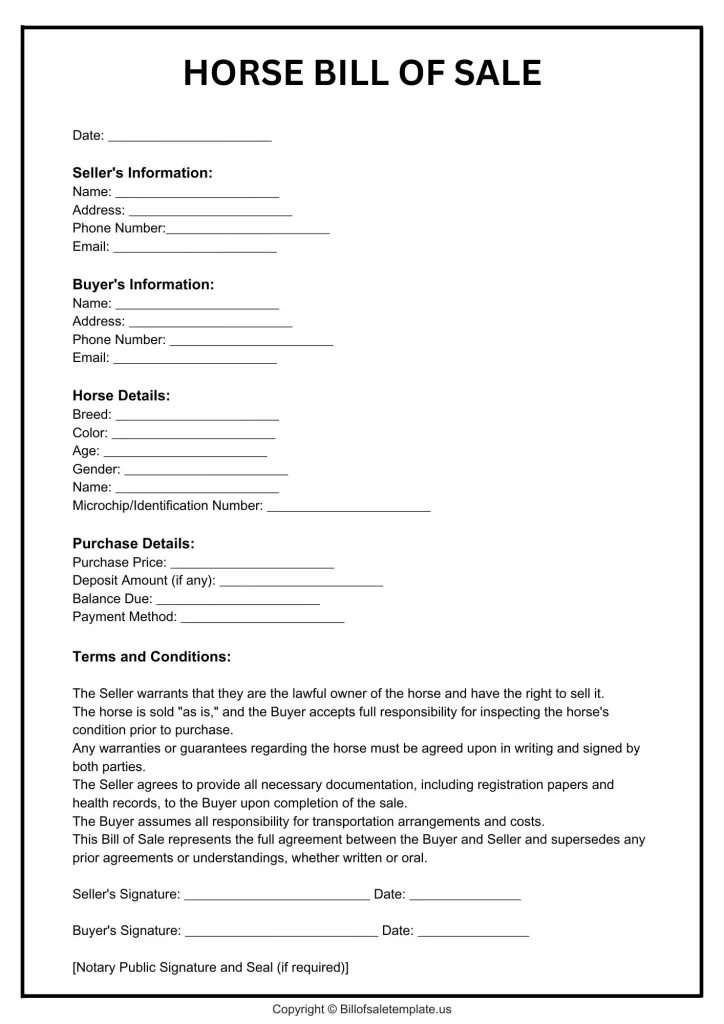
Review the completed form carefully before signing. Requirements may vary by jurisdiction, so consider obtaining professional advice when appropriate.

Ted Cruz is the founder and driving force behind BillofSaleTemplate.us, a comprehensive resource for free bill of sale templates tailored to meet a variety of needs. With a keen understanding of the importance of accurate and legally sound documentation, Ted has dedicated his expertise to providing accessible and user-friendly templates for all types of transactions, from vehicle sales to personal property exchanges.
Recognizing the diverse legal requirements across different states, Ted has meticulously crafted state-specific bill of sale templates to ensure compliance and ease of use for users nationwide. His commitment to simplifying the process of creating reliable and legally binding documents has made BillofSaleTemplate.us a trusted platform for individuals and businesses alike.