![Free Bill of Sale Template PDF, Word [United States]](https://billofsaletemplate.us/wordpress/wp-content/webp-express/webp-images/uploads/2024/06/bill-of-sale-Logo-1.png.webp)
A Notarized Bill of Sale is a written record used to document the sale and transfer of personal property from a seller to a buyer, with the signatures formally acknowledged by a notary public. It can be used for transactions involving vehicles, boats, trailers, equipment, machinery, and other valuable personal property.
A standard bill of sale records important details such as the names and addresses of the buyer and seller, a description of the property, the agreed purchase price, payment method, date of sale, and signatures. A notarized version adds another level of authentication because the notary verifies the identity of the individuals signing the document and acknowledges the execution of their signatures according to applicable notarial procedures.
Notarization does not automatically prove that the seller owns the property or guarantee that every statement in the bill of sale is accurate. Instead, it provides evidence that the document was signed by the identified parties under the required notarial process. Whether notarization is mandatory depends on the state, type of property, and circumstances of the transaction.
For buyers and sellers, a properly completed bill of sale creates a clear written record of what was sold, who purchased it, how much was paid, and when the transaction took place. When notarization is required or voluntarily chosen, it can provide additional documentation that may be useful for registration, recordkeeping, or resolving a future dispute.
Free Printable Notarized Bill of Sale Form Template
A Free Printable Notarized Bill of Sale Form provides a convenient way to record a property transaction and includes space for the parties and notary to complete the required information.
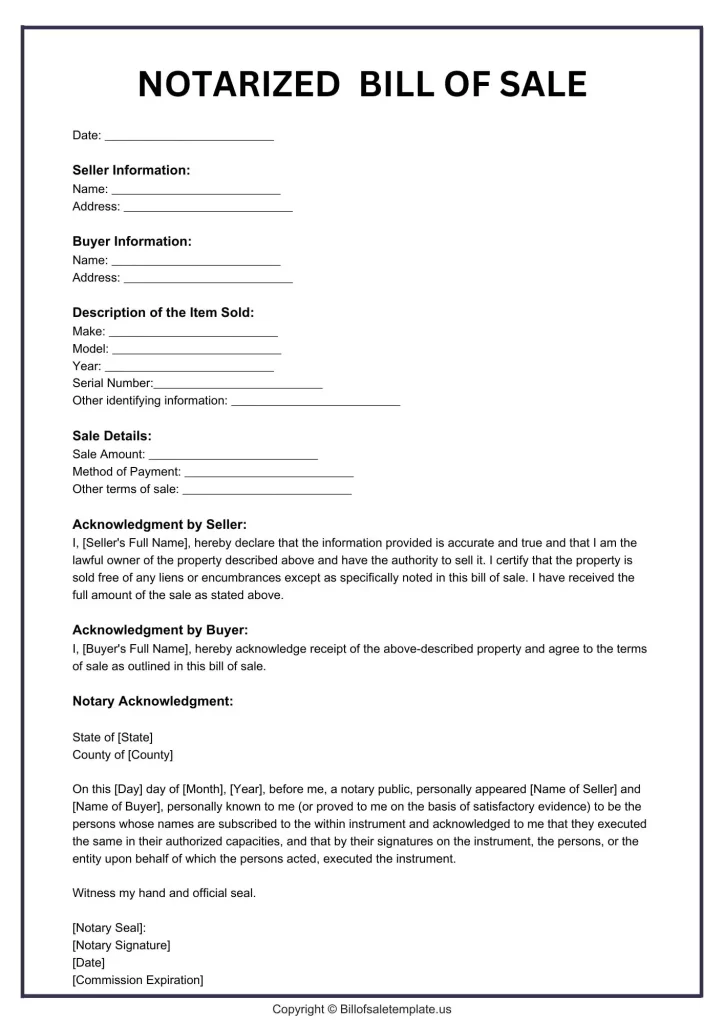
The form can generally include:
- Buyer’s full name, address, and contact information
- Seller’s full name, address, and contact information
- Description of the property being sold
- Vehicle identification number (VIN), serial number, or other identifying information, when applicable
- Purchase price
- Payment method
- Date of sale
- Condition of the property
- Warranty or “as-is” terms
- Ownership and lien statements
- Delivery or possession information
- Buyer and seller signatures
- Witness information, when applicable
- Notary acknowledgment, signature, and seal
Before using a template, check whether your state or the relevant government agency requires a specific form or additional documents.
What Should a Notarized Bill of Sale Include?
A well-prepared notarized bill of sale should contain enough information to clearly identify the parties, property, and terms of the transaction.
1. Buyer Information
Include the buyer’s:
- Full legal name
- Residential or mailing address
- Phone number
- Email address, if appropriate
Accurate buyer information helps establish who received the property and provides a clear record of the transaction.
2. Seller Information
The seller section should include:
- Full legal name
- Address
- Phone number
- Email address, if appropriate
The seller should also confirm that they have the legal right or authority to sell the property.
3. Property Description
The property should be described in enough detail to distinguish it from similar items.
Depending on what is being sold, this may include:
- Make
- Model
- Year
- Color
- Serial number
- VIN
- Registration number
- Size or identifying features
- Current condition
- Accessories or included items
For a vehicle, the VIN is especially important because it uniquely identifies the vehicle.
4. Purchase Price
Clearly state the total agreed purchase price.
If the amount has already been paid in full, the document can state that payment was received. If payment will be made in installments, the payment schedule and remaining balance should be documented separately or included in the agreement.
5. Payment Method
Specify how payment was made or will be made, such as:
- Cash
- Check
- Bank transfer
- Money order
- Electronic payment
- Other agreed method
Keeping separate payment records is also recommended.
6. Date of Sale
The exact date of the transaction should be recorded. If ownership or possession changes on a different date, that should also be clearly stated.
7. Condition of the Property
Describe whether the property is:
- New
- Used
- Refurbished
- Damaged
- Sold in its current condition
Any known defects, repairs, or significant issues should be disclosed where appropriate.
8. Warranty or “As-Is” Terms
The bill of sale should clearly explain whether the property is being sold:
- With a written warranty
- Without a warranty
- “As is”
- Subject to specific conditions
An “as-is” provision should be written carefully because its legal effect can vary depending on applicable law.
9. Ownership and Lien Information
For valuable property, particularly vehicles, it is useful to state whether:
- The seller owns the property
- There are any outstanding liens
- The property is subject to financing
- The seller has authority to transfer it
For vehicles, buyers should independently verify title and lien status through the appropriate records.
10. Signatures
The buyer and seller should sign and date the document according to the requirements applicable to the transaction.
If notarization is required, the parties generally should not sign the document in advance unless the notary specifically instructs them otherwise.
How to Get a Bill of Sale Notarized
Getting a bill of sale notarized is usually a straightforward process.
Step 1: Complete the Bill of Sale
Fill in all relevant information before meeting the notary. Check names, addresses, prices, VINs, serial numbers, dates, and other identifying details carefully.
Step 2: Check Whether Notarization Is Required
Not every bill of sale needs to be notarized. Requirements can differ by state and by the type of property being transferred.
For a vehicle, check the requirements of the state where the vehicle will be titled or registered.
Step 3: Find a Notary Public
Depending on your location, notarial services may be available through banks, shipping or business service providers, attorneys, government offices, or independent notaries.
Step 4: Bring Acceptable Identification
Each person signing should bring an acceptable government-issued identification document if required by the notary.
Step 5: Sign in Front of the Notary
If the notary requires personal appearance, the appropriate parties sign the document in the notary’s presence.
Step 6: Complete the Notarial Certificate
The notary completes the applicable acknowledgment or jurat, depending on the type of notarial act being performed.
Step 7: Receive the Completed Document
The notary signs or stamps the document as required and returns the completed bill of sale to the parties.
Both buyer and seller should retain a copy for their records.
Notarized Vehicle Bill of Sale
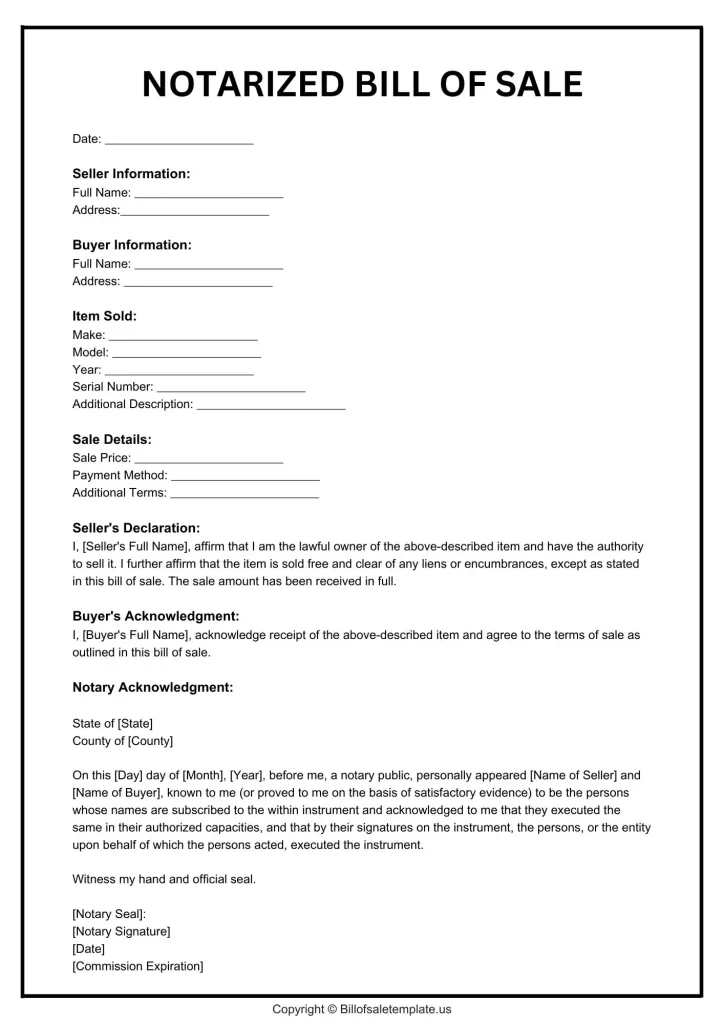
A Notarized Vehicle Bill of Sale records the details of a vehicle transaction and includes a section for notarization when required or desired.
A vehicle bill of sale may include:
- Seller information
- Buyer information
- Vehicle make and model
- Model year
- VIN
- Color
- Odometer reading
- Purchase price
- Payment method
- Date of sale
- Vehicle condition
- Warranty information
- Title and lien information
- Delivery date
- Buyer and seller signatures
- Notary acknowledgment
Important Vehicle Documents
A bill of sale is only one part of a vehicle transaction. Depending on the state, the buyer may also need the vehicle title, registration documents, odometer disclosure, application forms, insurance information, and applicable fees.
A bill of sale should not be assumed to replace the vehicle title or other documents required for a legal title transfer.
Notarized Automobile Bill of Sale
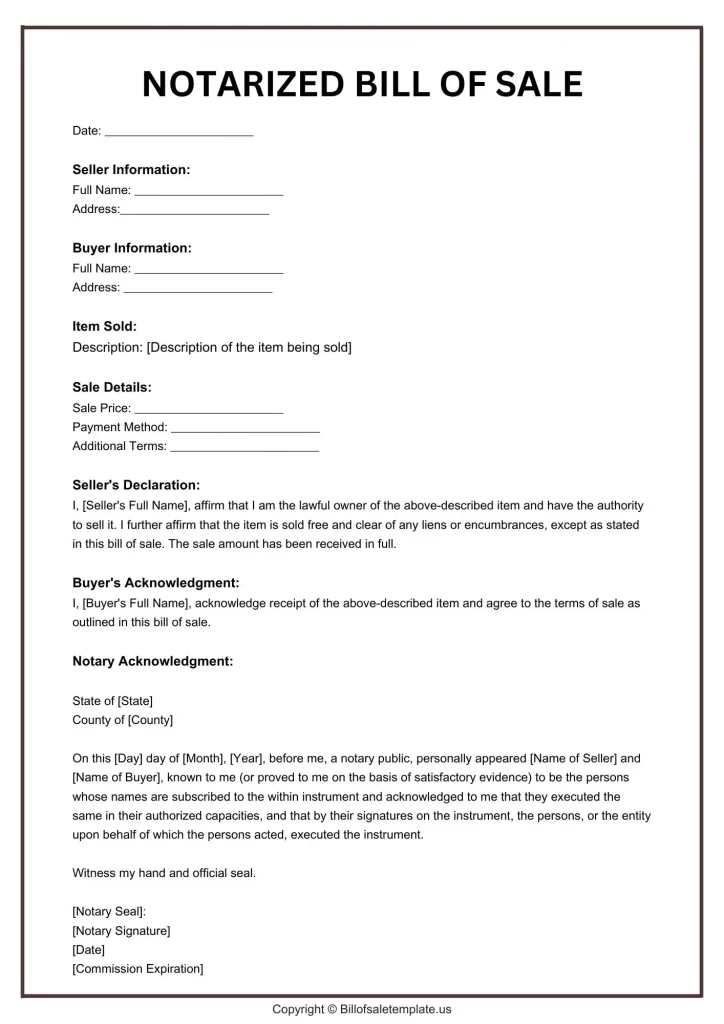
A notarized automobile bill of sale provides a written record of the purchase and sale of a car or other automobile. It identifies the parties, describes the vehicle, records the financial terms, and provides space for the required signatures and notarial acknowledgment.
Before completing the transaction, the buyer should compare the VIN on the bill of sale with the VIN on the vehicle and title. The seller should make sure that any required title, lien-release, and disclosure documents are properly completed.
Notarized Bill of Sale for a Car
A Notarized Bill of Sale for a Car is particularly useful when the buyer and seller want a formal record of the transaction or when applicable state rules require notarization.
The document should clearly identify the vehicle and record the agreed terms. If the vehicle is financed or subject to a lien, the parties should resolve the lien requirements before completing the transfer.
When Should a Bill of Sale Be Notarized?
Notarization may be appropriate when:
- State law specifically requires it.
- A government agency requests a notarized document.
- The transaction involves a vehicle, boat, trailer, or other regulated property and local requirements call for notarization.
- The parties want additional verification of the signing process.
- The transaction involves valuable property.
- The parties want stronger documentation of who signed the agreement.
However, notarization is not automatically required for every bill of sale. Requirements vary by jurisdiction and transaction type.
What Does a Notary Actually Verify?
A common misconception is that a notary guarantees the entire transaction.
Generally, the notary’s role is focused on the notarial act. Depending on the type of notarization and local law, the notary may:
- Verify the identity of the signer
- Confirm that the signer appears before the notary as required
- Observe or acknowledge the signing
- Confirm that the signer appears to act voluntarily
- Complete the appropriate notarial certificate
- Apply the required signature, stamp, or seal
A notary generally does not independently determine whether the seller actually owns the property, whether the property is free of liens, or whether the statements contained in the bill of sale are truthful.
Legal and Practical Considerations
Verify Ownership
Before purchasing valuable property, the buyer should confirm that the seller has the legal authority to sell it.
For vehicles, check the title and applicable ownership records.
Check for Liens
A lien or financing interest can affect the transfer of property. Buyers should verify whether any outstanding lien exists and obtain appropriate documentation when required.
Match Identification Numbers
For vehicles and equipment, compare the VIN or serial number on the property with the number written on the bill of sale and other ownership documents.
Document Payment
Keep proof of payment along with the signed bill of sale. This can help resolve disagreements over whether the purchase price was paid.
Describe the Condition Honestly
The document should accurately describe known defects, damage, repairs, or other important conditions.
Understand “As-Is” Language
An as-is provision can clarify that the buyer accepts the property in its existing condition, but it does not necessarily eliminate every legal obligation or protection. Applicable consumer-protection and other laws may still apply.
Follow State Requirements
Vehicle sales can involve requirements for:
- Title transfer
- Registration
- Taxes
- Odometer disclosure
- Insurance
- Lien release
- Emissions or inspection documents
- Seller notifications
These requirements differ by state.
Keep Copies
Both parties should retain signed copies of the bill of sale and related transaction documents.
Benefits of a Notarized Bill of Sale
Provides a Clear Transaction Record
It records who sold the property, who purchased it, what was sold, the price, and the date.
Adds Signature Verification
Notarization provides an additional layer of authentication for the signing process.
Helps Reduce Disputes
A detailed written record can reduce disagreements about the terms of the transaction.
Supports Recordkeeping
The document can be kept with receipts, titles, registration records, warranties, and other transaction paperwork.
May Support Registration
When accepted or required by the relevant authority, a bill of sale can help document a transaction for registration or title-related purposes.
Protects Both Parties
A properly completed document gives the buyer and seller evidence of the terms they agreed to.
Creates a Professional Record
Notarization can be useful when the parties want a more formal record of a significant transaction.
How to Complete a Notarized Bill of Sale
- Enter the full legal names and contact details of the buyer and seller.
- Describe the property accurately.
- Add the VIN, serial number, or other identifying information when applicable.
- Enter the purchase price and payment method.
- Record the date of sale.
- Describe the property’s condition.
- Include warranty or as-is terms.
- Add ownership and lien information when appropriate.
- Review every detail for accuracy.
- Follow the applicable notary procedure.
- Sign the document as instructed by the notary.
- Have the notary complete the required acknowledgment.
- Give both parties a completed copy.
- Complete any additional title, registration, tax, or reporting requirements.
FAQs
1. What is a notarized bill of sale?
A notarized bill of sale is a written record of a sale in which the signatures are formally acknowledged through a notarial process. It records information about the buyer, seller, property, purchase price, and transaction.
2. Does a bill of sale have to be notarized?
Not always. Whether notarization is required depends on the state, type of property, and specific transaction. Some transactions can use a standard signed bill of sale, while others may require notarization.
3. What does a notary do on a bill of sale?
The notary performs the applicable notarial act, which can include verifying the signer’s identity, witnessing or acknowledging the signature, and completing the notarial certificate.
4. Does notarization prove ownership?
No. Notarization generally verifies the signing process and identity of the signer. It does not independently establish that the seller owns the property. Ownership should be verified through the appropriate title, registration, or ownership records.
5. Can I sign a bill of sale before seeing the notary?
It depends on the type of notarial act and the notary’s instructions. If the notary must witness the signing, wait and sign in the notary’s presence.
6. What information should be included in a notarized vehicle bill of sale?
A vehicle bill of sale generally includes the buyer and seller information, vehicle make, model, year, VIN, odometer reading when applicable, purchase price, payment terms, date of sale, condition, signatures, and notarial acknowledgment when required.
7. Can a bill of sale replace a vehicle title?
Generally, no. A bill of sale is a record of the transaction, while the title is an ownership document. Vehicle title-transfer requirements vary by state.
8. Should both the buyer and seller keep a copy?
Yes. Both parties should keep a signed copy along with payment records and any related title, registration, warranty, or lien documents.
9. Can a bill of sale include an “as-is” clause?
Yes, an appropriate as-is provision can be included when the parties agree to it. However, its legal effect can depend on applicable law, and certain legal protections or disclosure requirements may still apply.
10. Where can I get a printable notarized bill of sale template?
A printable template can provide a convenient starting point for documenting a transaction. However, users should check their state or local requirements to determine whether a specific government form or additional document is required.
Final Note
A Notarized Bill of Sale is a useful way to create a formal record of a property transaction and authenticate the signing process. For the strongest documentation, make sure the bill of sale accurately identifies the parties and property, clearly states the purchase terms, records payment and condition details, and complies with the requirements applicable to the transaction.
Important: Notarization does not replace a title, registration, lien release, or other documents that may be required by law. Always check the requirements of the relevant state or government agency before completing a vehicle or other regulated-property transaction.

Ted Cruz is the founder and driving force behind BillofSaleTemplate.us, a comprehensive resource for free bill of sale templates tailored to meet a variety of needs. With a keen understanding of the importance of accurate and legally sound documentation, Ted has dedicated his expertise to providing accessible and user-friendly templates for all types of transactions, from vehicle sales to personal property exchanges.
Recognizing the diverse legal requirements across different states, Ted has meticulously crafted state-specific bill of sale templates to ensure compliance and ease of use for users nationwide. His commitment to simplifying the process of creating reliable and legally binding documents has made BillofSaleTemplate.us a trusted platform for individuals and businesses alike.