![Free Bill of Sale Template PDF, Word [United States]](https://billofsaletemplate.us/wordpress/wp-content/webp-express/webp-images/uploads/2024/06/bill-of-sale-Logo-1.png.webp)
An Equipment Bill of Sale is a written record of a transaction in which equipment is sold or transferred from a seller to a buyer. It identifies the equipment, documents the agreed purchase price and sale date, and records the terms accepted by both parties.
Whether you are selling construction machinery, farm equipment, business tools, industrial machinery, or used equipment, a bill of sale provides a clear record of what was sold and under what conditions. It can also document the equipment’s serial number, model, condition, included accessories, payment arrangements, and any warranties or as-is terms.
A properly completed form can help reduce misunderstandings by putting the important details of the transaction in writing. The buyer and seller can each keep a signed copy for their records and use it as supporting documentation for accounting, insurance, financing, resale, or other purposes when applicable.
Download the free Equipment Bill of Sale template below, complete the required information, and have both parties review and sign it before finalizing the transaction.
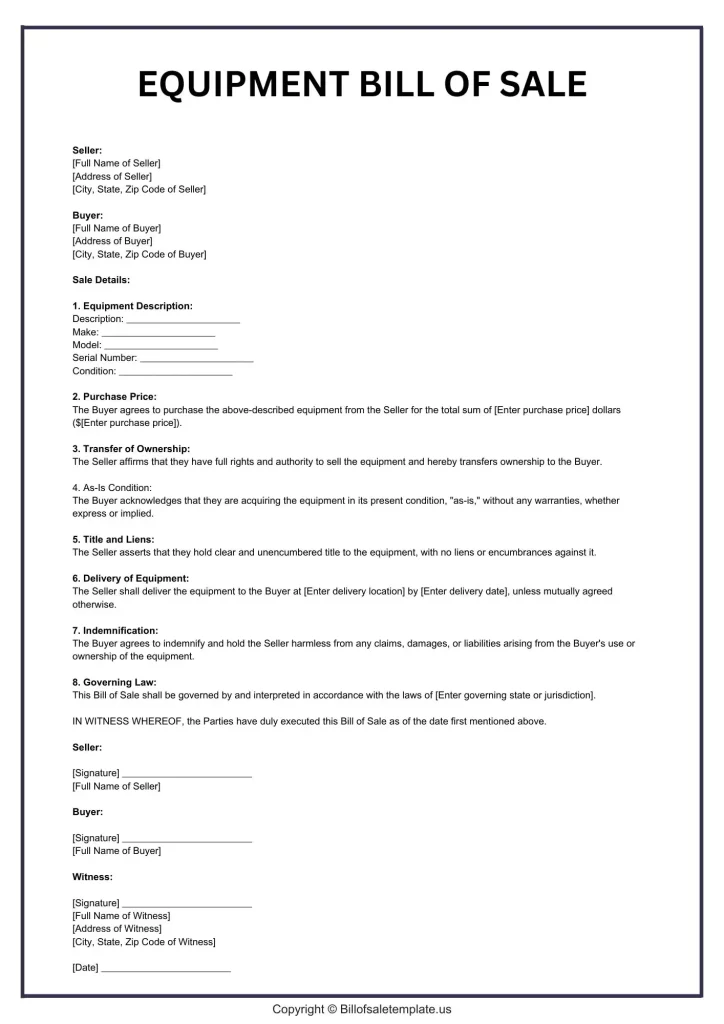
Free Printable Equipment Bill of Sale Template
This printable Equipment Bill of Sale is designed to make a private equipment transaction easier to document. It provides space for the buyer and seller’s information, equipment identification, purchase price, payment terms, condition, warranties, additional agreements, and signatures.
Before signing, both parties should verify that the equipment description, serial number, purchase price, and other transaction details are accurate.
What Is an Equipment Bill of Sale?
An Equipment Bill of Sale is a document used to record the sale of equipment between a buyer and seller. Unlike a simple receipt, it can provide a more complete record of the transaction by identifying the equipment and documenting the terms agreed upon by both parties.
The equipment may be new or used and can include items such as:
- Construction machinery
- Agricultural equipment
- Manufacturing machinery
- Industrial equipment
- Office equipment
- Restaurant equipment
- Landscaping machinery
- Tools and workshop equipment
- Generators and compressors
- Commercial equipment
The exact information needed can vary depending on the equipment and the location of the transaction. If the equipment has a separate title, registration, financing arrangement, or lien, additional documentation may also be necessary.
What Should an Equipment Bill of Sale Include?
A well-prepared form should clearly identify the parties, the equipment, and the terms of the sale.
1. Seller Information
Include the seller’s:
- Full legal name or business name
- Address
- Phone number
- Email address
2. Buyer Information
Include the buyer’s:
- Full legal name or business name
- Address
- Phone number
- Email address
3. Equipment Description
Provide enough information to distinguish the equipment from other similar items, such as:
- Equipment type
- Manufacturer or brand
- Model
- Year
- Serial number
- Product or identification number
- Hours of use, when applicable
- Current condition
- Color or other identifying characteristics
4. Purchase Price
Clearly state:
- Total sale price
- Deposit, if applicable
- Remaining balance
- Payment method
- Installment terms, if applicable
5. Condition of Equipment
Describe the equipment’s condition and identify any known defects, damage, repairs, or limitations that are relevant to the transaction.
6. Warranty or As-Is Terms
State whether the equipment is being sold with a warranty, under specific guarantees, or on an as-is basis.
7. Included Accessories
List attachments, tools, parts, manuals, spare components, or other items included in the sale.
8. Liens and Ownership
If applicable, document whether the equipment is subject to a loan, lien, security interest, or other claim and explain how it will be handled.
9. Signatures
The buyer and seller should sign and date the completed document. A witness or notary section can be included when required or desired.
Equipment Bill of Sale Template
The following is a general example of the information that can be included in an Equipment Bill of Sale.
EQUIPMENT BILL OF SALE
Date of Sale: ______________________________
Seller Information
Name/Business Name: _______________________
Address: __________________________________
Phone: ____________________________________
Email: ____________________________________
Buyer Information
Name/Business Name: _______________________
Address: __________________________________
Phone: ____________________________________
Email: ____________________________________
Equipment Information
Equipment Type: ____________________________
Manufacturer/Brand: ________________________
Model: ____________________________________
Year: _____________________________________
Serial Number: _____________________________
Product/ID Number: _________________________
Hours of Use: ______________________________
Condition: _________________________________
Sale Details
Purchase Price: $___________________________
Deposit: $_________________________________
Balance Due: $_____________________________
Payment Method: ___________________________
Payment Terms: _____________________________
Condition and Warranty
The equipment is sold under the following terms:
Warranty: __________________________________
As-Is: ☐ Yes ☐ No
Included Equipment or Accessories
Liens or Claims
Additional Terms
Signatures
Seller Signature: ___________________________
Printed Name: ______________________________
Date: _____________________________________
Buyer Signature: ____________________________
Printed Name: ______________________________
Date: _____________________________________
Witness/Notary, if applicable: _______________
Date: _____________________________________
Printable Equipment Bill of Sale
A printable Equipment Bill of Sale is useful when the buyer and seller want a straightforward paper record of their transaction.
The form can be downloaded, printed, completed by hand, and signed by both parties. It can also be useful for maintaining transaction records after the sale.
A typical printable form includes sections for:
- Buyer and seller details
- Equipment identification
- Serial number
- Purchase price
- Payment terms
- Equipment condition
- Warranty or as-is provisions
- Included accessories
- Additional agreements
- Signatures and dates
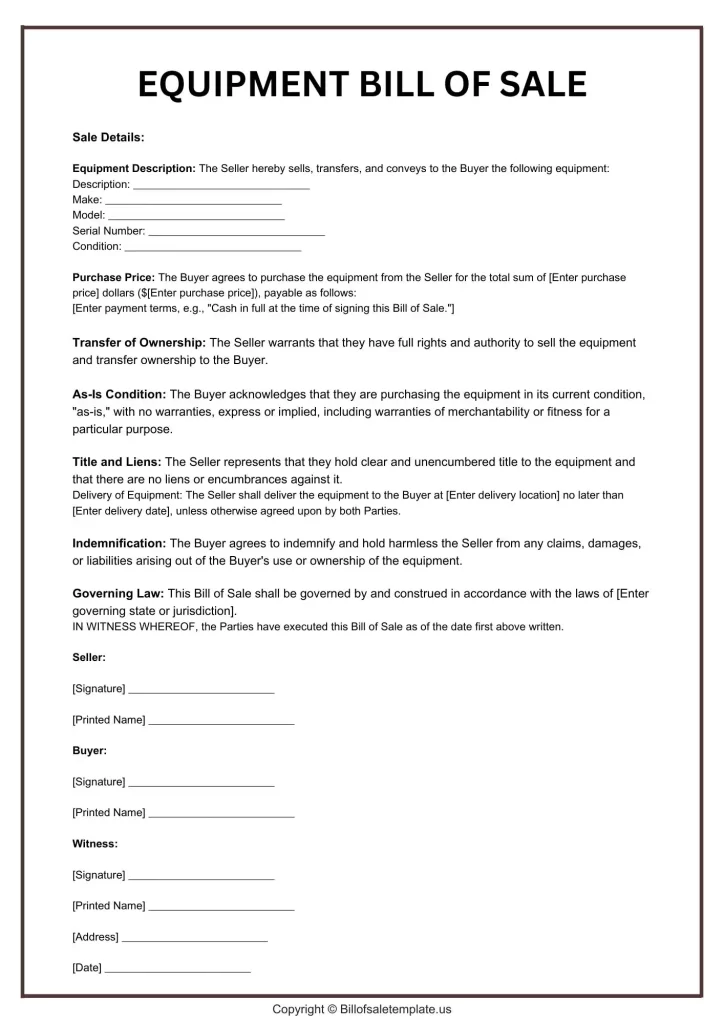
Both parties should review the completed document carefully and keep a copy for their records.
Free Equipment Bill of Sale Form
A free Equipment Bill of Sale form provides a ready-made structure for documenting an equipment transaction instead of creating a document from scratch.
It can be useful for individuals, small businesses, contractors, dealers, and other parties who need to record the sale of equipment.
The form can document:
- Who sold the equipment
- Who purchased it
- What equipment was sold
- How much it cost
- How payment was made
- The equipment’s condition
- Any warranties or as-is terms
- Accessories included
- Additional conditions
- Signatures confirming the transaction
[Download Free Equipment Bill of Sale Form]
The parties should make sure the form contains all information relevant to their particular transaction.
Heavy Equipment Bill of Sale
A Heavy Equipment Bill of Sale is used to document the sale of large machinery and equipment used in construction, agriculture, industrial operations, and other commercial activities.
Examples include:
- Excavators
- Bulldozers
- Wheel loaders
- Skid steers
- Backhoes
- Cranes
- Forklifts
- Graders
- Tractors
- Compactors
- Industrial machinery
Heavy equipment transactions may involve substantial amounts of money, so the form should identify the equipment as precisely as possible.
In addition to the basic information, consider recording:
- Serial number
- Manufacturer
- Model
- Year
- Engine information
- Hour-meter reading
- Attachments
- Operating condition
- Known mechanical problems
- Maintenance records
- Existing liens or financing
- Purchase price and payment terms
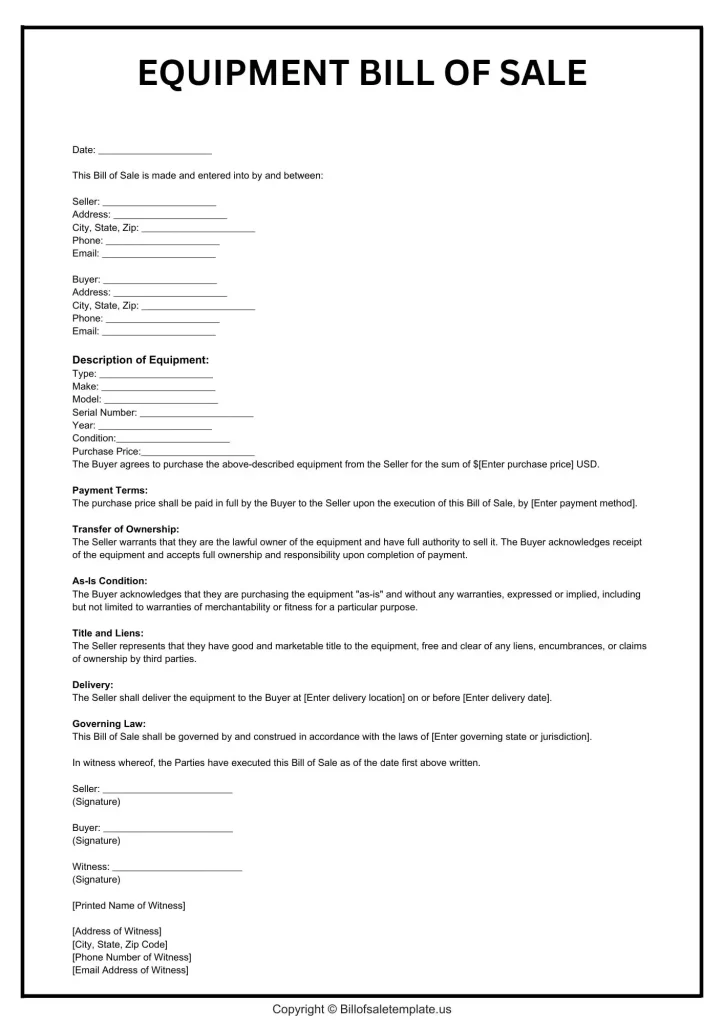
Construction Equipment Bill of Sale
A Construction Equipment Bill of Sale can be used when construction machinery is sold privately or between businesses.
For equipment such as excavators, loaders, cranes, bulldozers, and other machinery, the buyer and seller should provide a detailed description that makes the specific equipment easy to identify.
The form may include:
- Equipment type
- Manufacturer
- Model
- Year
- Serial number
- Hour-meter reading
- Attachments
- Current condition
- Known defects
- Purchase price
- Payment arrangements
- Warranty information
- As-is terms
- Signatures
If attachments or accessories are included, list them separately so both parties have a clear understanding of what is part of the sale.
Used Equipment Bill of Sale
A Used Equipment Bill of Sale records the sale of pre-owned equipment.
Because used equipment may have previous repairs, modifications, wear, or mechanical issues, the condition section is particularly important.
Before completing the purchase, the buyer should consider:
- Inspecting the equipment
- Checking the serial number
- Reviewing maintenance records
- Asking about known defects
- Confirming included accessories
- Checking for liens or financing
- Confirming the seller’s right to sell the equipment
- Reviewing any warranty or as-is terms
The bill of sale should accurately reflect the condition and terms agreed upon by the parties.
As-Is Equipment Bill of Sale
An As-Is Equipment Bill of Sale documents a transaction in which the equipment is sold under stated as-is terms.
If the parties agree that the equipment is being purchased as-is, the agreement should clearly identify that arrangement and document any known issues or disclosures that apply.
For example, the document can include:
- Current condition
- Known defects
- Existing damage
- Hours of use
- Repairs
- Missing components
- Included accessories
- Warranty exclusions or coverage
- Purchase price
An as-is provision does not necessarily remove every legal obligation or disclosure requirement. Applicable laws and the specific circumstances of the transaction should be considered.
Equipment Bill of Sale for Business Equipment
Businesses frequently buy and sell equipment as part of normal operations.
Examples include:
- Office furniture and equipment
- Restaurant equipment
- Manufacturing machinery
- Medical equipment
- Landscaping equipment
- Warehouse equipment
- Commercial tools
- Computer and technology equipment
For business transactions, the bill of sale can be particularly useful for maintaining accounting and asset records.
If the transaction involves multiple pieces of equipment, an itemized list can be attached to the bill of sale with each item’s description, serial number, and agreed value.
Equipment Serial Number and Identification
The serial number is often one of the most useful ways to distinguish a particular piece of equipment from similar items.
Before signing, the buyer and seller should compare the serial number on the equipment with the number entered on the bill of sale.
For larger or specialized equipment, additional identifiers may include:
- Model number
- Product number
- Engine number
- Asset number
- Hour-meter reading
- Manufacturer information
Accurate identification can help reduce confusion about which equipment was included in the transaction.
Equipment Condition and Warranty
The condition of the equipment should be described honestly and clearly.
Depending on the transaction, the agreement may address:
- Normal wear and tear
- Mechanical condition
- Cosmetic damage
- Known defects
- Recent repairs
- Replacement parts
- Maintenance history
- Warranty coverage
- As-is terms
If the seller makes specific promises about the equipment, those promises should be written into the agreement rather than relying solely on verbal statements.
Equipment Bill of Sale and Liens
Before purchasing expensive equipment, the buyer should determine whether the equipment is subject to a loan, lien, security interest, or other claim.
If financing exists, the parties should establish how the outstanding obligation will be handled and when the buyer will receive appropriate documentation showing that the relevant claim has been released, if applicable.
A bill of sale can document the parties’ agreement, but it should not be treated as proof that every lien or security interest has automatically been removed.
How to Write an Equipment Bill of Sale
Creating an Equipment Bill of Sale is straightforward when the important information is organized in advance.
Step 1: Identify the Buyer and Seller
Enter the full names or business names and contact information of both parties.
Step 2: Describe the Equipment
Record the equipment type, manufacturer, model, year, serial number, and other identifying information.
Step 3: State the Purchase Price
Enter the agreed price and any deposit or outstanding balance.
Step 4: Document Payment Terms
Specify whether payment is made by cash, check, bank transfer, financing, or installments.
Step 5: Describe the Condition
Record the equipment’s current condition and any known defects or damage.
Step 6: Add Warranty or As-Is Terms
Clearly state whether any warranty applies or whether the equipment is being sold as-is.
Step 7: List Included Items
Identify attachments, accessories, spare parts, tools, manuals, or other property included in the transaction.
Step 8: Address Liens
If the equipment has financing or another claim against it, document how that issue will be handled.
Step 9: Sign and Date
Both parties should review the completed document before signing and dating it.
Step 10: Keep Copies
The buyer and seller should each retain a signed copy with their transaction records.
Buyer Checklist for Equipment Purchases
Before completing an equipment purchase, the buyer should consider the following:
- Verify the seller’s identity.
- Confirm the seller has the right to sell the equipment.
- Check the serial number.
- Inspect the equipment.
- Review its condition.
- Ask about known defects.
- Review maintenance or service records, when available.
- Confirm included attachments and accessories.
- Check for outstanding financing or liens.
- Agree on the purchase price.
- Confirm payment terms.
- Review warranty or as-is provisions.
- Complete the bill of sale.
- Obtain any required ownership or transfer documents.
- Keep a signed copy.
Seller Checklist for Equipment Sales
Sellers should also keep complete records of the transaction.
- Confirm the buyer’s information.
- Verify the equipment description.
- Record the serial number accurately.
- Disclose relevant known issues.
- List included accessories.
- Confirm the purchase price.
- Record payment terms.
- Address outstanding liens or financing.
- State applicable warranty or as-is terms.
- Complete and sign the bill of sale.
- Provide required documents.
- Keep a signed copy for your records.
Does an Equipment Bill of Sale Transfer Ownership?
A bill of sale provides written evidence of a sale or transfer, but it does not necessarily replace a title, registration, lien release, or other ownership documents that may be required for particular equipment.
Requirements can vary depending on the type of equipment, transaction, and jurisdiction.
For equipment that has a formal title or registration system, the buyer and seller should complete the additional transfer process required by the relevant authority.
Does an Equipment Bill of Sale Need to Be Notarized?
Not every equipment transaction requires notarization.
Whether a bill of sale needs to be notarized depends on the equipment, jurisdiction, transaction, and applicable requirements.
If notarization is required, the parties should follow the instructions of the appropriate authority or institution.
Even when it is not mandatory, the parties may choose to use a witness or notary for additional documentation.
Can an Equipment Bill of Sale Be Used for Tax and Accounting Records?
A bill of sale can provide useful documentation for recording an equipment purchase or sale in financial records.
It may contain information such as:
- Purchase date
- Purchase price
- Equipment description
- Seller information
- Buyer information
- Payment details
Businesses should retain the bill of sale with their other transaction records and consult their accountant or tax professional about the appropriate tax treatment.
Why Use an Equipment Bill of Sale?
A properly completed bill of sale can provide several practical benefits:
Clear Transaction Record
It creates a written record of what was sold, when it was sold, and for how much.
Better Documentation
The equipment’s identifying information and condition can be recorded in one document.
Fewer Misunderstandings
Written terms make it easier for both parties to understand what was agreed upon.
Payment Record
The purchase price and payment arrangements can be documented.
Condition Record
Known defects, damage, warranties, and as-is terms can be clearly stated.
Business Record Keeping
Businesses can retain the document with their accounting and asset records.
Future Reference
The document may be useful when the equipment is later insured, financed, resold, or otherwise transferred, where applicable.
Legal Considerations
Equipment transactions can be subject to different requirements depending on the type of equipment and location.
Before completing a transaction, consider whether you need documentation relating to:
- Ownership
- Title or registration
- Liens
- Financing
- Sales tax
- Insurance
- Business records
- Warranty disclosures
- Safety or regulatory requirements
- Notarization
A bill of sale should accurately reflect the actual agreement between the parties.
This template is provided for general informational and record-keeping purposes and is not legal advice. Requirements can vary by jurisdiction and by the type of equipment being sold. For high-value, financed, commercial, or legally complicated transactions, consider obtaining advice from a qualified professional.
Frequently Asked Questions
What is an Equipment Bill of Sale?
An Equipment Bill of Sale is a written document that records the sale or transfer of equipment from a seller to a buyer. It typically includes the parties’ information, equipment description, purchase price, sale date, condition, and signatures.
What should an Equipment Bill of Sale include?
It should generally identify the buyer and seller, describe the equipment, record the serial number when available, state the purchase price and payment terms, address the equipment’s condition, and include signatures and dates.
Can I use an Equipment Bill of Sale for used equipment?
Yes. A bill of sale can be used to document the sale of used equipment. The condition, known defects, repairs, and as-is or warranty terms should be clearly recorded.
What is a Heavy Equipment Bill of Sale?
A Heavy Equipment Bill of Sale is used to document the sale of large machinery such as excavators, bulldozers, loaders, cranes, forklifts, and other heavy equipment.
What is a Construction Equipment Bill of Sale?
It is a document used to record the sale of construction machinery and can identify equipment such as excavators, backhoes, bulldozers, loaders, and cranes.
Should I include the equipment serial number?
Yes. When the equipment has a serial number, including it can help identify the specific item involved in the transaction.
Can I sell equipment as-is?
Equipment may be sold under as-is terms when permitted and properly documented. The agreement should clearly state the condition and any relevant disclosures.
What if the equipment has a lien?
The parties should identify the lien and agree on how it will be resolved. Buyers should confirm the status of any financing or security interest before completing the transaction.
Can businesses use an Equipment Bill of Sale?
Yes. Businesses can use a bill of sale to document purchases and sales of machinery, tools, office equipment, commercial equipment, and other business assets.
Does an Equipment Bill of Sale prove ownership?
It can provide evidence of the transaction, but it may not replace a title, registration, lien release, or other ownership documentation where those documents are required.
Do both parties need a copy?
Yes. The buyer and seller should each keep a signed copy of the completed bill of sale.
Can an Equipment Bill of Sale be used for tax purposes?
It can serve as supporting transaction documentation, but the appropriate tax treatment depends on the circumstances. Businesses should consult their tax professional when necessary.
Download Free Equipment Bill of Sale PDF
A clear bill of sale can make an equipment transaction easier to document and gives both parties a written record of the agreed terms.
Our free Equipment Bill of Sale template provides space for the buyer and seller, equipment details, serial number, purchase price, payment terms, condition, warranties, included accessories, liens, additional terms, and signatures.
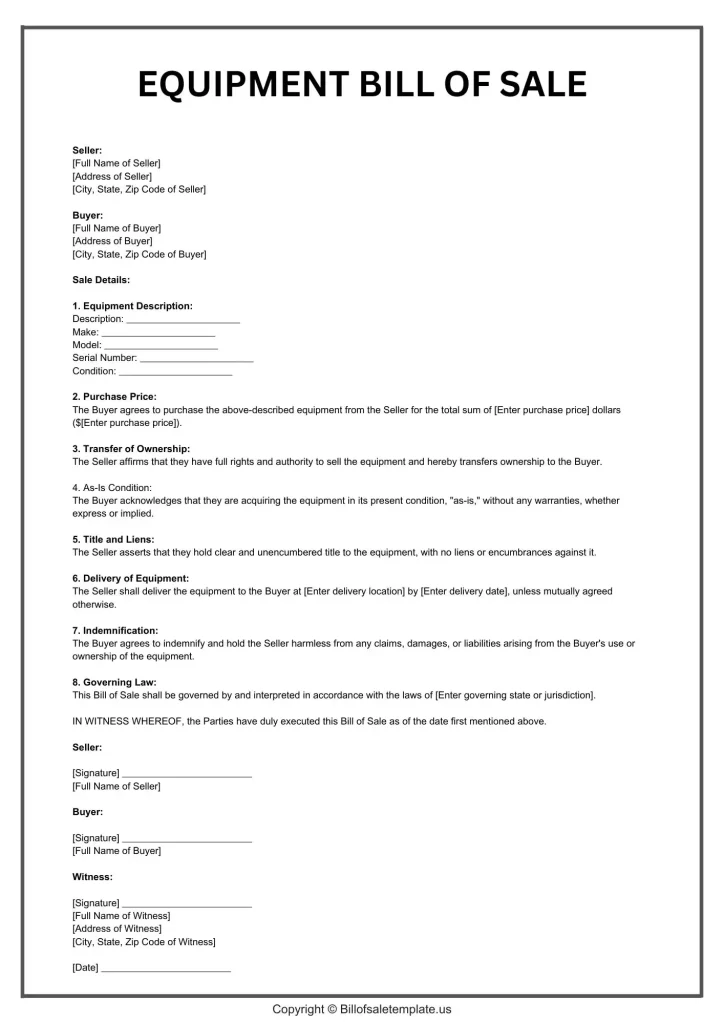
Before signing, review every detail carefully and make sure any required title, registration, lien, tax, or other transfer documents are completed separately.

Ted Cruz is the founder and driving force behind BillofSaleTemplate.us, a comprehensive resource for free bill of sale templates tailored to meet a variety of needs. With a keen understanding of the importance of accurate and legally sound documentation, Ted has dedicated his expertise to providing accessible and user-friendly templates for all types of transactions, from vehicle sales to personal property exchanges.
Recognizing the diverse legal requirements across different states, Ted has meticulously crafted state-specific bill of sale templates to ensure compliance and ease of use for users nationwide. His commitment to simplifying the process of creating reliable and legally binding documents has made BillofSaleTemplate.us a trusted platform for individuals and businesses alike.