![Free Bill of Sale Template PDF, Word [United States]](https://billofsaletemplate.us/wordpress/wp-content/webp-express/webp-images/uploads/2024/06/bill-of-sale-Logo-1.png.webp)
An Auto Bill of Sale is a written record of a vehicle transaction between a buyer and a seller. It documents the key terms of the sale, including the identities of the parties, vehicle information, purchase price, payment method, date of sale, and signatures.
Whether you are selling a used car to a private buyer, purchasing a vehicle from another individual, or transferring an automobile between family members, having the agreement in writing can provide a clear record of what both parties agreed to.
A typical auto bill of sale includes the vehicle’s year, make, model, VIN (Vehicle Identification Number), odometer reading, color, and condition, along with the buyer’s and seller’s names and contact information. It may also specify whether the vehicle is sold as-is or with a warranty, whether the purchase price has been paid in full, and whether any additional terms apply.
A bill of sale can be useful for maintaining transaction records and may be requested during certain title, registration, tax, or insurance processes. However, requirements differ by state. A bill of sale does not necessarily replace the vehicle title or other documents required to legally transfer ownership.
For this reason, both parties should complete the bill of sale accurately and check their state’s requirements before finalizing the transaction.
Free Printable Auto Bill of Sale Template
A Free Printable Auto Bill of Sale Template provides a convenient way to document a vehicle sale without creating a form from scratch.
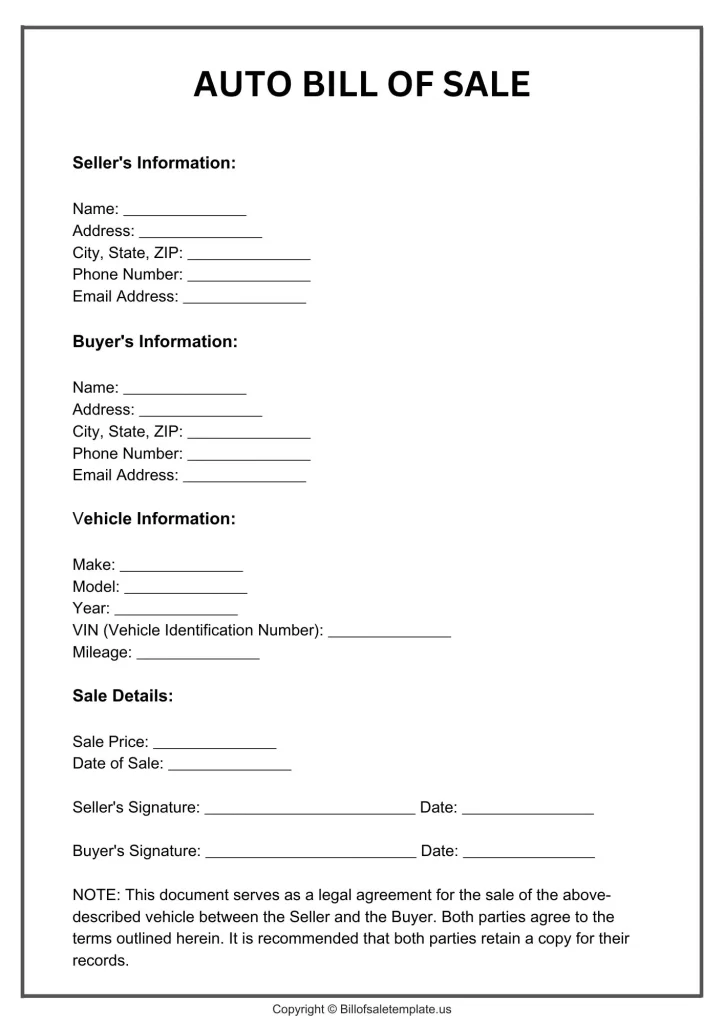
The template can be printed and completed manually or used as a reference when preparing a digital document. Before signing, the buyer and seller should review every section carefully and make sure the information matches the vehicle and other transaction documents.
Each party should keep a signed copy for their records.
What Is an Auto Bill of Sale?
An auto bill of sale is a document that records the sale of a motor vehicle from one party to another. It identifies the vehicle, the people involved, and the main financial and contractual terms of the transaction.
Depending on the transaction, an auto bill of sale may include:
- Buyer’s full legal name
- Seller’s full legal name
- Buyer’s and seller’s addresses
- Contact information
- Vehicle year, make, and model
- VIN
- Odometer reading
- Vehicle color
- License plate number, when applicable
- Title information
- Purchase price
- Payment method
- Payment status
- Date of sale
- Delivery or pickup information
- Vehicle condition
- Warranty information
- “As-is” terms
- Lien information
- Additional conditions
- Buyer and seller signatures
- Witness or notary information, when applicable
The exact requirements depend on the state and circumstances of the sale.
Why Use an Auto Bill of Sale?
A written bill of sale gives both parties a detailed record of the transaction.
It Can Help the Buyer
The document can help the buyer:
- Keep proof of the purchase
- Document the amount paid for the vehicle
- Confirm the vehicle identification details
- Support certain registration or title procedures
- Maintain records for insurance purposes
- Refer back to the agreed terms
- Establish what condition the vehicle was in when purchased
It Can Help the Seller
The seller can use the document to:
- Record that the vehicle was sold
- Document the agreed purchase price
- Confirm the date of the transaction
- Record the vehicle’s condition
- Keep evidence of the buyer and seller agreement
- Maintain records for future reference
- Support compliance with applicable state requirements
A bill of sale is helpful documentation, but it should not be treated as an automatic release from every legal obligation. Sellers should also complete any required state notifications, title transfers, and registration-related procedures.
Sample Auto Bill of Sale Template
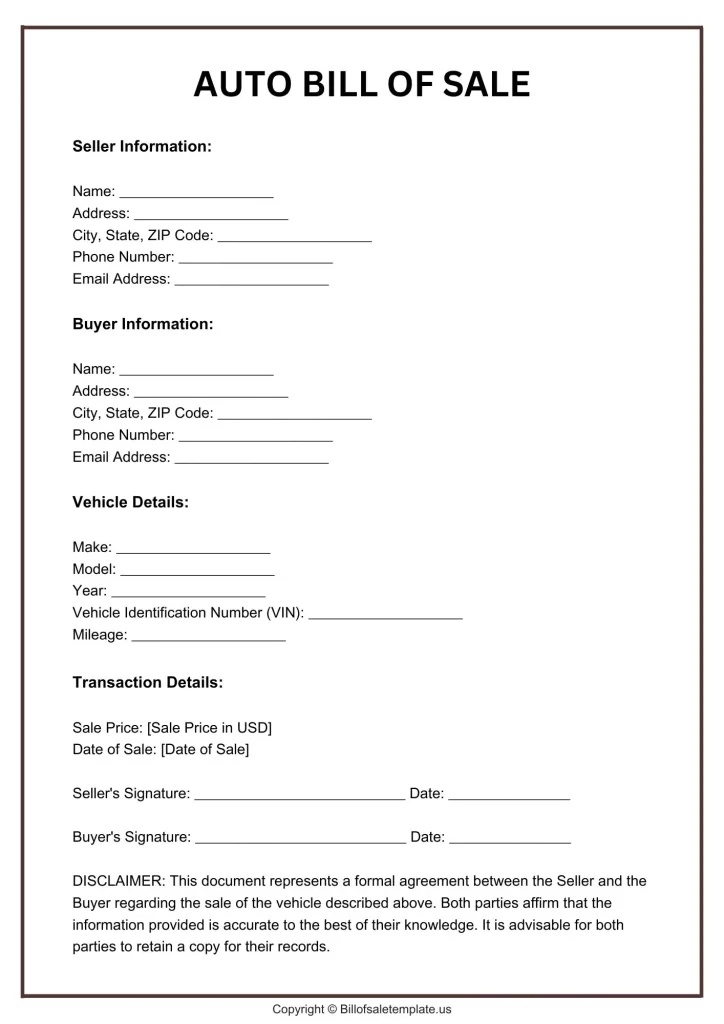
A sample auto bill of sale provides a practical example of how the information can be organized.
A well-prepared form should make it easy to identify:
- Who is selling the vehicle
- Who is buying the vehicle
- Which vehicle is being sold
- How much the buyer is paying
- How payment is being made
- When the transaction occurs
- What condition the vehicle is in
- Whether warranties apply
- What additional terms have been agreed upon
Key Sections of an Auto Bill of Sale
1. Date of Sale
The document should include the exact date of the transaction.
The sale date creates a clear record of when the parties entered into the agreement and may be relevant for tax, registration, insurance, or other administrative purposes.
Sale Date: __________________
2. Seller Information
Include the seller’s complete information, such as:
- Full legal name
- Address
- City, state, and ZIP code
- Phone number
- Email address, when appropriate
The seller should also confirm that they have the legal authority to sell the vehicle.
3. Buyer Information
The buyer section should include:
- Full legal name
- Address
- City, state, and ZIP code
- Phone number
- Email address, when appropriate
Accurate information helps clearly identify the person purchasing the vehicle.
4. Vehicle Information
The vehicle description is one of the most important parts of the document.
Include:
- Year
- Make
- Model
- VIN
- Body type
- Color
- Odometer reading
- License plate number, if applicable
- Title number, if applicable
The VIN should be checked carefully against the vehicle and title documents. An incorrect VIN can cause significant problems during title or registration processing.
5. Purchase Price
Clearly state the total amount agreed upon by the buyer and seller.
Purchase Price: $__________________
If a deposit has already been paid, the document can also identify:
- Deposit amount
- Remaining balance
- Payment due date
- Payment schedule, if applicable
Recording the financial terms helps prevent disagreements about how much was agreed upon.
6. Payment Method
The bill of sale can specify how payment was made.
Common methods include:
- Cash
- Personal check
- Cashier’s check
- Bank transfer
- Electronic payment
- Financing
- Other agreed payment methods
If the vehicle is being purchased through installments or financing, the payment terms should be clearly documented.
7. Payment Status
It is useful to clarify whether the purchase price has been paid in full.
For example:
☐ Paid in Full
☐ Partial Payment
☐ Balance Remaining
If money remains outstanding, the parties should document the amount due and applicable payment terms.
8. Vehicle Condition
The bill of sale should accurately describe the vehicle’s condition.
The parties may record whether the vehicle is:
- New
- Used
- Rebuilt
- Damaged
- Reconditioned
- In working condition
- Sold with known defects
Known issues or significant defects should be disclosed when required or appropriate.
The buyer should have an opportunity to inspect the vehicle before completing the purchase.
9. As-Is Auto Bill of Sale
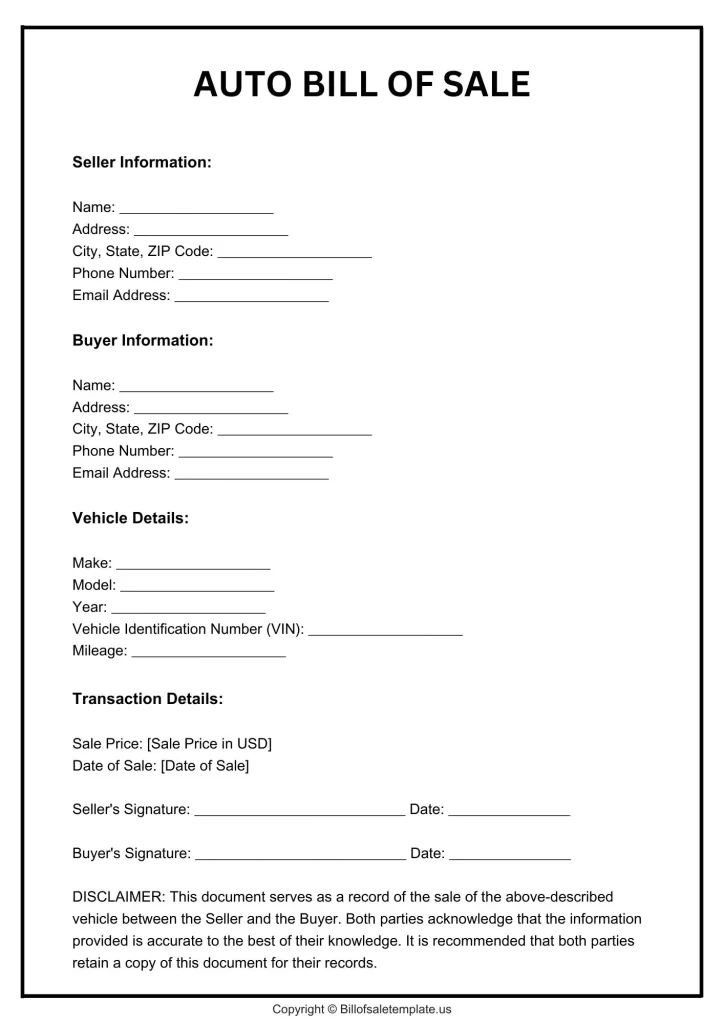
An as-is sale generally means the buyer accepts the vehicle in its existing condition, subject to applicable law and any specific representations or warranties made by the seller.
An as-is clause can clarify that the seller is not providing a general warranty regarding the vehicle’s condition.
However, an as-is statement should not be considered a blanket protection against every possible claim. Laws concerning fraud, required disclosures, consumer protection, warranties, and misrepresentation may still apply.
A good bill of sale should accurately describe the vehicle and any known issues rather than relying solely on an as-is clause.
10. Warranty Information
If the seller provides a warranty, the terms should be written clearly.
The document can specify:
- Whether a warranty is provided
- What components are covered
- Length of the warranty
- Start date
- Repair responsibilities
- Exclusions or limitations
If no warranty is provided, the document can clearly state the applicable no-warranty or as-is terms, subject to state law.
11. Odometer Reading
The vehicle’s mileage should be recorded accurately.
Odometer Reading: __________________ miles
Odometer information is important when purchasing a used vehicle because it provides a record of the mileage at the time of the transaction.
Certain vehicle transactions are subject to federal or state odometer disclosure requirements. A bill of sale may not replace a separate odometer disclosure statement when one is required.
12. Title and Lien Information
Before purchasing a vehicle, the buyer should determine whether the seller has a valid title and whether there are any outstanding liens.
The bill of sale may include:
- Title number
- Title status
- Lienholder information
- Lien release information
- Other ownership details
A seller should disclose any applicable lien or financing interest and complete the required lien-release process.
13. Additional Terms
The parties can add other terms that are relevant to the sale.
Examples include:
- Extra keys
- Spare tire
- Owner’s manual
- Floor mats
- Accessories
- Service records
- Repairs
- Delivery arrangements
- Pickup arrangements
- Deposit terms
- Remaining balance
- Other agreed conditions
Important verbal agreements should be written into the document whenever possible.
14. Delivery and Possession
The parties may record when and where the vehicle will be delivered or picked up.
The agreement can include:
- Delivery date
- Pickup date
- Location
- Transportation arrangements
- Delivery costs
- Responsibility for transportation
Clearly documenting possession can help avoid confusion about when the buyer receives the vehicle.
15. Buyer and Seller Signatures
Both parties should review the completed document before signing.
The form should provide space for:
Seller Signature: __________________________
Date: __________________
Buyer Signature: __________________________
Date: __________________
If witnesses or notarization are required or voluntarily used, the appropriate section can be completed as well.
Simple Auto Bill of Sale
Download Simple Auto Bill of Sale PDF
A simple auto bill of sale may be appropriate when the parties need a straightforward record of a basic vehicle transaction.
Even a simple form should contain the essential information needed to identify:
- The buyer
- The seller
- The vehicle
- The sale price
- The date of sale
- Payment terms
- Vehicle condition
- Signatures
For transactions involving financing, liens, unusual conditions, warranties, or other complications, additional documentation may be necessary.
Auto Bill of Sale for a Used Car
A bill of sale can be especially useful for private sales of used vehicles.
For a used car transaction, consider documenting:
- Vehicle history information
- Current mileage
- Known defects
- Accident or damage disclosures, when applicable
- Maintenance records
- Inspection results
- Purchase price
- Payment method
- Warranty or as-is terms
- Title status
- Lien status
The buyer may also want to obtain a vehicle history report and have the car independently inspected before purchasing it.
Auto Bill of Sale for a Family Member
An auto bill of sale can also be used when a vehicle is transferred between family members, although the applicable tax and title rules may differ from a standard sale.
Depending on the circumstances, the transaction may be treated as:
- A sale
- A gift
- A transfer between relatives
Because tax and title requirements can vary, the parties should check the rules applicable to their state and transaction type.
Is an Auto Bill of Sale the Same as a Vehicle Title?
No.
A bill of sale and a vehicle title serve different purposes.
| Document | Purpose |
|---|---|
| Auto Bill of Sale | Records the transaction between buyer and seller |
| Vehicle Title | Documents official vehicle ownership according to the applicable jurisdiction |
| Registration | Records the vehicle for lawful operation according to state requirements |
| Odometer Disclosure | Documents mileage when required |
| Receipt | Records payment |
A bill of sale may be required or accepted as part of a title or registration process, but it does not necessarily replace the title.
Does an Auto Bill of Sale Transfer Ownership?
A bill of sale documents the agreement and sale, but the legal transfer of vehicle ownership is generally governed by the applicable state title and registration laws.
In many transactions, the seller must properly assign the title and the buyer must complete the required title and registration process.
Therefore, buyers and sellers should not rely on the bill of sale alone.
Does an Auto Bill of Sale Need to Be Notarized?
Not necessarily.
Notarization requirements vary by state and transaction type. Some jurisdictions may require notarization for particular vehicle transactions, while others do not.
A buyer and seller may also choose notarization as an additional form of identity and signature verification when it is not mandatory.
Always check the applicable state requirements before assuming that notarization is required or sufficient.
Seller Responsibilities After the Sale
After selling a vehicle, the seller should check the applicable state requirements and may need to:
- Properly assign the vehicle title
- Complete required disclosures
- Submit a notice of sale when required
- Remove or transfer license plates when applicable
- Update or cancel insurance
- Keep a signed copy of the bill of sale
- Keep proof of payment
- Follow applicable registration procedures
The exact requirements vary by jurisdiction.
Buyer Responsibilities After Purchasing the Vehicle
After purchasing a vehicle, the buyer should generally:
- Obtain the properly assigned title
- Keep the signed bill of sale
- Apply for title transfer
- Register the vehicle
- Obtain required insurance
- Pay applicable taxes and fees
- Complete required inspections
- Complete emissions requirements when applicable
- Keep copies of all purchase documents
Buyers should check their state’s deadlines because title and registration requirements can vary.
Tax and Registration Considerations
Buying or selling an automobile may involve:
- Sales tax
- Use tax
- Title fees
- Registration fees
- Transfer fees
- Inspection fees
- Other state or local charges
The amount and responsibility for these costs depend on the jurisdiction and transaction.
A bill of sale can help document the purchase price, but it does not automatically satisfy tax or registration requirements.
Benefits of an Auto Bill of Sale
An auto bill of sale can provide several practical benefits.
Clear Transaction Record
It puts the main terms of the vehicle transaction in writing.
Documents the Purchase Price
The agreed amount can be recorded for future reference.
Identifies the Vehicle
The VIN and other vehicle details help establish exactly which vehicle was sold.
Records the Vehicle Condition
The parties can document the vehicle’s condition and applicable warranty or as-is terms.
Helps Reduce Disputes
A detailed written agreement can reduce misunderstandings about the sale.
Supports Record Keeping
Both parties can retain a copy with their financial and vehicle records.
May Support Registration or Title Procedures
Some states may require or accept a bill of sale as part of certain vehicle transactions.
Provides Evidence of the Agreement
If a disagreement occurs, a signed document can help establish what the parties agreed to.
Common Mistakes to Avoid
When preparing an auto bill of sale, avoid these common mistakes:
1. Incorrect VIN
Always compare the VIN with the vehicle and title.
2. Missing Purchase Price
Clearly record the agreed amount.
3. Incorrect Mileage
Enter the odometer reading accurately.
4. Incomplete Buyer or Seller Information
Use complete legal names and accurate contact details.
5. Leaving Important Sections Blank
Complete the relevant sections before signing.
6. Ignoring the Vehicle Title
A bill of sale does not necessarily replace a properly assigned title.
7. Failing to Disclose Known Issues
Important vehicle defects should be handled according to applicable law.
8. Relying Only on an As-Is Clause
An as-is clause does not necessarily eliminate obligations imposed by law.
9. Not Checking State Requirements
Each state can have different vehicle-sale, title, registration, and tax requirements.
10. Not Keeping a Copy
Both parties should retain a completed copy of the signed document.
How to Write an Auto Bill of Sale
Creating an auto bill of sale is relatively simple when you have the required information.
Step 1: Enter the Sale Date
Write the date of the transaction.
Step 2: Identify the Seller
Provide the seller’s complete legal name and contact information.
Step 3: Identify the Buyer
Enter the buyer’s full legal name and contact information.
Step 4: Describe the Vehicle
Add the year, make, model, VIN, mileage, color, and other relevant details.
Step 5: Enter the Purchase Price
State the total amount agreed upon.
Step 6: Record the Payment Method
Specify how payment was made or will be made.
Step 7: Describe the Vehicle Condition
Record the condition and known issues.
Step 8: Add Warranty or As-Is Terms
Clearly state whether the vehicle is sold with a warranty or without one.
Step 9: Add Additional Conditions
Record any special agreements between the parties.
Step 10: Check Title and Lien Information
Make sure the ownership documents are properly handled.
Step 11: Review the Form
Verify the names, VIN, mileage, price, dates, and other information.
Step 12: Sign the Document
Both parties should sign and date the agreement.
Step 13: Exchange Copies
Each party should receive a completed copy.
Step 14: Complete State Requirements
Finish any required title, registration, tax, insurance, or notice-of-sale procedures.
Auto Bill of Sale Checklist
Before completing the transaction, use this checklist:
- Buyer information is complete
- Seller information is complete
- Vehicle year is correct
- Make and model are correct
- VIN matches the vehicle
- Odometer reading is accurate
- Purchase price is correct
- Payment method is recorded
- Vehicle condition is described
- Known issues are disclosed
- Warranty/as-is terms are clear
- Title information has been checked
- Lien information has been addressed
- Additional terms are included
- Required signatures are completed
- Both parties have copies
- State-specific requirements have been checked
Frequently Asked Questions
1. What is an Auto Bill of Sale?
An auto bill of sale is a written record of a vehicle transaction between a buyer and seller. It documents information about the parties, vehicle, purchase price, payment terms, date of sale, and other agreed conditions.
2. What should be included on an Auto Bill of Sale?
It should generally include the buyer’s and seller’s information, vehicle year, make, model, VIN, mileage, purchase price, payment method, sale date, condition, warranty or as-is terms, and signatures.
3. Is an Auto Bill of Sale required?
The requirement depends on the state and type of transaction. Even when it is not mandatory, having one can provide useful documentation for both parties.
4. Can I write my own Auto Bill of Sale?
Yes. A private-party vehicle bill of sale can often be created by the parties themselves, provided it contains the necessary information and complies with applicable requirements.
5. Can an Auto Bill of Sale be handwritten?
A handwritten bill of sale may be acceptable in many situations, provided the applicable jurisdiction does not require a specific form. It should be clear, complete, and signed by the appropriate parties.
6. Does an Auto Bill of Sale prove ownership?
It provides evidence of the vehicle transaction, but it may not serve as the official proof of ownership. The vehicle title and state-specific ownership procedures are also important.
7. Does a bill of sale transfer the title?
Not necessarily. The title-transfer process is governed by the applicable state or jurisdiction and generally involves additional paperwork.
8. Do I need a bill of sale when buying a used car?
It depends on the state. However, keeping a signed bill of sale is generally useful because it documents the purchase and agreed terms.
9. Do both buyer and seller sign the bill of sale?
Generally, yes. Having both parties sign and date the document provides a stronger record that both parties agreed to the terms.
10. Does an Auto Bill of Sale need to be notarized?
Not in every transaction. Notarization requirements vary by state and circumstances.
11. What is an “As-Is” Auto Bill of Sale?
An as-is bill of sale records that the buyer accepts the vehicle in its current condition, subject to applicable law and any specific warranties or representations made by the seller.
12. Should the VIN be on an Auto Bill of Sale?
Yes. Including the VIN is strongly recommended because it uniquely identifies the vehicle.
13. Should mileage be included?
Yes. The current odometer reading should be recorded accurately, along with any separate odometer disclosure required by law.
14. Who keeps the Auto Bill of Sale?
Both the buyer and seller should keep a signed copy for their records.
15. Can an Auto Bill of Sale be used for a gift?
It may be possible to document a vehicle gift, but a gift may have different tax and title requirements from a standard sale. Check the applicable state requirements.
16. What should I do after selling my car?
Complete the required title-transfer paperwork, provide required documents to the buyer, notify the appropriate agency if required, update insurance as appropriate, and retain copies of the transaction documents.
17. What should I check before buying a used car?
Check the VIN, title, lien status, mileage, vehicle history, condition, maintenance records, and applicable inspection requirements. An independent inspection can also be helpful.
18. Can I use the same Auto Bill of Sale in every state?
A generic template can be a useful starting point, but state requirements differ. Some states require specific forms or additional documentation, so always verify local requirements.
Free Auto Bill of Sale Template
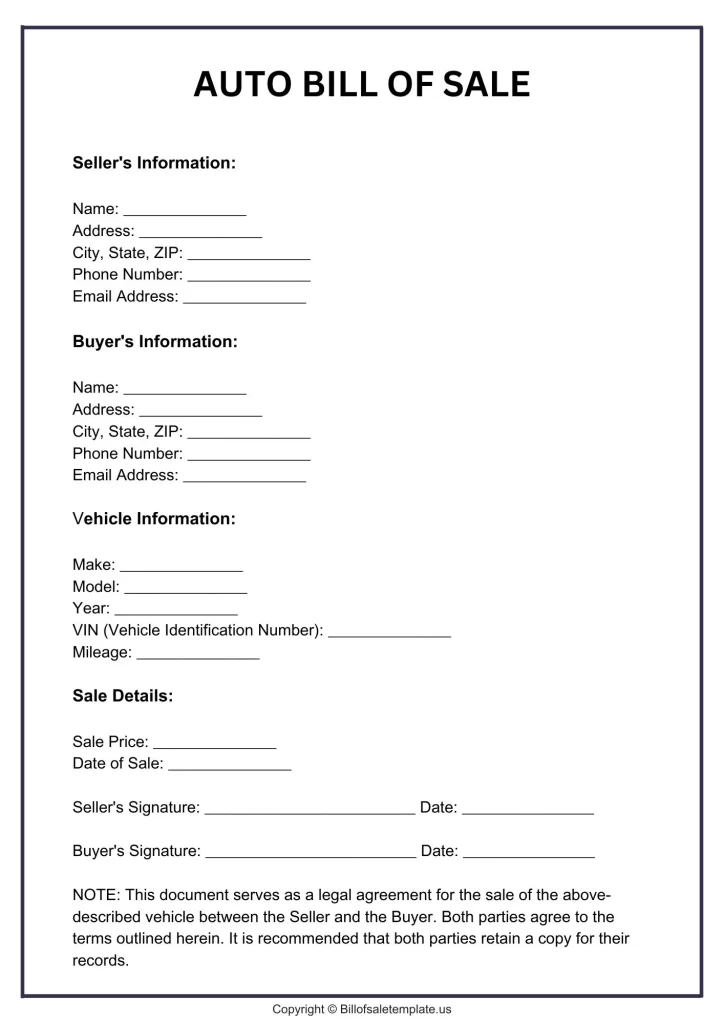
A printable auto bill of sale makes it easier to record the essential information involved in a private vehicle transaction. Before using a generic form, make sure it meets the requirements that apply to your state and the specific vehicle sale.
Final Takeaway
An Auto Bill of Sale is a practical way to put the important details of a vehicle transaction in writing. It identifies the buyer and seller, describes the automobile, records the purchase price and payment terms, and documents the condition and date of the sale.
For the best protection, the buyer and seller should provide accurate information, verify the VIN and title, disclose relevant vehicle information, clearly state the purchase terms, sign the document, and keep copies of the completed paperwork.
Most importantly, remember that a bill of sale is only one part of a vehicle transaction. Title transfer, registration, taxes, insurance, odometer disclosures, lien releases, and notice-of-sale requirements can vary by state. Checking the applicable requirements before completing the transaction helps ensure that the sale is properly documented from beginning to end.

Ted Cruz is the founder and driving force behind BillofSaleTemplate.us, a comprehensive resource for free bill of sale templates tailored to meet a variety of needs. With a keen understanding of the importance of accurate and legally sound documentation, Ted has dedicated his expertise to providing accessible and user-friendly templates for all types of transactions, from vehicle sales to personal property exchanges.
Recognizing the diverse legal requirements across different states, Ted has meticulously crafted state-specific bill of sale templates to ensure compliance and ease of use for users nationwide. His commitment to simplifying the process of creating reliable and legally binding documents has made BillofSaleTemplate.us a trusted platform for individuals and businesses alike.