![Free Bill of Sale Template PDF, Word [United States]](https://billofsaletemplate.us/wordpress/wp-content/uploads/2024/06/bill-of-sale-Logo-1-189x74.png)
An Equine Bill of Sale is a written agreement used to document the sale and transfer of ownership of a horse or other equine animal from a seller to a buyer. It creates a clear record of the transaction and outlines important details about the horse, purchase price, payment terms, condition, and responsibilities of both parties.
Because horses can have significant financial value and may involve breeding, competition, transportation, boarding, veterinary care, or registration, documenting the transaction is especially important. A well-prepared Equine Bill of Sale identifies the horse through details such as its registered name, breed, age, sex, color, markings, registration number, microchip number, and other distinguishing characteristics.
The agreement can also record known health conditions, injuries, medications, vaccination history, dental or veterinary records, and any other information disclosed by the seller. If the horse is being sold as-is, that should be clearly stated. If the seller is providing a health guarantee, trial period, return right, breeding rights, or another special promise, those terms should be written into the agreement rather than relying on verbal statements.
For the seller, the bill of sale provides evidence that the horse was transferred to the buyer on a specific date and under specified conditions. For the buyer, it provides documentation of the purchase and may be useful for registration, insurance, transportation, boarding, resale, or resolving future ownership disputes.
A notarized signature may provide additional authentication where appropriate, although notarization is not automatically required for every horse sale. Requirements can vary by state, jurisdiction, breed registry, or the circumstances of the transaction.
Free Printable Equine Bill of Sale Template
An Equine Bill of Sale Template provides a convenient way to document a horse sale without creating the agreement from scratch. The form can include sections for the buyer and seller, horse identification, purchase price, payment arrangements, health disclosures, warranties, delivery details, and signatures.
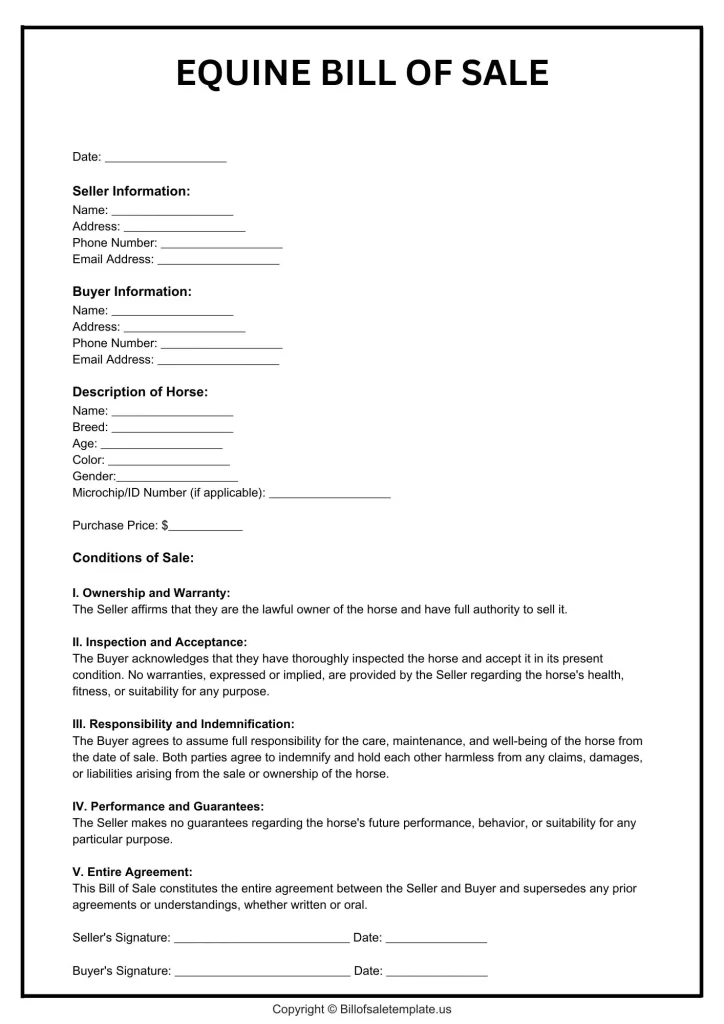
Before signing, both parties should review every section carefully and make sure that the information accurately describes the horse and the terms of the transaction.
What to Include in an Equine Bill of Sale
A complete Equine Bill of Sale should generally include the following information:
- Date of Sale: The date when the purchase agreement is completed or ownership is transferred.
- Seller Information: Full legal name, address, phone number, and email address.
- Buyer Information: Full legal name, address, phone number, and email address.
- Horse Identification: Registered name, barn name, breed, sex, age or date of birth, color, markings, height, and other identifying characteristics.
- Registration Details: Registration organization, registration number, and transfer documents, when applicable.
- Microchip Information: Microchip number, if the horse has one.
- Purchase Price: The total agreed price for the horse.
- Payment Terms: Cash, check, electronic transfer, financing, deposit, installment arrangement, or other agreed payment method.
- Health and Condition: Known illnesses, injuries, medical conditions, medications, behavioral concerns, and other relevant disclosures.
- Veterinary Examination: Whether a pre-purchase veterinary examination was completed, declined, or made a condition of the sale.
- Warranties or Guarantees: Any health, soundness, performance, breeding, or other guarantees provided by the seller.
- As-Is Terms: A clear statement if the horse is being purchased in its current condition without additional warranties.
- Delivery and Transportation: Who is responsible for transportation, delivery costs, and risk during transit.
- Registration Transfer: Details regarding transfer of ownership with a breed registry, if applicable.
- Special Conditions: Trial periods, return rights, breeding rights, competition restrictions, boarding arrangements, or other negotiated terms.
- Signatures: Dated signatures from both buyer and seller.
- Witness or Notary: An optional section when witnessing or notarization is desired or required.
Equine Bill of Sale Contract
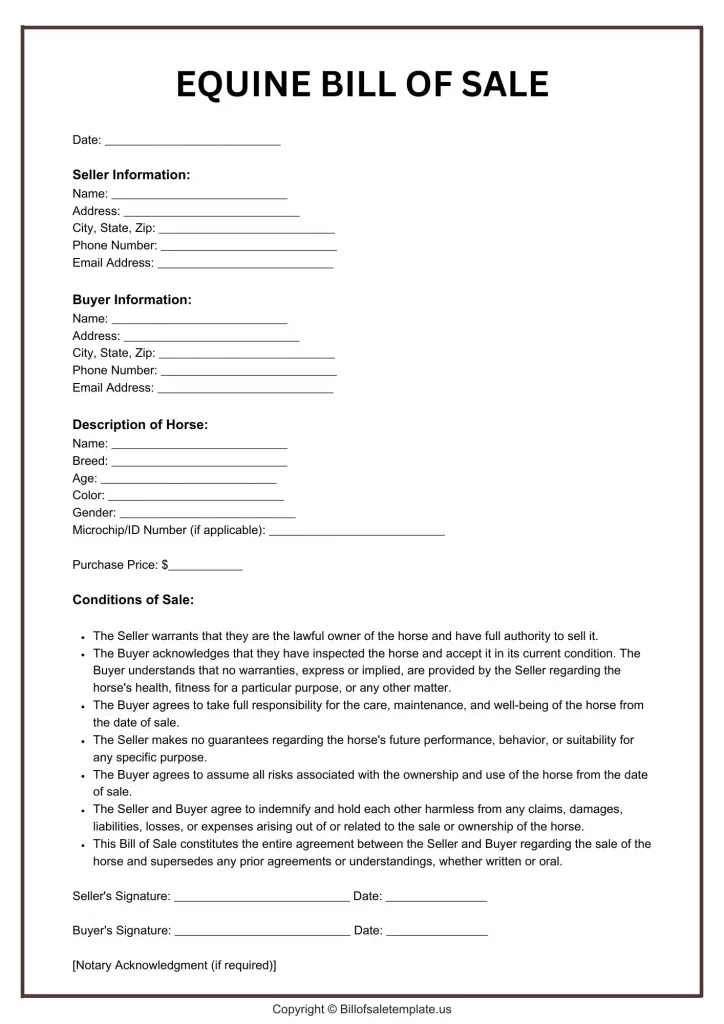
An Equine Bill of Sale Contract provides a more detailed written record of the horse transaction. It can be particularly useful when the sale involves a high-value horse, special conditions, financing, breeding rights, a trial period, or specific health representations.
1. Date and Location of Sale
Record the date and location where the transaction takes place. This establishes a clear timeline for the agreement.
2. Seller Information
Include:
- Full legal name
- Residential or mailing address
- Telephone number
- Email address
The seller should confirm that they have the legal authority to sell the horse.
3. Buyer Information
Include:
- Full legal name
- Address
- Telephone number
- Email address
Accurate buyer information helps establish who is receiving ownership of the horse.
4. Horse Identification
Provide as much identifying information as possible, including:
- Registered name
- Stable or barn name
- Breed
- Sex
- Age or date of birth
- Color
- Distinctive markings
- Height
- Registration number
- Microchip number
- Brand or tattoo, if applicable
- Photograph or identification attachment, if appropriate
Detailed identification helps ensure that both parties are referring to the same horse.
5. Health and Condition Disclosure
The agreement should accurately describe known health and condition information. Depending on the circumstances, this may include:
- Current or previous illnesses
- Injuries
- Surgeries
- Medications
- Vaccinations
- Dental treatment
- Farrier history
- Veterinary treatment
- Known behavioral issues
- Allergies or special care requirements
The seller should disclose material information honestly, while the buyer may wish to arrange an independent veterinary examination before completing the purchase.
6. Purchase Price and Payment
Clearly state:
- Total purchase price
- Deposit amount
- Remaining balance
- Payment method
- Payment deadline
- Installment terms, if applicable
- Whether the purchase price has been paid in full
Keeping payment terms in writing can help prevent misunderstandings.
7. Ownership and Lien Statement
The seller should state whether they are the lawful owner and whether the horse is subject to any lien, security interest, lease, ownership claim, or other encumbrance.
If another person or organization has an interest in the horse, that information should be disclosed before the transaction is completed.
8. Warranties and Representations
Any promises made by the seller should be written clearly into the agreement. These may relate to:
- Health
- Soundness
- Temperament
- Training
- Competition history
- Breeding ability
- Registration
- Ownership
- Previous medical conditions
Avoid relying solely on verbal promises when a particular representation is important to the transaction.
9. As-Is Sale
If the horse is being sold as-is, the agreement should clearly state that the buyer accepts the horse in its condition at the time of sale, subject to applicable law and any specific written representations or warranties.
An as-is clause should not be treated as permission to conceal known problems or make false statements about the horse.
10. Delivery and Risk of Loss
The agreement can specify:
- Delivery date
- Delivery location
- Transportation company
- Transportation costs
- Responsibility for loading and unloading
- Responsibility for veterinary emergencies during transportation
- When possession and risk transfer to the buyer
This is especially important when the horse is being transported to another state or country.
11. Registration and Transfer Documents
If the horse is registered with a breed or competition organization, the parties should identify which documents will be transferred and who is responsible for submitting the ownership-transfer paperwork.
12. Signatures
The buyer and seller should sign and date the agreement after reviewing all terms.
A witness or notary section may be included when appropriate.
Simple Equine Bill of Sale
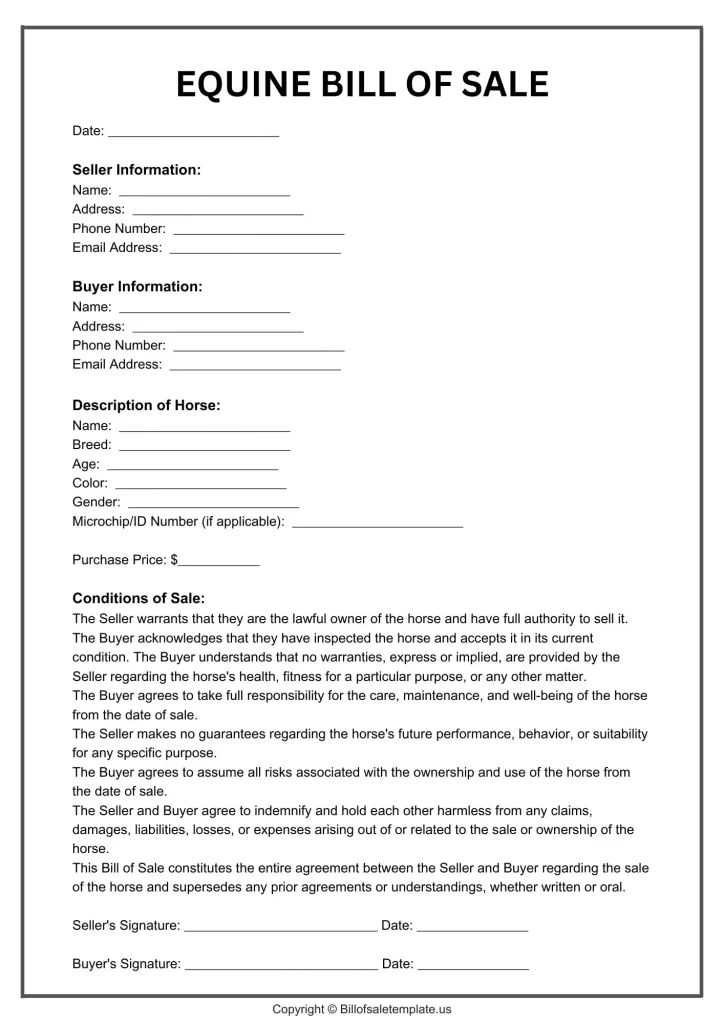
A simple Equine Bill of Sale can be suitable for a straightforward transaction where the buyer and seller do not need extensive contractual provisions. At a minimum, it should identify the parties, identify the horse, state the purchase price and date, describe the condition and terms of sale, and contain both parties’ signatures.
For a higher-value horse or a transaction involving special promises, financing, breeding rights, or significant health considerations, a more detailed agreement may be appropriate.
Free Equine Bill of Sale Form
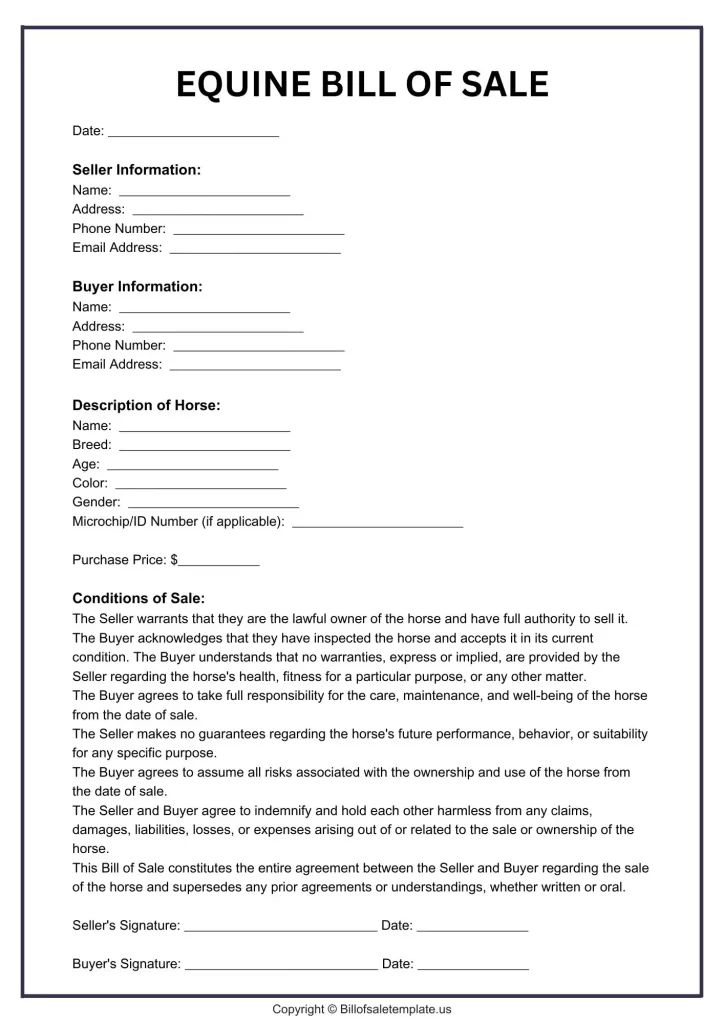
A free Equine Bill of Sale form can help buyers and sellers organize the most important details of a horse transaction in one place. After completing the form, both parties should review the information, sign the agreement, and retain a copy for their records.
Health and Veterinary Information
A horse’s health can be one of the most important aspects of an equine transaction. The agreement should provide enough space to document material information known to the seller.
Consider including:
- Current health status
- Recent veterinary examination
- Vaccination records
- Current medications
- Previous surgeries
- Known injuries
- Chronic conditions
- Dental history
- Farrier history
- Allergies
- Dietary requirements
- Behavioral concerns
- Current treatments
Pre-Purchase Veterinary Examination
The buyer may choose to have a veterinarian examine the horse before completing the purchase. The agreement can state whether:
- A veterinary examination was completed;
- The buyer declined an examination;
- The sale is conditional on satisfactory veterinary results; or
- The buyer accepts the horse based on an examination already performed.
The exact arrangement should be recorded in writing.
Representations, Warranties, and Disclaimers
A strong Equine Bill of Sale should clearly distinguish between facts disclosed by the seller, warranties provided by the seller, and conditions accepted by the buyer.
Seller’s Representations
The seller may confirm that:
- They have the legal authority to sell the horse.
- The horse’s identifying information is accurate to the best of their knowledge.
- Known material health conditions have been disclosed.
- Any known liens or ownership interests have been disclosed.
- Registration documents provided with the sale are accurate.
Buyer’s Acknowledgment
The buyer may acknowledge that:
- They have had an opportunity to inspect the horse.
- They understand the horse’s disclosed condition.
- They have had an opportunity to obtain an independent veterinary examination.
- They agree to the written terms of the transaction.
As-Is Transactions
When applicable, an as-is provision can state that the horse is being purchased in its existing condition and that no additional warranties apply except those specifically written into the agreement.
However, an as-is clause does not necessarily eliminate every legal obligation or protect against fraud, misrepresentation, or obligations imposed by applicable law.
Additional Terms Worth Including
Depending on the transaction, an Equine Bill of Sale may also address:
Trial Period
If the buyer is allowed to take the horse on trial, specify:
- Trial period
- Location
- Trial conditions
- Who pays expenses
- Veterinary requirements
- Return conditions
- Transportation responsibilities
Breeding Rights
For breeding horses, specify:
- Breeding rights
- Number of breeding services
- Stallion or mare rights
- Frozen or fresh semen arrangements
- Foal ownership
- Registration requirements
Competition and Performance
If the horse is being purchased for competition, the agreement may record relevant information about:
- Training
- Competition history
- Performance records
- Discipline
- Current level of training
- Known limitations
Transportation
Clearly identify who is responsible for transportation expenses and risk while the horse is being moved.
Registration Papers
State whether registration certificates, transfer forms, health certificates, Coggins/test records, passports, or other documents are included.
How to Notarize an Equine Bill of Sale
Notarization is not automatically required for every horse transaction. Whether it is necessary depends on applicable law, registry requirements, and the terms of the transaction.
If notarization is desired or required, the general process is:
Step 1: Complete the Form
Enter all relevant buyer, seller, horse, payment, and transaction information.
Step 2: Review the Agreement
Check names, dates, purchase price, horse identification numbers, health disclosures, and special conditions carefully.
Step 3: Do Not Sign Before the Notary
If the notary must witness the signatures, wait until the signing appointment before signing.
Step 4: Bring Identification
The parties should bring acceptable government-issued identification as required by the notary.
Step 5: Sign the Agreement
Sign the document in accordance with the notary’s instructions.
Step 6: Notary Verification
The notary verifies the identity of the signers and completes the applicable notarial certificate.
Step 7: Keep Copies
Both buyer and seller should retain a completed copy of the signed agreement and any supporting documents.
Important Considerations Before Selling or Buying a Horse
Verify Ownership
The buyer should confirm that the seller has the right to sell the horse and that there are no undisclosed ownership interests or liens.
Match the Horse to the Documents
Verify the horse’s registered name, markings, registration number, microchip number, and other identifying details against the actual animal and supporting records.
Review Health Records
Ask for relevant veterinary, vaccination, dental, farrier, and medication records before completing the transaction.
Consider a Veterinary Examination
For a significant purchase, an independent pre-purchase veterinary examination can provide valuable information about the horse’s condition.
Put Important Promises in Writing
If the seller makes an important statement about the horse’s health, training, temperament, breeding ability, or performance, consider documenting it in the agreement.
Document Payment
Keep receipts, bank-transfer confirmations, canceled checks, or other evidence showing how and when payment was made.
Clarify Transportation
Determine who will arrange and pay for transportation and when responsibility for the horse transfers to the buyer.
Check Registration Requirements
If the horse is registered with a breed association or competition organization, check its specific ownership-transfer requirements.
Follow Local Requirements
Horse-sale laws and documentation requirements can differ by jurisdiction. Buyers and sellers should check the applicable state or local rules before relying on a generic form.
Benefits of an Equine Bill of Sale
An Equine Bill of Sale provides several practical benefits:
- Documents the Transaction: Creates a written record of the sale.
- Establishes the Parties: Clearly identifies the buyer and seller.
- Identifies the Horse: Records details that distinguish the horse from other animals.
- Records the Purchase Price: Documents the agreed financial terms.
- Clarifies Condition: Records health disclosures and agreed condition terms.
- Reduces Disputes: Gives both parties a written reference if disagreements arise.
- Supports Registration: May assist with ownership transfer through a breed registry or other organization.
- Documents Payment: Creates a record of the payment arrangement.
- Clarifies Responsibility: Establishes agreed delivery and transfer terms.
- Supports Future Resale: Gives the buyer documentation that can be useful when the horse is later sold.
- Provides Additional Protection: Written representations and agreed terms can help protect both parties, subject to applicable law.
- Creates a Permanent Record: Both parties can retain the agreement with their other transaction documents.
FAQs
1. What is an Equine Bill of Sale?
An Equine Bill of Sale is a written document that records the sale and transfer of ownership of a horse or other equine animal. It identifies the buyer, seller, horse, purchase price, transaction date, and other agreed terms.
2. What information should be included in an Equine Bill of Sale?
A comprehensive form should generally include:
- Buyer and seller information
- Horse’s name and identifying details
- Breed, sex, age, color, and markings
- Registration or microchip number, if applicable
- Purchase price
- Payment terms
- Health and condition disclosures
- Warranties or as-is terms
- Delivery arrangements
- Special conditions
- Buyer and seller signatures
3. Do I need a Bill of Sale when buying a horse?
A written bill of sale is strongly recommended because it creates a clear record of the transaction and the agreed terms. Specific legal or registration requirements can vary by jurisdiction and organization.
4. Does an Equine Bill of Sale prove ownership?
It can serve as important evidence of a purchase and ownership transfer, but it may not replace a title, registration certificate, or other ownership documents required by a particular registry or jurisdiction.
5. Should I get a veterinary examination before buying a horse?
For many horse purchases, particularly higher-value transactions, an independent pre-purchase veterinary examination can be useful. It allows the buyer to better understand the horse’s health and condition before completing the transaction.
6. Can a horse be sold “as-is”?
Yes, a horse can be sold subject to an as-is agreement where permitted by applicable law. The agreement should clearly explain the condition accepted by the buyer. An as-is clause should not be used to conceal known problems or override legal protections.
7. Should an Equine Bill of Sale be notarized?
Not necessarily. Notarization requirements vary depending on the jurisdiction and circumstances. Even when notarization is not mandatory, the parties may choose it as an additional form of authentication.
8. Can I use a free Equine Bill of Sale template?
Yes. A free template can provide a useful starting point for documenting a horse transaction. However, it should be reviewed and customized to reflect the actual horse, transaction terms, and applicable local requirements.
9. Who should keep the Equine Bill of Sale?
Both the buyer and seller should retain a signed copy. The buyer may need it for registration, insurance, transportation, resale, or ownership records, while the seller can retain it as evidence of the completed transaction.
10. What if the horse has a registration certificate?
If the horse is registered with a breed registry, the buyer and seller should check the registry’s transfer procedure. The bill of sale may be used alongside the registry’s required ownership-transfer documents.
11. What happens if the horse has a known medical condition?
Known material medical conditions should be disclosed accurately and, where appropriate, recorded in the bill of sale. Buyers should consider obtaining veterinary advice before completing the purchase.
12. Can special conditions be added to an Equine Bill of Sale?
Yes. Parties can include appropriate additional terms covering trial periods, breeding rights, transportation, registration, warranties, payment arrangements, return conditions, or other mutually agreed matters.

Ted Cruz is the founder and driving force behind BillofSaleTemplate.us, a comprehensive resource for free bill of sale templates tailored to meet a variety of needs. With a keen understanding of the importance of accurate and legally sound documentation, Ted has dedicated his expertise to providing accessible and user-friendly templates for all types of transactions, from vehicle sales to personal property exchanges.
Recognizing the diverse legal requirements across different states, Ted has meticulously crafted state-specific bill of sale templates to ensure compliance and ease of use for users nationwide. His commitment to simplifying the process of creating reliable and legally binding documents has made BillofSaleTemplate.us a trusted platform for individuals and businesses alike.