![Free Bill of Sale Template PDF, Word [United States]](https://billofsaletemplate.us/wordpress/wp-content/webp-express/webp-images/uploads/2024/06/bill-of-sale-Logo-1.png.webp)
Buying or selling a trailer is an important transaction that should always be documented properly. Whether you’re purchasing a utility trailer, cargo trailer, boat trailer, travel trailer, or homemade trailer, having a Trailer Bill of Sale protects both the buyer and the seller by creating a written record of the sale.
Many people assume that a simple handshake or verbal agreement is enough when transferring ownership of a trailer. While an oral agreement may be valid in some situations, it often creates problems later if ownership, payment, taxes, or registration are questioned. A properly completed Trailer Bill of Sale Form provides clear evidence of the transaction and helps avoid legal disputes.
If you’re planning to register a trailer, transfer ownership, or prove that a trailer was legally purchased, this document is one of the most important records you can have. It includes the trailer’s identification details, the agreed purchase price, the names of both parties, and the date of sale, making it an essential part of the ownership transfer process.
Free Trailer Bill of Sale Template
A Trailer Bill of Sale Template provides a simple way to document the transfer of ownership between a buyer and seller. It can be used for private sales involving most trailer types, including utility trailers, enclosed trailers, cargo trailers, livestock trailers, boat trailers, travel trailers, and flatbed trailers.
The document should be completed before the trailer changes hands. Both parties should review every section carefully to ensure all information is accurate.
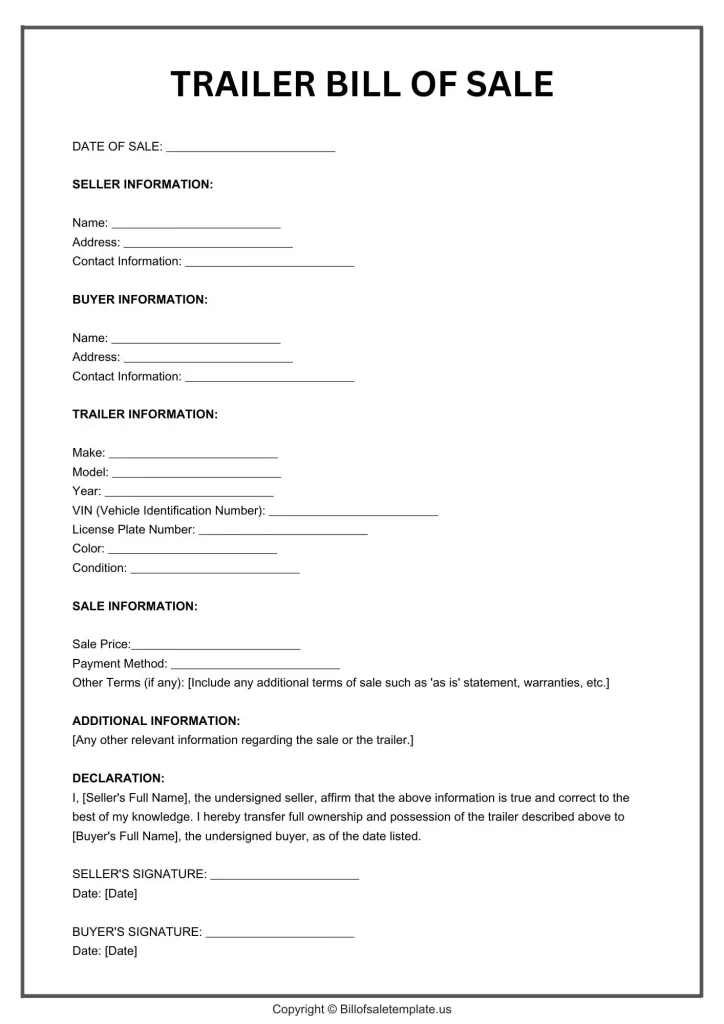
What Is a Trailer Bill of Sale?
A Trailer Bill of Sale is a legal document that records the transfer of ownership of a trailer from one person or business to another. It acts as written proof that a sale has taken place and documents the terms agreed upon by both parties.
Unlike a receipt, a Bill of Sale for Trailer contains detailed information about the trailer, the buyer, the seller, and the financial terms of the transaction. This information helps government agencies verify ownership during registration and can also be used to resolve disputes if questions arise later.
Whether you’re selling a trailer privately or purchasing one from an individual, completing a Trailer Sale Contract is considered a best practice and, in many jurisdictions, is required as part of the registration process.
Types of Trailers Covered
A Trailer Bill of Sale can be used for many different trailer types, including:
| Trailer Type | Common Use |
|---|---|
| Utility Trailer | Landscaping, equipment, and general hauling |
| Cargo Trailer | Commercial transportation and enclosed storage |
| Boat Trailer | Transporting boats and watercraft |
| Travel Trailer | Recreational camping and travel |
| Flatbed Trailer | Construction equipment and machinery |
| Livestock Trailer | Transporting animals |
| ATV Trailer | Carrying ATVs and recreational vehicles |
| Motorcycle Trailer | Transporting motorcycles |
| Car Hauler Trailer | Vehicle transportation |
| Homemade Trailer | Custom-built trailers requiring registration |
Regardless of the trailer type, documenting the transaction with a Trailer Ownership Document protects everyone involved.
Why Is a Trailer Bill of Sale Important?
Many buyers only realize the importance of a Trailer Bill of Sale Form when they attempt to register the trailer and discover that important information is missing. A complete and accurate document serves several important purposes beyond simply recording the sale.
1. Provides Proof of Ownership
One of the primary purposes of a Trailer Bill of Sale is establishing proof that ownership has changed from the seller to the buyer.
Without documentation, proving ownership can become difficult if:
- The original owner cannot be contacted.
- Registration records are incomplete.
- The trailer is reported stolen.
- Multiple parties claim ownership.
A signed bill of sale creates a permanent record that can help resolve these issues.
2. Supports Trailer Registration
Most registration authorities require documentation proving how the trailer was acquired. A Trailer Bill of Sale Template often serves as one of the primary documents needed during registration.
Depending on your jurisdiction, you may also need:
- Existing title or ownership certificate
- Vehicle Identification Number (VIN)
- Government-issued identification
- Registration application
- Proof of insurance (if required)
- Payment of taxes and registration fees
Having a properly completed bill of sale helps streamline the registration process and reduces the likelihood of delays.
3. Protects Both Buyer and Seller
A properly prepared Trailer Purchase Agreement protects both parties involved in the transaction.
Buyer Protection
The buyer benefits because the document confirms:
- The agreed purchase price
- Date of purchase
- Trailer specifications
- Seller information
- Transfer of ownership
- Condition of the trailer at the time of sale
Seller Protection
The seller benefits by documenting:
- The date ownership transferred
- The buyer’s identity
- The amount paid
- Any “as-is” sale terms
- Release of future responsibility for the trailer
This documentation may help protect the seller if the trailer is involved in accidents, parking violations, or legal disputes after the sale.
4. Helps Prevent Fraud
Trailer theft and fraudulent sales occur more frequently than many buyers realize. Completing a Trailer Bill of Sale with accurate identifying information helps reduce the risk of fraud.
Always verify:
- VIN number
- Seller identification
- Registration documents
- Ownership records (where available)
- Trailer serial numbers
- Existing liens, if applicable
Matching all identifying information before payment can help avoid purchasing a trailer that cannot legally be transferred.
5. Creates a Legal Record of the Transaction
A written record is often easier to rely on than verbal agreements.
A complete Trailer Sale Contract documents:
- Date of sale
- Purchase price
- Trailer description
- Buyer details
- Seller details
- Signatures
- Any warranties or “as-is” terms
If disagreements arise in the future, this document may serve as important evidence of the transaction.
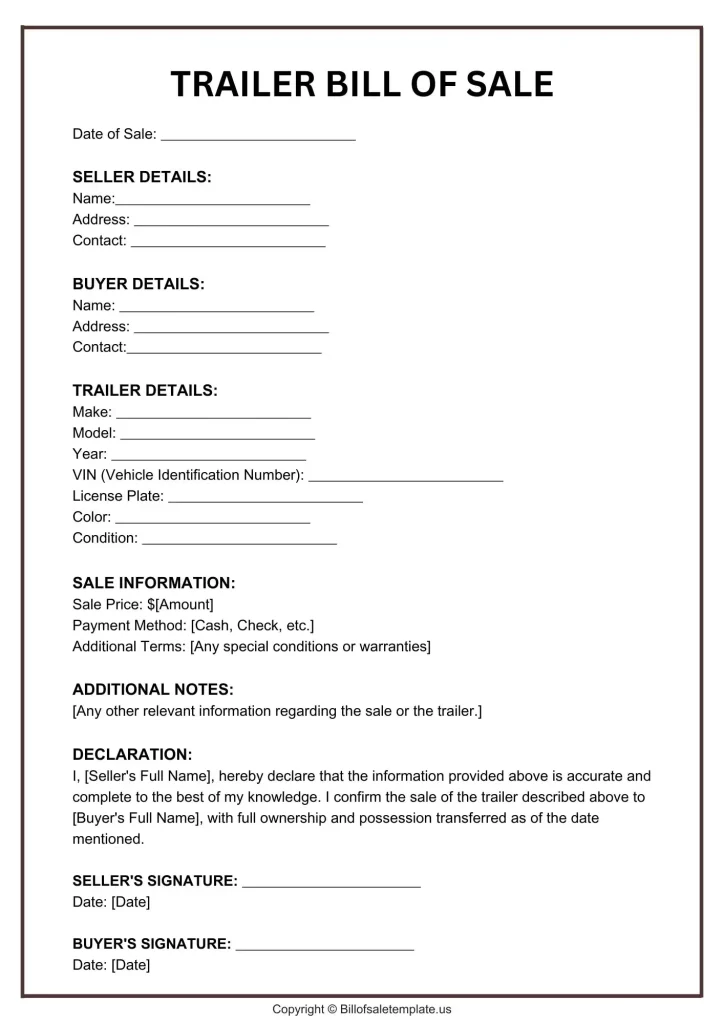
When Do You Need a Trailer Bill of Sale?
A Trailer Bill of Sale is recommended whenever ownership of a trailer changes, even if local laws do not explicitly require one.
The document is commonly used in the following situations:
| Situation | Bill of Sale Recommended? |
| Private trailer sale | Yes |
| Buying a used trailer | Yes |
| Selling a utility trailer | Yes |
| Purchasing a travel trailer | Yes |
| Homemade trailer registration | Yes |
| Gifting a trailer | Yes |
| Family ownership transfer | Yes |
| Trailer donation | Yes |
| Commercial trailer sale | Yes |
| Estate transfer | Often Required |
Even when not legally mandatory, keeping a signed Printable Trailer Bill of Sale provides valuable protection for both parties.
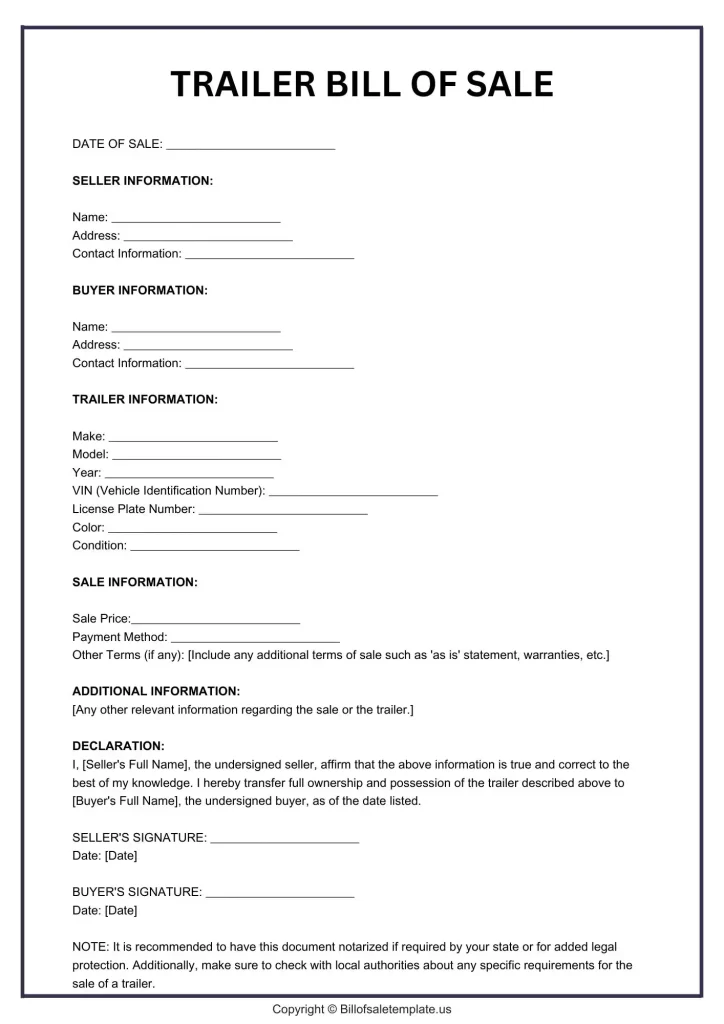
Is a Trailer Bill of Sale Legally Required?
Whether a Trailer Bill of Sale Form is legally required depends on the laws of the state, province, or territory where the trailer will be registered.
In many jurisdictions, the bill of sale is required when:
- Registering a trailer
- Paying sales or transfer taxes
- Applying for a title
- Assigning a VIN to a homemade trailer
- Resolving ownership disputes
- Correcting registration records
Some locations may also require additional supporting documents, such as:
- Certificate of Title
- Vehicle Registration
- Manufacturer’s Certificate of Origin (MCO/MSO)
- Lien Release (if applicable)
- Odometer disclosure (generally not required for trailers)
- Safety inspection documents (where applicable)
Before completing the sale, buyers should verify the registration requirements with their local motor vehicle authority to ensure all necessary paperwork is available.
Legal Requirements for a Valid Trailer Bill of Sale
Although requirements vary by jurisdiction, a legally effective Trailer Bill of Sale should generally include the following essential information.
| Required Information | Why It Matters |
| Buyer’s full legal name | Identifies the new owner |
| Seller’s full legal name | Confirms legal ownership transfer |
| Complete addresses | Contact information for both parties |
| Trailer make and model | Identifies the trailer |
| Year of manufacture | Helps distinguish similar models |
| Vehicle Identification Number (VIN) | Primary identification number |
| Purchase price | Required for tax calculations |
| Date of sale | Establishes ownership transfer date |
| Payment method | Documents financial transaction |
| Trailer condition | Reduces future disputes |
| Buyer signature | Confirms acceptance |
| Seller signature | Confirms transfer of ownership |
The more complete the document, the easier it will be to register the trailer and prove ownership if questions arise in the future.
Trailer Registration Requirements After the Sale
Completing a Trailer Bill of Sale is only one step in the ownership transfer process. After purchasing a trailer, the buyer is generally responsible for registering it with the appropriate motor vehicle authority before using it on public roads, if registration is required in their jurisdiction.
Registration laws vary by state, province, or territory, but most agencies require proof that the trailer was legally purchased. A properly completed Trailer Bill of Sale Form is one of the most commonly accepted ownership documents during registration.
Failure to register the trailer within the required timeframe may result in late fees, penalties, or restrictions on legally operating the trailer.
Documents Commonly Required for Trailer Registration
While requirements differ by jurisdiction, you will typically need the following:
| Required Document | Purpose |
|---|---|
| Trailer Bill of Sale | Proof of purchase and ownership transfer |
| Government-issued Photo ID | Verifies the buyer’s identity |
| Certificate of Title (if applicable) | Establishes legal ownership |
| Current Registration or Ownership Certificate | Confirms previous ownership |
| Vehicle Identification Number (VIN) | Used to identify the trailer |
| Registration Application | Required by the licensing authority |
| Proof of Insurance (where required) | Necessary in some jurisdictions |
| Payment of Taxes and Registration Fees | Required before registration is issued |
Some jurisdictions may request additional documents for imported, rebuilt, or homemade trailers.
Step-by-Step Trailer Registration Process
Although procedures vary by location, the registration process generally follows these steps.
Step 1: Complete the Trailer Bill of Sale
Both the buyer and seller should complete every section of the Trailer Bill of Sale Template before the trailer changes ownership.
Review the following carefully:
- VIN
- Make
- Model
- Year
- Purchase price
- Date of sale
- Signatures
Even a small mistake can delay registration.
Step 2: Gather Supporting Documents
Before visiting your local licensing office, organize all required paperwork.
This may include:
- Signed Bill of Sale
- Title or ownership document
- Existing registration
- Identification
- Proof of insurance (if required)
- Tax payment documents
Keeping everything together helps prevent multiple trips to the registration office.
Step 3: Submit Your Registration Application
Visit your local licensing authority or motor vehicle agency and submit all required documentation.
The registration office will review:
- Ownership documents
- Trailer identification
- VIN
- Tax calculations
- Registration eligibility
If everything is accurate, your application will move forward for processing.
Step 4: Pay Applicable Taxes and Fees
Most jurisdictions require buyers to pay applicable taxes and registration fees before ownership is officially transferred.
The amount depends on factors such as:
- Purchase price
- Trailer type
- Weight
- Location
- Registration class
Always keep copies of payment receipts with your ownership documents.
Step 5: Receive Registration Documents
Once approved, you may receive:
- Registration certificate
- Trailer license plate
- Registration sticker (if applicable)
- Updated ownership records
Store these documents safely, as they may be required during inspections or future sales.
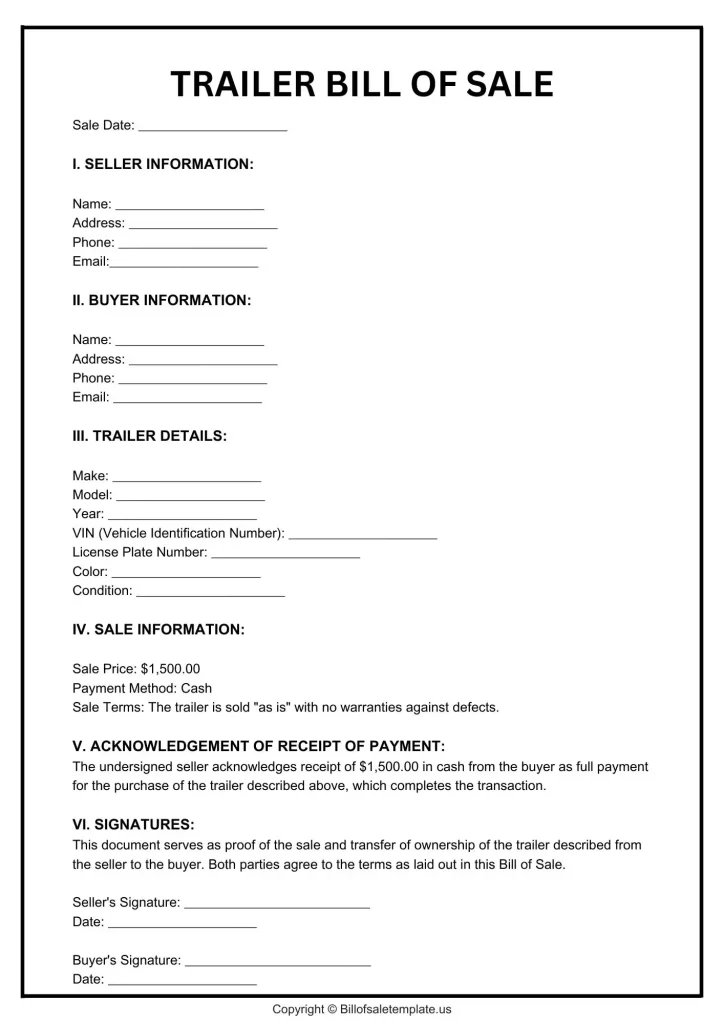
Information That Must Be Included on a Trailer Bill of Sale
A complete Trailer Bill of Sale should accurately describe both the transaction and the trailer being sold. Omitting important information can create registration delays or future ownership disputes.
1. Buyer Information
Include:
- Full legal name
- Residential address
- City, State/Province, ZIP or Postal Code
- Phone number
- Email address (optional)
Avoid using nicknames or abbreviations that do not match official identification.
2. Seller Information
The seller should provide:
- Full legal name
- Complete mailing address
- Contact number
- Email address (optional)
The seller’s information confirms who transferred ownership.
3. Trailer Description
Accurate trailer identification is essential.
Include:
- Year
- Make
- Model
- Body style
- Trailer type
- Color
- Empty weight (if known)
- Gross Vehicle Weight Rating (GVWR), if available
- Number of axles
- Length
- VIN (Vehicle Identification Number)
The VIN is the single most important identifying detail on the form.
4. Vehicle Identification Number (VIN)
The Vehicle Identification Number (VIN) uniquely identifies a trailer.
Before signing the document:
- Compare the VIN on the trailer with the VIN on the title or registration.
- Verify every letter and number.
- Never estimate or guess missing characters.
- Ensure there are no alterations or signs of tampering.
A missing or incorrect VIN can prevent registration and may raise concerns about the trailer’s ownership history.
5. Purchase Price
Record the exact amount paid for the trailer.
Include:
- Total purchase price
- Currency
- Deposit amount (if applicable)
- Remaining balance
- Payment method
Examples of payment methods include:
- Cash
- Certified check
- Personal check
- Bank transfer
- Cashier’s check
- Electronic payment
The purchase price is often used to calculate taxes and registration fees.
6. Date of Sale
The date of sale establishes when ownership officially changed.
This date may also determine:
- Registration deadlines
- Tax obligations
- Liability for future incidents
- Warranty periods (if applicable)
Always use the actual date the transaction occurred.
7. Condition of the Trailer
The condition section documents the trailer’s status at the time of sale.
Include details such as:
- New
- Used
- Good condition
- Fair condition
- Needs repair
If known, describe:
- Rust
- Structural damage
- Tire condition
- Brake issues
- Lighting defects
- Electrical problems
- Suspension repairs
- Missing parts
Being transparent reduces the likelihood of future disputes.
8. “As-Is” Clause
Private trailer sales are commonly completed on an “As-Is” basis.
An “As-Is” clause generally means:
- The buyer accepts the trailer in its current condition.
- No future repairs are guaranteed.
- No warranties are provided unless specifically stated.
Example wording:
“The trailer is sold As-Is, with no warranties or guarantees expressed or implied. The buyer has inspected the trailer and accepts its current condition.”
This clause can help protect the seller while encouraging buyers to inspect the trailer before purchase.
9. Signatures
The transaction should be signed by both parties.
Required signatures typically include:
- Seller
- Buyer
Optional signatures:
- Witness
- Notary Public (only if required locally)
Unsigned documents may not be accepted during registration.
How to Fill Out a Trailer Bill of Sale (Step-by-Step)
Completing the form carefully helps ensure a smooth ownership transfer.
Step 1 – Enter Buyer and Seller Details
Write the complete legal names and addresses of both parties.
Double-check spelling against government-issued identification.
Step 2 – Describe the Trailer
Provide complete trailer details, including:
- Year
- Make
- Model
- VIN
- Color
- Trailer type
- Weight (if known)
Accurate descriptions help distinguish the trailer from similar models.
Step 3 – Record the Sale Price
Write the agreed purchase price exactly as paid.
Do not leave this section blank.
If the trailer is being gifted, indicate “Gift” where permitted and comply with local regulations.
Step 4 – Document the Trailer’s Condition
Describe the trailer honestly.
Examples include:
- Recently serviced
- Minor cosmetic scratches
- Tires replaced
- Brake system repaired
- Electrical wiring updated
- Frame in excellent condition
Providing accurate condition details benefits both parties.
Step 5 – Include Additional Terms
If the parties agree to special conditions, include them in writing.
Examples:
- Spare tire included
- Tool box included
- Winch included
- Hitch included
- Registration fees paid by buyer
- Delivery arranged by seller
Written terms help prevent misunderstandings.
Step 6 – Sign the Document
After reviewing all information:
- Buyer signs
- Seller signs
- Date each signature
Each party should keep an original signed copy.
Common Types of Trailers Covered by a Trailer Bill of Sale
A Trailer Bill of Sale Form can be used for many different trailer categories.
| Trailer Type | Typical Use |
| Utility Trailer | General hauling |
| Cargo Trailer | Commercial transport |
| Enclosed Trailer | Equipment storage |
| Boat Trailer | Boat transportation |
| Travel Trailer | Camping and recreation |
| Horse Trailer | Livestock transport |
| Flatbed Trailer | Construction equipment |
| Car Hauler | Vehicle transport |
| Dump Trailer | Landscaping and construction |
| ATV Trailer | Recreational vehicles |
| Snowmobile Trailer | Winter sports equipment |
| Motorcycle Trailer | Motorcycle transportation |
| Homemade Trailer | Custom-built trailers |
Each trailer type should be accurately described on the Trailer Ownership Document to ensure proper identification.
Tips for Buyers Before Purchasing a Trailer
Buying a trailer is a significant investment. Before signing the Trailer Purchase Agreement, take time to inspect the trailer thoroughly.
Verify Ownership
Ask the seller to provide:
- Current registration
- Title (if applicable)
- Government-issued identification
- Previous ownership documents
Inspect the VIN
Compare the VIN on:
- The trailer frame
- Ownership documents
- Registration records
All VIN numbers should match exactly.
Inspect the Trailer
Look for signs of:
- Rust
- Bent frame
- Cracks
- Tire wear
- Brake damage
- Suspension problems
- Lighting issues
- Floor damage
- Water leaks (travel trailers)
Consider hiring a professional inspector for high-value trailers.
Confirm Outstanding Liens
Before purchasing, verify whether the trailer has any outstanding loans or liens.
Buying a trailer with an unresolved lien may create legal complications after the sale.
Tips for Sellers
Sellers should also take steps to protect themselves during the transaction.
Best practices include:
- Verify the buyer’s identity.
- Complete every section of the Printable Trailer Bill of Sale.
- Remove personal belongings before delivery.
- Record the exact sale date.
- Keep copies of all paperwork.
- Notify the appropriate authority if required by local law.
- Photograph the trailer before transferring possession.
Maintaining thorough records can help resolve future questions regarding ownership or liability.
Taxes and Registration Fees for a Trailer
One of the most important responsibilities after purchasing a trailer is paying any applicable taxes and registration fees. These charges vary depending on your state, province, or territory, as well as the type, weight, and intended use of the trailer.
A completed Trailer Bill of Sale serves as the primary document used by registration authorities to verify the purchase price and calculate taxes. Providing inaccurate information may result in delays, reassessments, penalties, or legal consequences.
What Taxes May Apply?
Depending on your jurisdiction, buyers may be required to pay one or more of the following:
| Tax or Fee | Description |
|---|---|
| Sales Tax | Charged based on the purchase price or fair market value, depending on local laws. |
| Registration Fee | Required to legally register the trailer for road use. |
| License Plate Fee | Covers the issuance of a trailer license plate where applicable. |
| Title Fee | Charged when issuing or transferring a title document. |
| VIN Inspection Fee | May apply if the trailer requires VIN verification. |
| Weight-Based Fee | Some jurisdictions calculate registration fees according to the trailer’s weight. |
Always check with your local motor vehicle agency for the most current fee schedule.
Homemade Trailer Registration
Registering a homemade trailer usually involves additional documentation because there is no manufacturer-issued title or original ownership record.
If you built the trailer yourself or purchased an unfinished project, you’ll likely need to demonstrate that the trailer was legally constructed using properly acquired materials.
Additional Documents That May Be Required
Registration authorities may ask for:
- Completed Trailer Bill of Sale
- Receipts for major components
- VIN assignment application
- Weight certificate
- Inspection certificate
- Photographs of the completed trailer
- Construction details or build specifications
Because requirements differ by jurisdiction, it’s a good idea to contact your local licensing office before applying.
VIN Assignment
Most homemade trailers must be assigned a Vehicle Identification Number (VIN) before registration.
During this process, officials may inspect the trailer to verify:
- Construction quality
- Safety features
- Frame design
- Axle configuration
- Lighting equipment
- Brake system (where required)
Once approved, a VIN plate or decal is issued and permanently attached to the trailer.
Common Mistakes That Can Delay Registration
Even a well-prepared Trailer Bill of Sale Form can be rejected if important information is missing or incorrect.
Avoid these common mistakes to ensure a smoother registration process.
1. Incorrect VIN
The VIN is the most critical identifier on the form.
Common errors include:
- Missing digits
- Transposed numbers
- Incorrect letters
- Illegible handwriting
Always compare the VIN on the trailer with the ownership documents before signing.
2. Missing Signatures
Both buyer and seller should sign the document.
An unsigned Bill of Sale for Trailer may not be accepted by the registration authority and could delay the ownership transfer.
3. Incomplete Buyer or Seller Information
Leaving out names, addresses, or contact details can create problems if ownership is later questioned.
Use full legal names exactly as they appear on government-issued identification.
4. Incorrect Purchase Price
The purchase price should accurately reflect the amount paid.
Reporting an incorrect value may:
- Delay registration
- Trigger additional verification
- Result in tax reassessments
- Lead to financial penalties
5. Missing Trailer Description
The trailer description should include enough detail to clearly identify the unit.
Important information includes:
- Make
- Model
- Year
- VIN
- Color
- Trailer type
- Number of axles
- Length (if available)
6. Forgetting to Keep Copies
Both parties should keep signed copies of the Trailer Bill of Sale for their records.
Electronic copies should also be stored securely in case the original document is lost.
Bill of Sale vs. Title vs. Registration
These three documents are often confused, but each serves a different purpose.
| Document | Purpose | Who Issues It? |
| Trailer Bill of Sale | Records the sale and transfer of ownership | Buyer and Seller |
| Certificate of Title | Establishes legal ownership (where applicable) | Motor Vehicle Authority |
| Trailer Registration | Authorizes legal operation on public roads | Registration Agency |
Trailer Bill of Sale
The Trailer Bill of Sale documents the transaction itself, including:
- Buyer information
- Seller information
- Purchase price
- Trailer description
- Date of sale
- Signatures
It serves as proof that the sale occurred.
Certificate of Title
Where titles are issued, the certificate identifies the legal owner of the trailer.
The title may also show:
- VIN
- Owner’s name
- Lienholder information
- Title number
Trailer Registration
Registration allows the trailer to be legally used on public roads where required.
Registration typically includes:
- Registration certificate
- License plate
- Expiration date
- Registration number
Can You Sell a Trailer Without a Title?
Whether a trailer can be sold without a title depends on local laws.
Some jurisdictions do not issue titles for certain types of trailers or trailers below a specific weight.
If a title is unavailable, buyers may still need:
- Trailer Bill of Sale
- Current registration
- VIN verification
- Ownership declaration
- Supporting documentation required by the registration authority
Before purchasing a trailer without a title, verify the applicable requirements to avoid registration problems later.
Buying a Used Trailer: Best Practices
Purchasing a used trailer can save money, but it also requires careful inspection and documentation.
Before completing the transaction:
Verify Ownership
Ask the seller for:
- Current registration
- Title (if applicable)
- Government-issued identification
- Previous ownership documents
Inspect the Trailer
Examine the trailer for:
- Frame damage
- Rust or corrosion
- Bent axles
- Worn tires
- Suspension issues
- Brake system condition
- Electrical wiring
- Lights and reflectors
- Hitch and coupler condition
- Safety chains
A detailed inspection helps identify potential repairs before purchase.
Confirm the VIN
Verify that the VIN:
- Matches the ownership documents
- Has not been altered
- Is permanently attached to the trailer
- Is clearly legible
Check for Outstanding Liens
If a lender has a financial interest in the trailer, ownership may not transfer until the lien is satisfied.
Request documentation showing that any liens have been released before completing the purchase.
Selling a Trailer: Best Practices
Sellers can reduce future disputes by preparing the trailer and documentation carefully.
Before the Sale
- Clean the trailer.
- Remove all personal belongings.
- Gather registration documents.
- Locate maintenance records.
- Verify the VIN.
- Prepare a completed Trailer Bill of Sale Template.
During the Sale
- Allow the buyer to inspect the trailer.
- Explain any known defects honestly.
- Record the exact purchase price.
- Have both parties sign the document.
- Exchange copies before the trailer leaves.
After the Sale
Depending on local laws:
- Notify the registration authority.
- Cancel or transfer insurance.
- Keep copies of all paperwork.
- Record the date ownership changed.
How a Trailer Bill of Sale Helps Resolve Disputes
Although most trailer sales proceed without issues, disagreements can arise months or even years later. A properly completed Trailer Bill of Sale provides written evidence of the transaction and can help clarify what both parties agreed to at the time of sale.
Common disputes include:
- Claims of unpaid purchase money
- Questions about the agreed sale price
- Ownership disagreements
- Hidden damage allegations
- Warranty misunderstandings
- Registration issues caused by missing information
A detailed bill of sale can demonstrate:
- The identities of the buyer and seller
- The trailer that was sold
- The purchase price
- The date ownership transferred
- Whether the trailer was sold “As-Is”
- Any additional terms agreed upon in writing
Keeping signed copies of the document is one of the simplest ways to protect both parties if a disagreement occurs.
FAQs
1. What is a Trailer Bill of Sale?
A Trailer Bill of Sale is a legal document that records the sale and transfer of ownership of a trailer from a seller to a buyer. It includes details about the trailer, purchase price, date of sale, and signatures of both parties.
2. Is a Trailer Bill of Sale legally required?
Requirements vary by jurisdiction. Even where it is not mandatory, a Trailer Bill of Sale is strongly recommended because it serves as proof of ownership and simplifies the registration process.
3. Can I handwrite a Trailer Bill of Sale?
Yes. A handwritten bill of sale is generally acceptable if it is clear, complete, and signed by both the buyer and seller. Many people, however, prefer using a printable template to reduce the risk of missing important details.
4. Does a Trailer Bill of Sale need to be notarized?
In many jurisdictions, notarization is not required. However, some states or provinces may have different rules, so always verify local requirements before completing the sale.
5. What information should be included on the form?
A complete Trailer Bill of Sale should include the buyer’s and seller’s names, addresses, trailer description, VIN, purchase price, payment method, sale date, trailer condition, and signatures.
6. Can I register a trailer without a Bill of Sale?
Some jurisdictions allow alternative proof of ownership, but registration is generally much easier with a properly completed Trailer Bill of Sale. Without one, you may be required to provide additional documentation.
7. What should I do if the trailer has no VIN?
If the trailer does not have a VIN, contact your local registration authority. Homemade or custom-built trailers often require a VIN assignment before they can be registered.
8. Is an “As-Is” clause important?
Yes. An “As-Is” clause states that the buyer accepts the trailer in its current condition unless other warranties are specifically provided in writing. This helps reduce misunderstandings after the sale.
9. Should both parties keep a copy?
Absolutely. Both the buyer and seller should retain a signed copy of the Trailer Bill of Sale for their records. Digital scans are also recommended as a backup.
10. Can I use the same Bill of Sale template for different trailer types?
Yes. A standard Trailer Bill of Sale Template can generally be used for utility trailers, cargo trailers, travel trailers, boat trailers, enclosed trailers, livestock trailers, flatbed trailers, and many other trailer types, provided it accurately describes the trailer being sold.
Conclusion
A Trailer Bill of Sale is much more than a simple receipt—it is an essential legal document that records the transfer of ownership, protects both the buyer and seller, and supports the trailer registration process.
Whether you are buying or selling a utility trailer, cargo trailer, travel trailer, boat trailer, flatbed trailer, or homemade trailer, taking the time to complete a detailed Trailer Bill of Sale Form can help prevent future disputes, registration delays, and ownership complications.
Before finalizing the transaction:
- Verify the trailer’s VIN and identifying details.
- Confirm the buyer’s and seller’s information.
- Record the exact purchase price.
- Clearly describe the trailer’s condition.
- Include any additional terms in writing.
- Ensure both parties sign and date the document.
- Keep signed copies for your records.
Using a Free Printable Trailer Bill of Sale Template is one of the easiest ways to document a private trailer sale while creating a clear, organized record that can be used for registration, tax purposes, and proof of ownership.
By following the guidance in this article and completing every section of the form accurately, buyers and sellers can complete a trailer ownership transfer with greater confidence and fewer complications.

Ted Cruz is the founder and driving force behind BillofSaleTemplate.us, a comprehensive resource for free bill of sale templates tailored to meet a variety of needs. With a keen understanding of the importance of accurate and legally sound documentation, Ted has dedicated his expertise to providing accessible and user-friendly templates for all types of transactions, from vehicle sales to personal property exchanges.
Recognizing the diverse legal requirements across different states, Ted has meticulously crafted state-specific bill of sale templates to ensure compliance and ease of use for users nationwide. His commitment to simplifying the process of creating reliable and legally binding documents has made BillofSaleTemplate.us a trusted platform for individuals and businesses alike.