![Free Bill of Sale Template PDF, Word [United States]](https://billofsaletemplate.us/wordpress/wp-content/webp-express/webp-images/uploads/2024/06/bill-of-sale-Logo-1.png.webp)
When you buy or sell a car through a private transaction in Georgia, keeping clear documentation can make the ownership process much easier. A Georgia Automobile Bill of Sale provides a written record of the transaction and identifies the vehicle, buyer, seller, sale price, date, and other important details.
Georgia’s Department of Revenue provides Form T-7, Bill of Sale, for documenting a vehicle transaction. The current form includes sections for vehicle information, seller and purchaser details, lienholders, purchase price, odometer reading, and signatures.
However, there is an important distinction: a bill of sale does not replace the certificate of title when a Georgia title is required. For a titled vehicle, the seller must properly assign the title and the buyer must complete the required title and registration process.
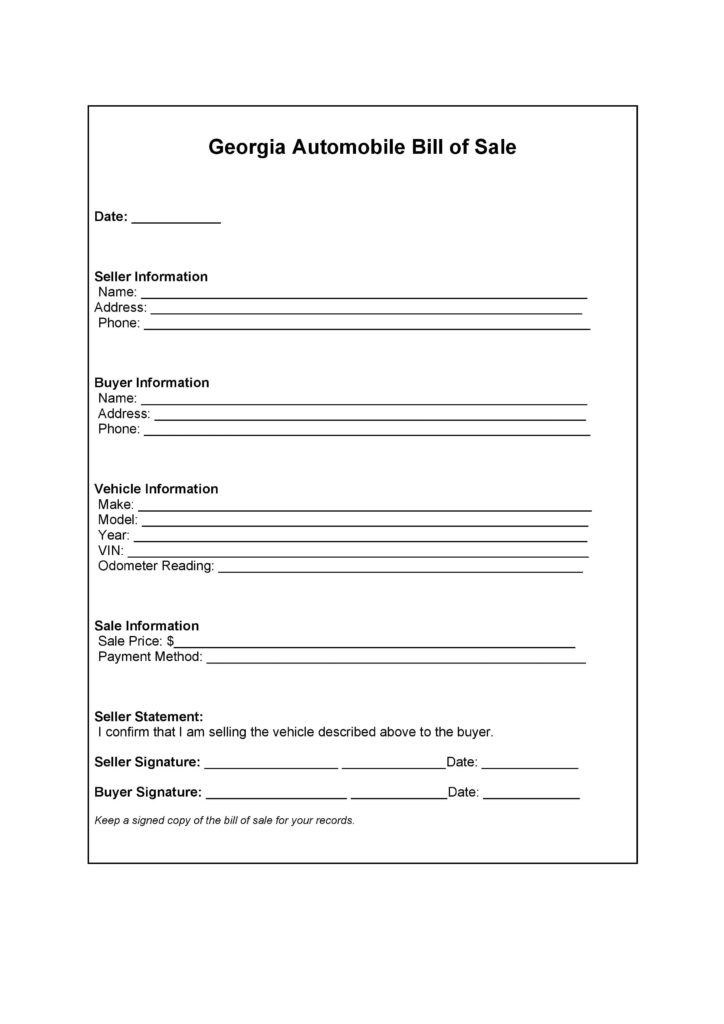
What Is an Automobile Bill of Sale in Georgia?
A Georgia automobile bill of sale is a written document showing that a vehicle was sold or transferred from one party to another.
It can document:
- Buyer’s full legal name
- Seller’s full legal name
- Buyer and seller addresses
- Vehicle identification number (VIN)
- Year
- Make
- Model
- Odometer reading
- Date of sale
- Purchase price
- Lienholder information
- Signatures of the parties
A properly completed bill of sale gives both the buyer and seller a record of the transaction.
Is a Bill of Sale Required When Selling a Car in Georgia?
A bill of sale is not the primary ownership document for a Georgia vehicle that requires a title.
For a titled vehicle, Georgia requires the seller to transfer ownership using the certificate of title. The Georgia Department of Revenue identifies the bill of sale as supporting documentation, while the original properly assigned title serves as proof of ownership for a titled vehicle.
For certain older vehicles that do not require a title, a properly completed bill of sale can serve as proof of ownership. Georgia DOR specifically states that a bill of sale is used for vehicles that are 1985 or older and do not require a title.
Even when it isn’t the primary required document, creating a bill of sale is a practical way to preserve a record of the transaction.
Georgia Form T-7 Bill of Sale
The T-7 Bill of Sale is the Georgia Department of Revenue’s official bill-of-sale form.
The current form is designed to document a transaction and the vehicle’s odometer information. It contains sections for:
- Vehicle information
- Seller/transferor information
- Purchaser/transferee information
- Lienholder or security-interest information
- Certification and signatures
The form should be completed completely and legibly. The Georgia DOR warns that corrections or alterations can void the form.
Georgia Department of Revenue Form T-7
What Information Goes on a Georgia Automobile Bill of Sale?
A complete bill of sale should identify the transaction without leaving important details unclear.
Vehicle Information
Include:
- VIN
- Year
- Make
- Model
- Odometer reading
- Date of sale
- Purchase price
These details are included on the official Georgia T-7 form.
Seller Information
Record:
- Full legal name
- Mailing address
- City
- State
- ZIP code
- County
If the seller is a business, additional tax identification information may be required on Form T-7.
Buyer Information
Include the buyer’s:
- Full legal name
- Mailing address
- City
- State
- ZIP code
- County
The buyer’s legal name should match the identification used for the title and registration process.
Lien Information
If a lender or another party has a security interest in the vehicle, that information should be properly disclosed.
Do not assume that a bill of sale removes a lien.
What Is the Difference Between a Bill of Sale and a Car Title?
These documents serve different purposes.
Bill of Sale
The bill of sale documents the transaction between the buyer and seller.
Certificate of Title
The certificate of title establishes the ownership record for a vehicle that requires a title.
For a Georgia vehicle that requires a title, the seller must properly assign the original title to the buyer.
Simple way to remember it:
Bill of sale = transaction record
Title = ownership document
A buyer should not rely on a bill of sale alone when the vehicle requires a Georgia title.
How to Transfer a Car Title in Georgia
When selling a titled vehicle, the seller and buyer should carefully complete the title assignment.
Georgia DOR instructs sellers to complete the purchaser information, current address, sale date, and odometer reading on the title. The title should be completed using blue or black ink, and alterations or erasures can cause problems.
The seller should also cancel the vehicle’s registration after the sale.
The buyer then becomes responsible for titling and registering the vehicle.
How Long Does a Buyer Have to Register a Car in Georgia?
According to the Georgia Department of Revenue, a buyer purchasing a vehicle through a casual sale must title and register the vehicle within 7 days of the purchase date.
The buyer should visit the appropriate County Tag Office with the required documentation.
Do not wait until the deadline if there is any possibility of a problem with the title or other paperwork.
What Documents Does a Buyer Need?
For a typical casual sale of a titled Georgia vehicle, the buyer may need:
- Original valid title properly assigned
- Completed title assignment
- Form MV-1
- Valid Georgia driver’s license or identification
- Proof of insurance
- Applicable fees and taxes
- Bill of sale when applicable
Georgia DOR lists the required documents and fees for casual-sale title and registration transactions.
The exact documentation can vary depending on the vehicle and circumstances.
Odometer Disclosure on a Georgia Bill of Sale
Odometer information is an important part of a vehicle transaction.
The current Georgia T-7 form requires the seller to disclose the odometer reading and the buyer to acknowledge it when federal odometer-disclosure requirements apply. Vehicles 20 model years old or older are exempt from federal odometer disclosure requirements, according to the current T-7 instructions.
When an odometer disclosure is required, enter the mileage accurately.
Never guess, alter, or intentionally misstate the vehicle’s mileage.
What If the Odometer Reading Is Wrong?
If the mileage shown on the vehicle does not appear accurate, do not simply enter a number without investigating.
Georgia’s T-7 form provides options for situations where the mileage exceeds the mechanical limits of the odometer or where the displayed mileage is not the actual mileage.
An inaccurate odometer statement can create serious problems for both parties.
Does a Georgia Automobile Bill of Sale Need to Be Notarized?
A standard Georgia automobile bill of sale does not generally require notarization.
The more important issue is completing the required title and ownership paperwork correctly.
If a particular transaction involves a special affidavit, court order, power of attorney, or another document with separate notarization requirements, follow the instructions for that document.
Can You Sell a Car in Georgia Without a Bill of Sale?
In many titled-vehicle transactions, the title is the key ownership document and a separate bill of sale is not necessarily the document that transfers ownership.
However, keeping a bill of sale is still useful.
It can provide evidence of:
- Sale date
- Purchase price
- Vehicle identification
- Odometer information
- Buyer and seller
- Other agreed terms
For older vehicles that do not require a title, Georgia DOR specifically recognizes a bill of sale as proof of ownership.
Can a Bill of Sale Replace a Georgia Car Title?
Generally, no.
If the vehicle requires a Georgia certificate of title, the seller needs to properly transfer the title.
A bill of sale does not automatically replace a missing title.
If a seller says, “I don’t have the title, but I can give you a bill of sale,” the buyer should stop and determine why the title is missing before completing the purchase.
What If the Seller Lost the Title?
A missing title should be addressed before completing the transaction whenever possible.
The seller may need to obtain a replacement title or resolve another ownership issue.
A buyer should not assume that a signed bill of sale solves a missing-title problem.
Georgia DOR provides procedures for replacement titles and other title-related situations.
What If There Is a Lien on the Car?
A lien means another party may have a financial or security interest in the vehicle.
Before buying a used car, determine whether:
- A loan is outstanding
- A lienholder is listed
- The loan has been paid off
- A lien release is available
The current T-7 form includes a specific section for lienholders, security-interest holders, or encumbrance holders.
Do not assume that purchasing the vehicle automatically removes a lien.
Can a Used Car Be Sold “As Is”?
A private seller and buyer can document the vehicle’s condition and any agreed “as-is” terms in the bill of sale.
It is helpful to record known issues instead of relying entirely on verbal statements.
For example, the document can identify:
- Existing body damage
- Engine problems
- Transmission issues
- Worn tires
- Electrical faults
- Air-conditioning problems
- Previous accident damage
An as-is statement should not be used to justify fraud or intentional concealment of known problems.
How to Write an Automobile Bill of Sale in Georgia
You can prepare the document by following a simple process.
Step 1: Identify the Seller
Enter the seller’s complete legal name and address.
Step 2: Identify the Buyer
Use the buyer’s full legal name and current address.
Step 3: Describe the Vehicle
Enter the VIN, year, make, and model.
Step 4: Record the Mileage
Enter the accurate odometer reading when disclosure is required.
Step 5: Enter the Sale Date
Use the actual date of the ownership transfer.
Step 6: State the Purchase Price
Record the actual amount agreed upon by the parties.
Step 7: Disclose Liens
Identify any lienholder or security interest when applicable.
Step 8: Add Additional Terms
Document condition, included equipment, warranties, or other agreements.
Step 9: Sign the Document
Both parties should review the information before signing.
Step 10: Keep Copies
The buyer and seller should each retain a signed copy.
Buying a Car From a Private Seller in Georgia
A private-party purchase deserves careful preparation.
Before paying, the buyer should:
- Verify the seller’s identity.
- Confirm the seller owns the vehicle.
- Check the VIN on the car.
- Compare the VIN with the title.
- Review the title for errors.
- Check for liens.
- Inspect the vehicle.
- Review the purchase price.
- Complete the bill of sale.
- Properly complete the title assignment.
- Keep copies of the paperwork.
- Begin the title and registration process promptly.
A few minutes spent checking the documents can prevent significant problems later.
Selling a Car Privately in Georgia
The seller also has responsibilities.
Before handing over the vehicle, the seller should:
- Confirm the buyer’s information
- Complete the title assignment correctly
- Record the sale date
- Complete required odometer information
- Provide a bill of sale when appropriate
- Keep copies of transaction records
- Cancel the vehicle’s registration
Georgia DOR states that the seller must transfer ownership and cancel the registration after selling the vehicle.
Common Georgia Automobile Bill of Sale Mistakes
1. Entering the Wrong VIN
Double-check every character.
2. Using an Incorrect Legal Name
Use the parties’ full legal names.
3. Recording the Wrong Sale Date
Use the actual date of transfer.
4. Misstating the Purchase Price
Document the actual transaction accurately.
5. Guessing the Odometer Reading
Mileage must be disclosed accurately when required.
6. Ignoring Existing Liens
Check whether a lender has an interest in the vehicle.
7. Forgetting the Title
A bill of sale does not replace a required certificate of title.
8. Leaving Fields Blank
Complete the form carefully and legibly.
9. Making Corrections on Form T-7
Georgia’s current T-7 instructions state that corrections or alterations can void the form.
10. Not Keeping a Copy
Both parties should retain their own records.
Georgia Automobile Bill of Sale Checklist
Before completing the transaction, verify:
- Buyer’s full legal name
- Seller’s full legal name
- Buyer address
- Seller address
- Vehicle VIN
- Year
- Make
- Model
- Odometer reading
- Sale date
- Actual purchase price
- Lien information
- Title
- Required signatures
- Buyer copy
- Seller copy
- Insurance information
- Registration and title requirements
Frequently Asked Questions
What is a Georgia automobile bill of sale?
It is a written record documenting the sale or transfer of a motor vehicle between a buyer and seller.
Is Form T-7 the Georgia bill of sale?
Yes. Form T-7 is the Georgia Department of Revenue’s Bill of Sale form for motor vehicle transactions.
Do I need a bill of sale to transfer a car title in Georgia?
The requirements depend on the vehicle and transaction. For a titled vehicle, the properly assigned title is essential. A bill of sale can serve as supporting documentation and is specifically used as proof of ownership for certain vehicles that do not require a title.
Can I sell a car with only a bill of sale?
If the vehicle requires a title, you generally cannot substitute a bill of sale for the required title.
Does the bill of sale need to be notarized?
A standard automobile bill of sale does not generally require notarization.
How long does the buyer have to register a car in Georgia?
For a vehicle purchased through a casual sale, Georgia DOR states that the buyer must title and register the vehicle within 7 days of purchase.
What vehicles can use a bill of sale as proof of ownership?
Georgia DOR states that a bill of sale can be used for a vehicle that is 1985 or older and does not require a title.
Should both parties keep the bill of sale?
Yes. The buyer and seller should each retain a signed copy with their other vehicle records.
Final Thoughts
A Georgia Automobile Bill of Sale is a practical way to document a private vehicle transaction. It puts important information—such as the buyer, seller, VIN, mileage, sale date, purchase price, and lien information—in one place.
But remember that the bill of sale and vehicle title serve different purposes. For vehicles that require a title, the seller must properly assign the title, while the buyer must complete the required title and registration process.
The safest approach is to verify the VIN, inspect the vehicle, check for liens, review the title, record accurate information, and keep copies of everything.
If you are using Georgia’s official paperwork, the current Form T-7 provides a standardized way to document the transaction.
Disclaimer: This article is for general informational purposes and is not legal, tax, or official government advice. Vehicle title, registration, tax, and bill-of-sale requirements can change or vary according to the vehicle and transaction. Always verify the latest requirements with the Georgia Department of Revenue or your local County Tag Office before buying or selling a vehicle.

Ted Cruz is the founder and driving force behind BillofSaleTemplate.us, a comprehensive resource for free bill of sale templates tailored to meet a variety of needs. With a keen understanding of the importance of accurate and legally sound documentation, Ted has dedicated his expertise to providing accessible and user-friendly templates for all types of transactions, from vehicle sales to personal property exchanges.
Recognizing the diverse legal requirements across different states, Ted has meticulously crafted state-specific bill of sale templates to ensure compliance and ease of use for users nationwide. His commitment to simplifying the process of creating reliable and legally binding documents has made BillofSaleTemplate.us a trusted platform for individuals and businesses alike.