![Free Bill of Sale Template PDF, Word [United States]](https://billofsaletemplate.us/wordpress/wp-content/webp-express/webp-images/uploads/2024/06/bill-of-sale-Logo-1.png.webp)
Planning for future medical care is one of the most important decisions you can make for yourself and your family. An Advance Directive Form allows you to document your healthcare wishes before a medical emergency occurs, helping ensure that your preferences are known if you become unable to communicate or make decisions for yourself.
Many people assume that family members will automatically know what treatment they would want. Unfortunately, disagreements often arise during serious illness or injury, especially when there are no written instructions. An advance directive helps reduce uncertainty by clearly stating your wishes and identifying who should make healthcare decisions on your behalf if necessary.
In the United States, advance directives are recognized under state law, while the Patient Self-Determination Act (PSDA) of 1990 requires many healthcare providers to inform patients about their rights to make advance healthcare decisions. Because laws vary by state, the exact signing, witnessing, and notarization requirements may differ depending on where you live.
Whether you are preparing for surgery, managing a chronic condition, planning for retirement, or simply organizing your estate plan, an Advance Directive Form can provide peace of mind for both you and your loved ones.
What Is an Advance Directive?
An Advance Directive is a legal document that allows you to communicate your future healthcare wishes if you become unable to make or express medical decisions.
Depending on your state’s laws, an advance directive may include:
- A Living Will that states your treatment preferences.
- A Medical Power of Attorney (also called a Healthcare Proxy in some states) that appoints someone to make healthcare decisions for you.
- Additional healthcare instructions permitted under state law.
Some states provide a single combined form, while others use separate documents for each purpose.
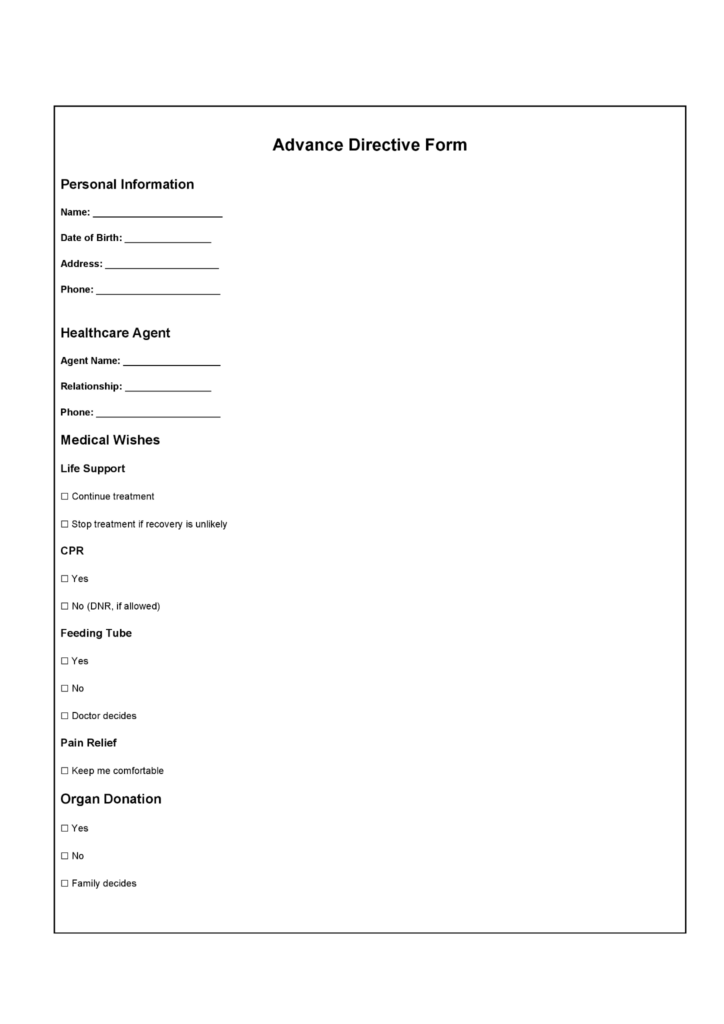
Advance Directive Form Template
What Is Included in an Advance Directive?
Most Advance Directive Forms include two main components:
1. Living Will
A Living Will records your preferences about medical treatment if you are terminally ill, permanently unconscious, or otherwise unable to communicate.
Common topics include:
- CPR
- Mechanical ventilation
- Artificial nutrition and hydration
- Dialysis
- Pain management
- Comfort care
- Organ donation
2. Medical Power of Attorney / Healthcare Proxy
This section appoints a trusted person to make healthcare decisions for you if situations arise that are not specifically covered by your written instructions.
Advance Directive vs. Living Will
|
Feature |
Advance Directive |
Living Will |
|---|---|---|
|
Broad healthcare planning document |
Yes |
No |
|
Includes treatment preferences |
Yes |
Yes |
|
Can appoint a healthcare agent |
Yes |
No |
|
May include additional instructions |
Yes |
Limited |
|
Part of an estate plan |
Yes |
Yes |
Advance Directive vs. Medical Power of Attorney
|
Feature |
Advance Directive |
Medical Power of Attorney |
|---|---|---|
|
May include multiple healthcare documents |
Yes |
No |
|
Appoints a healthcare agent |
Often |
Yes |
|
Provides treatment instructions |
Often |
Not necessarily |
|
Used for broad healthcare planning |
Yes |
More limited |
Why You Should Have an Advance Directive
Advance care planning is not only for older adults. Medical emergencies can happen at any age.
An Advance Directive can help you:
- Choose who will make healthcare decisions for you.
- Document your treatment preferences.
- Reduce stress for family members.
- Prevent disagreements among relatives.
- Support your overall estate plan.
- Ensure your values guide future medical care.
- Provide clarity during emergencies.
- Reduce the likelihood of court involvement.
Who Should Create an Advance Directive?
In general, any competent adult can benefit from having one.
Consider creating an advance directive if you:
- Are 18 or older.
- Are married or have children.
- Own a home or have significant assets.
- Have a chronic medical condition.
- Are planning major surgery.
- Want to reduce uncertainty for loved ones.
- Are updating your estate plan.
Federal Law: The Patient Self-Determination Act
Key Federal Protection
The Patient Self-Determination Act (PSDA) of 1990 requires many healthcare facilities that participate in Medicare or Medicaid to:
- Inform patients about advance directives.
- Ask whether a patient has one.
- Document that information in the medical record.
- Educate staff and the community about advance care planning.
Important: The PSDA does not create one nationwide advance directive form. State laws still determine the legal requirements.
State Law Requirements
Advance directives are governed primarily by state law.
Requirements may vary regarding:
-
Witnesses
-
Notarization
-
Signing procedures
-
Minimum age
-
Mental capacity
-
Revocation
-
Recognition of out-of-state documents
General U.S. Overview
|
Requirement |
Typical Practice |
|---|---|
|
Minimum age |
18+ |
|
Mental capacity |
Required |
|
Witnesses |
Often 2 adults |
|
Notarization |
Required in some states |
|
Revocation |
Generally allowed while competent |
Note: Always follow your state’s specific legal requirements.
Who Can Be Your Healthcare Agent?
Most states allow you to appoint a trusted adult such as:
-
Spouse
-
Adult child
-
Parent
-
Sibling
-
Relative
-
Close friend
-
Another trusted adult
Choose someone who understands your values and is willing to make difficult decisions if necessary.
How to Complete an Advance Directive Form
Completing an Advance Directive Form is one of the most effective ways to communicate your healthcare wishes before a medical emergency occurs. While the exact format varies by state, the general process is similar throughout the United States.
Before filling out the form, take time to think about the types of medical care you would want if you were unable to speak for yourself. Discuss your wishes with your family, healthcare provider, and the person you plan to appoint as your healthcare agent.
Step-by-Step Guide
| Step | What to Do | Why It Matters |
|---|---|---|
| 1 | Download the correct form for your state | State laws and required forms differ. |
| 2 | Enter your personal information | Identifies you as the person creating the directive. |
| 3 | Choose your healthcare agent | Appoints someone to make healthcare decisions if needed. |
| 4 | Name one or more alternate agents | Provides a backup if your primary agent cannot serve. |
| 5 | Record your treatment preferences | Gives guidance about life-sustaining treatment and other healthcare decisions. |
| 6 | Review your state’s witness or notarization requirements | Ensures the document meets legal requirements. |
| 7 | Sign and date the form | Completes the document. |
| 8 | Provide copies to the appropriate people | Makes sure your directive is available when needed. |
Information You’ll Need Before Completing the Form
Preparing the necessary information in advance can make the process easier and help you avoid mistakes.
Personal Information
Most forms ask for:
- Full legal name
- Residential address
- Date of birth
- Telephone number
- Emergency contact (if requested)
Healthcare Agent Information
Include your chosen healthcare agent’s:
- Full legal name
- Address
- Telephone number(s)
- Email address (if requested)
- Relationship to you
It is also a good idea to list one or more alternate agents.
Healthcare Preferences
Your Advance Directive may allow you to provide instructions about:
- CPR (cardiopulmonary resuscitation)
- Mechanical ventilation
- Artificial nutrition and hydration
- Dialysis
- Pain management
- Hospice care
- Organ donation
- Religious or cultural preferences
- Comfort-focused care
Being as clear as possible can help your healthcare team and agent understand your wishes.
Choosing a Healthcare Agent
Selecting the right healthcare agent is one of the most important decisions in your advance care plan.
Qualities of a Good Healthcare Agent
Choose someone who:
- Is at least 18 years old (or otherwise meets your state’s requirements).
- Understands your healthcare values.
- Can remain calm during emergencies.
- Communicates effectively with doctors and nurses.
- Is willing to advocate for your wishes.
- Can make difficult decisions under pressure.
- Is dependable and easy to contact.
Who Can Usually Serve as Your Healthcare Agent?
| Person | Commonly Allowed?* |
|---|---|
| Spouse | Yes |
| Adult child | Yes |
| Parent | Yes |
| Sibling | Yes |
| Relative | Yes |
| Close friend | Yes |
| Trusted adult | Yes |
*State law may impose restrictions, such as prohibiting your treating healthcare provider or certain facility employees from serving as your agent.
Witness and Notary Requirements
There is no single nationwide rule for executing an Advance Directive. Each state establishes requirements.
General U.S. Overview
| Requirement | Typical Practice |
|---|---|
| Minimum age | 18 or older |
| Mental capacity | Required |
| Witnesses | Often two adult witnesses |
| Notarization | Required in some states; optional or not required in others |
| Voluntary signature | Required |
When Does an Advance Directive Become Effective?
Most Advance Directives become effective only when you are unable to make or communicate your own healthcare decisions.
As long as you have decision-making capacity, you continue to make your own medical choices.
When the legal standard for incapacity is met under your state’s law, your healthcare provider and healthcare agent may begin relying on your Advance Directive.
Where Should You Store Your Advance Directive?
Creating the document is only the first step. It should also be easy to locate if it is ever needed.
Best Places to Keep Copies
| Location | Recommendation |
|---|---|
| Home | Keep the original in a secure but accessible place. |
| Healthcare agent | Provide a complete copy. |
| Alternate healthcare agent | Provide a copy. |
| Primary care physician | Ask that it be added to your medical record. |
| Hospital | Provide a copy if you receive ongoing treatment. |
| Trusted family members | Tell them where the original is stored. |
Avoid placing the only original in a safe deposit box that may not be accessible during an emergency.
Updating Your Advance Directive
Your healthcare preferences may change over time. Review your Advance Directive regularly and update it when necessary.
Consider reviewing it after:
- Marriage or divorce
- Birth or adoption of a child
- Death of your healthcare agent
- Moving to another state
- Diagnosis of a serious illness
- Major surgery
- Significant changes in your personal beliefs or treatment preferences
If you make substantial changes, it is often best to complete a new Advance Directive rather than making handwritten edits.
Revoking an Advance Directive
Most states allow you to revoke your Advance Directive as long as you have the legal capacity to do so.
Depending on state law, revocation may be accomplished by:
- Destroying the document.
- Signing a written revocation.
- Executing a new Advance Directive.
- Communicating your intent to revoke in a manner recognized by your state’s law.
After revoking your directive, notify your healthcare agent, family members, physicians, and any healthcare facilities that have copies.
Common Mistakes to Avoid
| Mistake | Why It Can Be a Problem |
|---|---|
| Choosing the wrong healthcare agent | Your wishes may not be followed effectively. |
| Failing to discuss your preferences | Your agent may be unsure how to act. |
| Using the wrong state’s form | It may not satisfy local legal requirements. |
| Forgetting to sign or obtain required witnesses | The document could be challenged. |
| Not naming an alternate agent | Delays may occur if your primary agent is unavailable. |
| Keeping the document hidden | Healthcare providers may not know it exists. |
| Never updating the document | It may no longer reflect your current wishes. |
Advance Directive vs. DNR Order
These documents serve different purposes and should not be confused.
| Feature | Advance Directive | Do Not Resuscitate (DNR) Order |
|---|---|---|
| Legal document created by an individual | Yes | No |
| Medical order issued by a healthcare provider | No | Yes |
| Covers a range of healthcare decisions | Yes | No |
| Specifically addresses CPR | May include preferences | Yes |
| Used in emergencies | Yes | Yes |
A DNR order addresses only whether CPR should be attempted. An Advance Directive covers broader healthcare planning.
Advance Directive vs. POLST
A POLST (Physician Orders for Life-Sustaining Treatment) form is different from an Advance Directive.
| Feature | Advance Directive | POLST |
|---|---|---|
| Intended for all competent adults | Yes | Generally for people with serious illness or frailty, depending on state program |
| Completed by the individual | Yes | Completed with a healthcare provider |
| Expresses future wishes | Yes | Contains current medical orders |
| Travels with the patient | Often | Yes |
| Used by emergency medical personnel | May guide care | Yes, according to state law and program |
Because POLST programs vary by state, ask your healthcare provider whether one is appropriate for your situation.
Conclusion
Creating an Advance Directive Form is one of the most important steps you can take to ensure your healthcare wishes are respected if you become unable to make or communicate medical decisions. Rather than leaving difficult choices to family members during an emotional time, an advance directive provides clear guidance for your healthcare team and the person you trust to act on your behalf.
Although the Patient Self-Determination Act (PSDA) encourages healthcare providers to educate patients about advance directives, the legal requirements for creating and signing these documents are established by state law. For that reason, it’s important to use the correct form for your state and follow all applicable execution requirements, including any witness or notarization rules.
Advance directives are not just for older adults or people with serious illnesses. Any competent adult can benefit from documenting their healthcare preferences and appointing a trusted healthcare agent. Reviewing your directive periodically and updating it after major life events can help ensure it continues to reflect your current wishes.
By combining an Advance Directive with other estate planning documents—such as a Medical Power of Attorney, Living Will, HIPAA Authorization, and Last Will and Testament—you can create a more complete plan that protects both your healthcare decisions and your loved ones.
FAQs
1. What is an Advance Directive Form?
An Advance Directive Form is a legal document that allows you to record your healthcare wishes and, in many states, appoint a healthcare agent to make medical decisions if you become unable to make or communicate those decisions yourself.
2. Is an Advance Directive the same as a Living Will?
Not always. An Advance Directive is a broader term that may include a Living Will, a Medical Power of Attorney (or Healthcare Proxy), and other healthcare instructions, depending on your state’s laws.
3. Who should have an Advance Directive?
Any adult who wants their healthcare preferences respected during a medical emergency or period of incapacity should consider completing an Advance Directive. It is beneficial for adults of all ages, not just seniors.
4. Do I need a lawyer to complete an Advance Directive?
Many states provide official Advance Directive forms that individuals can complete without hiring a lawyer. However, if you have complex medical, family, or estate planning concerns, consulting an attorney may be helpful.
5. Does an Advance Directive need to be notarized?
Requirements vary by state. Some states require notarization, some require witnesses, and others allow either method. Always follow the legal requirements of the state where you execute the document.
6. Can I change or cancel my Advance Directive?
Yes. In most states, you may update, replace, or revoke your Advance Directive at any time as long as you have the legal capacity to do so. After making changes, provide updated copies to your healthcare agent, healthcare providers, and anyone else who has the previous version.
7. Is an Advance Directive valid in another state?
Many states recognize Advance Directives that were validly executed in another state, but recognition and legal requirements differ. If you move permanently, review your documents to ensure they comply with your new state’s laws.
8. Where should I keep my Advance Directive?
Store the original in a secure but accessible location. Give copies to your healthcare agent, alternate agent, primary care physician, and any healthcare facilities where you regularly receive treatment. Let trusted family members know where the document is kept.
9. What happens if I do not have an Advance Directive?
If you become unable to make healthcare decisions without an Advance Directive, state law generally determines who may act on your behalf. Depending on the circumstances, disagreements among family members or court involvement may occur.
10. What documents should I prepare along with an Advance Directive?
Many people include the following documents as part of a comprehensive estate and healthcare plan:
| Document | Purpose |
|---|---|
| Medical Power of Attorney | Appoints someone to make healthcare decisions on your behalf. |
| Living Will | States your preferences for medical treatment in specific situations. |
| HIPAA Authorization Form | Allows designated individuals to access your protected health information. |
| Last Will and Testament | Explains how your property should be distributed after your death. |
| Revocable Living Trust | Helps manage assets during your lifetime and after your death while potentially avoiding probate for trust assets. |
| Financial Power of Attorney | Authorizes someone to manage your financial affairs if you cannot do so yourself. |

Ted Cruz is the founder and driving force behind BillofSaleTemplate.us, a comprehensive resource for free bill of sale templates tailored to meet a variety of needs. With a keen understanding of the importance of accurate and legally sound documentation, Ted has dedicated his expertise to providing accessible and user-friendly templates for all types of transactions, from vehicle sales to personal property exchanges.
Recognizing the diverse legal requirements across different states, Ted has meticulously crafted state-specific bill of sale templates to ensure compliance and ease of use for users nationwide. His commitment to simplifying the process of creating reliable and legally binding documents has made BillofSaleTemplate.us a trusted platform for individuals and businesses alike.