![Free Bill of Sale Template PDF, Word [United States]](https://billofsaletemplate.us/wordpress/wp-content/uploads/2024/06/bill-of-sale-Logo-1-189x74.png)
Planning for future medical care isn’t always easy, but it is one of the most important decisions you can make for yourself and your loved ones. A Living Will allows you to document your healthcare preferences in advance, ensuring that your wishes are known if you become unable to communicate due to illness, injury, or incapacity.
Many people assume that family members will automatically know what medical decisions to make on their behalf. Unfortunately, disagreements often arise during medical emergencies, especially when there is no written documentation explaining the patient’s preferences. A Living Will helps reduce uncertainty by providing clear instructions about the types of medical treatments you do or do not want under specific circumstances.
In the United States, Living Wills are commonly included as part of an Advance Directive. While federal law recognizes the importance of advance care planning through the Patient Self-Determination Act (PSDA) of 1990, the legal requirements for creating and executing a Living Will are determined by each state’s laws. Because of this, witness, notarization, and signing requirements can differ depending on where you live.
Whether you’re planning for retirement, managing a chronic illness, preparing for surgery, or simply taking a proactive approach to estate planning, creating a Living Will can provide peace of mind for both you and your family.
What Is a Living Will?
A Living Will is a legal document that outlines your medical treatment preferences if you become unable to make or communicate healthcare decisions. It allows you to refuse or accept certain medical interventions when you are permanently unconscious, terminally ill, or otherwise unable to express your wishes.
Unlike a traditional will, which distributes your property after death, a Living Will only addresses healthcare decisions made while you are still alive.
Your Living Will can guide doctors, hospitals, and your chosen healthcare decision-maker regarding treatments such as:
- Cardiopulmonary resuscitation (CPR)
- Mechanical ventilation
- Artificial nutrition and hydration
- Dialysis
- Pain management
- Life-support equipment
- Comfort care
- Organ and tissue donation preferences (if permitted under applicable law)
By documenting your preferences ahead of time, you help ensure that your healthcare aligns with your personal values and beliefs.
Living Will Template (Free PDF & Word)
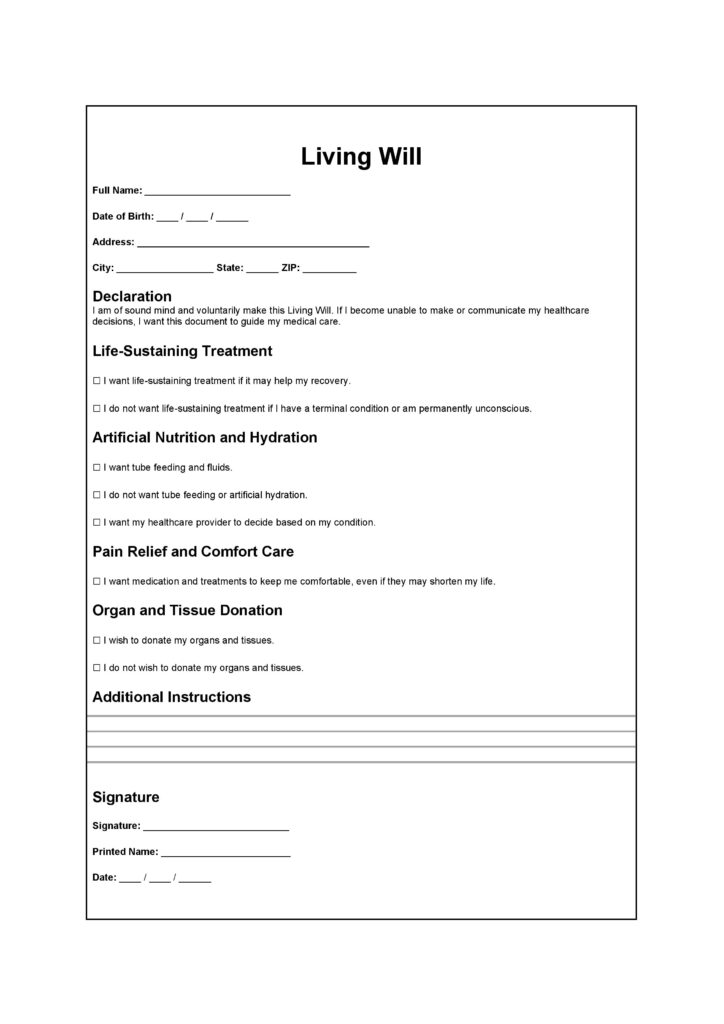
What Is an Advance Directive?
Many people use the terms Living Will and Advance Directive interchangeably, but they are not exactly the same.
An Advance Directive is a broader legal document that may include:
- A Living Will
- A Medical Power of Attorney (Healthcare Proxy)
- Additional healthcare instructions permitted under state law
The Living Will explains what medical treatments you want or do not want, while the Medical Power of Attorney appoints someone you trust to make healthcare decisions if situations arise that are not specifically covered by your written instructions.
Together, these documents provide a comprehensive plan for future medical care.
Why You Should Have a Living Will
Medical emergencies can happen at any age. While many people create a Living Will later in life, adults of all ages can benefit from having one.
Without written healthcare instructions, doctors may rely on state laws and family members to determine what treatment should be provided. In situations where relatives disagree, decisions may become emotionally difficult and could delay medical care.
Creating a Living Will allows you to:
- Make your own healthcare decisions before an emergency occurs.
- Reduce stress for your family.
- Help healthcare providers understand your wishes.
- Avoid unnecessary disputes among loved ones.
- Ensure your personal values guide medical treatment.
- Support your appointed healthcare agent if you have one.
Advance planning gives you greater control over future healthcare decisions while reducing uncertainty during difficult situations.
When Should You Create a Living Will?
There is no perfect age to prepare a Living Will. Instead, it should be created while you are mentally capable of understanding your medical choices.
Many people choose to prepare one after:
- Turning 18 years old.
- Getting married.
- Having children.
- Receiving a serious medical diagnosis.
- Beginning treatment for a chronic illness.
- Planning for major surgery.
- Retiring.
- Updating their estate plan.
Healthcare professionals often recommend completing an Advance Directive before any significant medical procedure, as unexpected complications can occur even during routine surgeries.
Situations Where a Living Will Is Especially Helpful
A Living Will can provide valuable guidance in many medical situations.
Examples include:
Terminal Illness
Individuals diagnosed with terminal illnesses often use a Living Will to document their preferences regarding life-sustaining treatment, pain management, and comfort care.
Progressive Neurological Disorders
People living with Alzheimer’s disease, Parkinson’s disease, ALS, multiple sclerosis, or other neurological conditions may choose to record their healthcare wishes before losing decision-making capacity.
Serious Accidents
Unexpected accidents can leave a person unconscious for an extended period. A Living Will helps medical professionals understand the patient’s wishes when immediate decisions must be made.
Chronic Medical Conditions
Individuals with advanced heart disease, kidney failure, chronic respiratory disease, or other long-term illnesses often prepare Living Wills as part of their ongoing healthcare planning.
Planned Surgery
Although complications are uncommon, many patients complete an Advance Directive before undergoing major surgical procedures.
Who Can Create a Living Will?
In general, a person may create a Living Will if they:
- Are at least 18 years old (or meet their state’s legal age requirements).
- Have the mental capacity to understand healthcare decisions.
- Sign the document voluntarily without coercion.
Some states recognize advance directives created by emancipated minors or under other specific circumstances. Because these rules vary, you should review the laws in your state before completing your document.
Federal Law and Living Wills
One of the most important federal laws affecting advance care planning is the Patient Self-Determination Act (PSDA) of 1990.
The PSDA requires healthcare facilities that participate in Medicare or Medicaid to:
- Inform patients about their rights to make healthcare decisions.
- Provide information about Advance Directives.
- Ask whether patients have an Advance Directive.
- Record that information in the patient’s medical record.
- Educate staff and the community about advance care planning.
The PSDA does not create one nationwide Living Will. Instead, each state establishes its own legal requirements for Advance Directives.
State Laws Matter
Although the basic purpose of a Living Will is similar throughout the United States, every state has its own laws regarding:
- Required forms
- Witness requirements
- Notarization
- Signing procedures
- Revocation
- Recognition of out-of-state documents
For this reason, you should always use a Living Will that complies with your state’s legal requirements or consult a qualified attorney if you have questions.
What a Living Will Can and Cannot Do
A Living Will is a powerful legal document, but it has a specific purpose. It allows you to state your preferences about certain medical treatments if you become unable to communicate your decisions due to illness or incapacity. It does not replace conversations with your family or healthcare providers, nor does it cover every possible medical situation.
Understanding the scope of a Living Will helps ensure that your expectations match what the document is legally designed to accomplish.
What a Living Will Can Do
A properly prepared Living Will may allow you to:
- State whether you want life-sustaining treatment in certain medical situations.
- Accept or refuse the use of mechanical ventilation.
- Provide instructions regarding artificial nutrition and hydration.
- Express your preferences about CPR (where consistent with state law and medical orders).
- Describe your wishes regarding comfort care and pain management.
- Include organ and tissue donation preferences where permitted.
- Guide doctors and your healthcare agent if you become unable to communicate.
When combined with a Medical Power of Attorney, a Living Will becomes an important part of a comprehensive advance care plan.
What a Living Will Cannot Do
A Living Will generally cannot:
- Require a doctor to provide treatment that is medically inappropriate or unavailable.
- Require healthcare providers to act contrary to federal or state law.
- Appoint someone to make healthcare decisions (this is done through a Medical Power of Attorney or Healthcare Proxy).
- Make financial or property decisions.
- Replace a Last Will and Testament.
- Authorize physician-assisted death where it is prohibited by law.
Healthcare professionals must continue to provide care that complies with applicable laws, medical ethics, and accepted standards of practice.
Medical Treatments Commonly Addressed in a Living Will
Most Living Wills discuss medical treatments that may become necessary during serious illness or permanent incapacity.
Examples include:
Cardiopulmonary Resuscitation (CPR)
You may express your wishes regarding CPR if your heart or breathing stops. In many situations, a separate physician-signed Do Not Resuscitate (DNR) order may also be required before emergency responders can withhold CPR.
Mechanical Ventilation
A Living Will can explain whether you want a ventilator used if you are unable to breathe independently.
Artificial Nutrition and Hydration
You may specify whether feeding tubes or intravenous hydration should be used if you cannot eat or drink naturally.
Dialysis
Individuals with advanced kidney disease sometimes include instructions about dialysis if recovery is unlikely.
Pain Management and Comfort Care
Many people request that pain relief and comfort measures continue even if life-prolonging treatments are withheld.
Organ and Tissue Donation
Some states allow your Living Will or Advance Directive to include organ donation preferences. You can also register as an organ donor through your state’s donor registry or driver’s license program.
Living Will vs. Last Will and Testament
Although their names are similar, these documents serve entirely different purposes.
| Living Will | Last Will and Testament |
|---|---|
| Takes effect while you are alive but unable to make healthcare decisions. | Takes effect after your death. |
| Covers medical treatment preferences. | Distributes your property and assets. |
| Helps guide healthcare providers. | Guides your executor and beneficiaries. |
| Part of an Advance Directive. | Part of an estate plan. |
A Last Will controls what happens to your estate after death. A Living Will helps guide medical decisions during your lifetime if you lose decision-making capacity.
Living Will vs. Medical Power of Attorney
These documents work well together but serve different functions.
Living Will
- Records your treatment preferences.
- Gives written medical instructions.
- Speaks for you through your documented wishes.
Medical Power of Attorney
Also known as a Healthcare Proxy or Durable Power of Attorney for Healthcare in some states, this document:
- Appoints someone you trust.
- Allows that person to make healthcare decisions on your behalf if you cannot.
- Covers situations not specifically addressed in your Living Will.
Many estate planning attorneys recommend preparing both documents together for more complete healthcare planning.
Living Will vs. Advance Directive
An Advance Directive is an umbrella term that may include several healthcare planning documents.
Depending on your state, an Advance Directive may contain:
- Living Will
- Medical Power of Attorney
- Healthcare instructions
- Organ donation preferences
- Mental health treatment preferences (where authorized)
Because terminology differs among states, your state may use a different name for these forms while serving the same general purpose.
Living Will vs. DNR Order
A Living Will and a Do Not Resuscitate (DNR) order are not the same.
Living Will
- Prepared by you.
- Expresses future treatment preferences.
- May guide physicians if you lose decision-making capacity.
DNR Order
- Written or signed by a physician or other authorized healthcare professional, depending on state law.
- Specifically instructs healthcare providers not to perform CPR if your heart or breathing stops.
- Used in hospitals, nursing homes, or other care settings according to state regulations.
Some people choose to have both documents as part of their healthcare planning.
Living Will vs. POLST
A POLST (Physician Orders for Life-Sustaining Treatment) or MOLST (Medical Orders for Life-Sustaining Treatment) is different from a Living Will.
A POLST form:
- Is intended for individuals with serious or advanced illnesses.
- Is completed with a healthcare professional.
- Contains medical orders that healthcare providers follow immediately.
- Travels with the patient across care settings in participating states.
A Living Will, by contrast, expresses your future preferences and may require interpretation before being applied to your medical situation.
Not every state uses the term POLST. Some states use different names for similar medical order forms.
Other Documents You May Need
A complete healthcare and estate plan often includes additional legal documents.
- Medical Power of Attorney – Allows a trusted person to make healthcare decisions on your behalf.
- HIPAA Authorization – Authorizes healthcare providers to share your medical information with designated individuals in accordance with the Health Insurance Portability and Accountability Act (HIPAA).
- Financial Power of Attorney – Allows someone to manage financial matters if you become unable to do so.
- Last Will and Testament – Determines how your assets are distributed after your death.
- Revocable Living Trust – Helps manage property during your lifetime and after death while potentially avoiding probate for certain assets.
- Organ Donation Registration – Allows you to document your decision regarding organ and tissue donation.
How a Living Will Benefits Your Family
Creating a Living Will is not only about protecting your own wishes—it can also ease the burden on those closest to you.
Without written guidance, family members may be forced to make difficult medical decisions during highly emotional circumstances. Differing opinions can create stress and conflict at a time when everyone is focused on your care.
A Living Will can help by:
- Reducing uncertainty during medical emergencies.
- Giving loved ones confidence that they are honoring your wishes.
- Supporting communication between family members and healthcare providers.
- Minimizing disagreements about treatment decisions.
- Providing peace of mind that your preferences have been documented in advance.
Common Misconceptions About Living Wills
Many people misunderstand what a Living Will does. Here are some common myths.
Myth: Only older adults need a Living Will.
Fact: Any competent adult can benefit from advance care planning, regardless of age.
Myth: My spouse can automatically make every medical decision for me.
Fact: State laws vary, and having written documents can avoid uncertainty or delays.
Myth: A Living Will replaces my Last Will.
Fact: These documents serve completely different legal purposes.
Myth: Once signed, a Living Will cannot be changed.
Fact: You may generally revise or revoke your Living Will while you still have decision-making capacity, subject to your state’s laws.
Myth: A Living Will covers every medical situation.
Fact: It provides guidance for the situations described in the document. A Medical Power of Attorney can help address circumstances not specifically covered.
Conclusion
Preparing a Living Will is an important step in protecting your healthcare choices and reducing uncertainty for your loved ones. By documenting your treatment preferences before a medical emergency occurs, you help ensure that your values remain central to future healthcare decisions.
Because Living Will requirements differ from state to state, always use a form that complies with your state’s laws or seek advice from a qualified attorney if you have questions about your specific situation.
A Living Will is most effective when it is kept up to date, shared with your healthcare providers and trusted family members, and reviewed after major life or health changes.
FAQs
1. What is a Living Will?
A Living Will is a legal document that outlines your medical treatment preferences if you become unable to communicate your healthcare decisions.
2. Is a Living Will legally binding in the United States?
In many situations, yes. However, the legal requirements and enforceability depend on your state’s advance directive laws.
3. Is a Living Will the same as an Advance Directive?
Not always. A Living Will is often one part of an Advance Directive, which may also include a Medical Power of Attorney and other healthcare instructions.
4. Do I need a lawyer to create a Living Will?
Many states provide official forms that you can complete without a lawyer. If you have complex medical or estate planning needs, consulting an attorney may be helpful.
5. Does a Living Will need to be notarized?
Some states require notarization, some require witnesses, and others allow either. Check your state’s legal requirements before signing.
6. Can I change my Living Will?
Generally, yes. Most states allow you to amend or revoke your Living Will while you have decision-making capacity.
7. Where should I keep my Living Will?
Keep the original in a safe but accessible location, and provide copies to your healthcare provider, healthcare agent, close family members, and anyone else involved in your care.
8. What happens if I don’t have a Living Will?
Healthcare decisions may be made according to state law by your healthcare team and authorized decision-makers, which may not always reflect your personal preferences.
9. Should I also create a Medical Power of Attorney?
Yes. Many people prepare both documents because they work together to provide more complete healthcare planning.
10. Can my Living Will be used in another state?
Many states recognize valid advance directives created elsewhere, but recognition and requirements vary. Review your documents if you move to a different state.

Ted Cruz is the founder and driving force behind BillofSaleTemplate.us, a comprehensive resource for free bill of sale templates tailored to meet a variety of needs. With a keen understanding of the importance of accurate and legally sound documentation, Ted has dedicated his expertise to providing accessible and user-friendly templates for all types of transactions, from vehicle sales to personal property exchanges.
Recognizing the diverse legal requirements across different states, Ted has meticulously crafted state-specific bill of sale templates to ensure compliance and ease of use for users nationwide. His commitment to simplifying the process of creating reliable and legally binding documents has made BillofSaleTemplate.us a trusted platform for individuals and businesses alike.