![Free Bill of Sale Template PDF, Word [United States]](https://billofsaletemplate.us/wordpress/wp-content/uploads/2024/06/bill-of-sale-Logo-1-189x74.png)
A car bill of sale is a basic yet very significant document when it comes to the process of purchasing or selling a car. Consider it as a written receipt that effectuates the transfer of title between the seller and the buyer. It contains such essential information as the car make, model, year, Vehicle Identification Number (VIN), name and addresses of both the seller and buyer, price at which the car was sold, and the date when it was sold. The document particularly comes in handy to safeguard both parties since it makes it clear that the car has been sold as-is or with some conditions agreed to.
To the seller, Car Bill of Sale is a document that shows that he does not own the car anymore and this is an important document in case of any disagreement in future, traffic fines, and car accidents. To the buyer, it serves as a legal confirmation that they have now acquired ownership of the vehicle which is required to register the car, pay taxes or obtain insurance. In certain states, a signature of the Bill of Sale is obligatory, however, in most cases, it is sufficient to have it signed to consider the transaction complete. Although you may be selling a car to your friend or family, putting the sale on paper will save everybody involved and avert misunderstanding. All in all, it is a small piece of paper that bears huge significance in a hassle-free, safe and legal vehicle transaction.
Printable Bill of Sale for Car Form Template
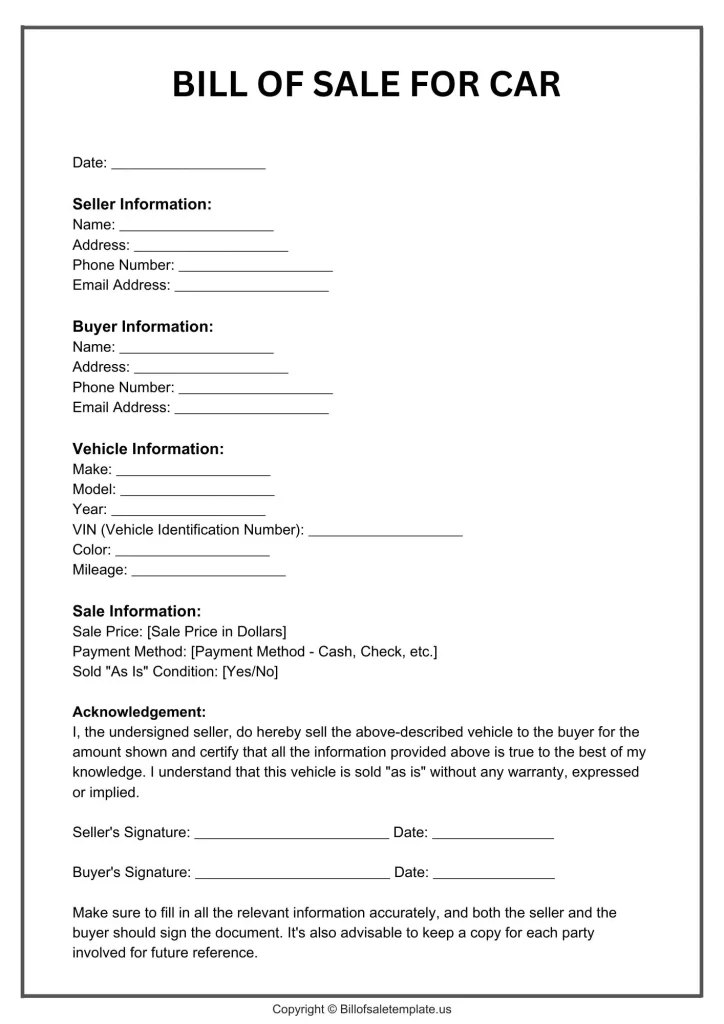
The following points outline the key elements and factors for each situation:
Bill of Sale for an Entire Car
- Title of the Document
- Write the purpose on the top of the paper, Bill of Sale of Entire Car.
- Write the purpose on the top of the paper, Bill of Sale of Entire Car.
- Date of Sale
- Add the specific date on which the transaction is occurring.
- Helps determine the process of transfer of ownership on a legal basis.
- Seller Information
- Full address, full name, and contact details of the individual selling the car.
- Ensures that the party transfer of the ownership is evident.
- Buyer Information
- Complete address and contact as well as the name of the individual purchasing the car.
- Establishes legal receipt of ownership.
- Vehicle Details
- Add make, model, year, color and Vehicle Identification Number (VIN).
- Add mileage at time of sale.
- Helps uniquely distinguishes the vehicle and eliminates the controversy.
- Sale Price
- Indicate the amount that has been agreed on the car.
- State that it was paid in full or in installments (e.g., USD).
- Payment Method
- Indicate the method of payment: cash, check, bank transfer, or other.
- Helps are data that prove if there will be future disagreements.
- “As-Is” Statement
- Note whether the automobile is being sold as-is, which is a situation whereby the buyer accepts the car as it is given to him with no warranties.
- Guarantees the seller of claims in the future concerning the condition of the car.
- Odometer Disclosure
- Add a statement of the current mileage of the car as stipulated by law.
- Significant to avoid cheating on the odometer.
- Signatures
- The document should be signed and dated by both the seller and the buyer.
- Omit witness signatures unless necessary.
Notarization (Optional but Recommended)
-
- In certain states, it is necessary to notarize the Bill of Sale to legalize it.
- Gives an added security to both sides.
- Additional Terms (Optional)
- Other terms agreed to such as addition of spare parts, additional keys or new repairs.
- Delivery of Vehicle
- Specify the date and place of delivery of the vehicle to the buyer.
- Establishes the time of ownership and responsibility.
Such a form makes Bill of Sale of an Entire Car complete, legally protective and everyone clearly understand it.
Legal Considerations for Both Scenarios
Proof of Ownership Transfer
- Make sure that the Bill of Sale is clear that ownership of the vehicle has been transferred to the buyer.
- Guarantees both sides in case of conflicts in the future.
State and Local Requirements
- Each state has certain requirements of selling vehicles, including notarization, registration or emission certificates.
- Check the local DMV requirements to check whether the sale is legal.
Odometer and Vehicle History Disclosure
- Sellers should legally be able to give correct mileage during the period of sale.
- The information on previous accidents or major repairs can be disclosed to prevent the fraud claims.
“As-Is” vs. Warranties
- When the vehicle is sold in as-is condition, the seller will not incur the cost of repairing the vehicle in future.
- In case there are any warranties they should be well-presented in the Bill of Sale.
Tax and Registration Responsibilities
- The customer might require to pay sales tax and transfer the vehicle to the customer name.
- To avoid future liability, the seller is expected to take all the paperwork done.
Liability After Sale
- After the ownership is transferred, the seller must inform DMV or the appropriate authorities to prevent fines, tickets, and accidents associated with the car..
Fraud Prevention
- Also add extensive information of both parties as well as the vehicle to avoid identity theft or fraudulent claims.
- It is advisable to maintain the copies of the Bill of Sale in case of legal defense.
Notarization (If Required)
-
- Certain states or circumstances might need the notarization in order to enforce the document.
- It is an added process of verification between the buyer and the seller.
Free Bill of Sale for Car
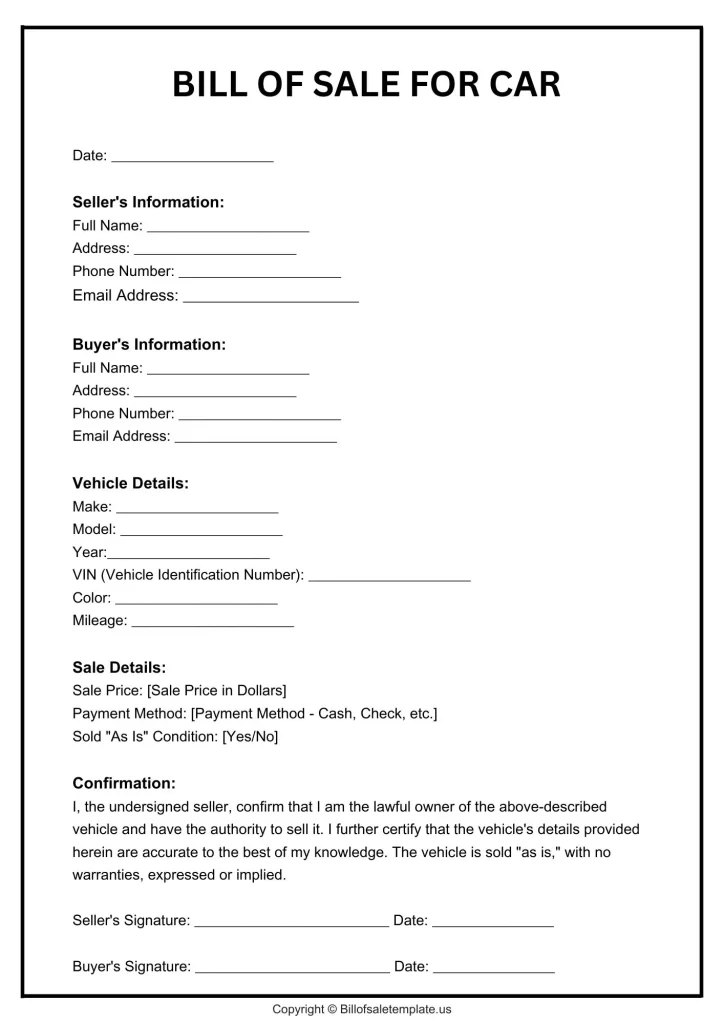
Example Language for a Bill of Sale for Car Parts
Title of the Document
- Make it clear by stating that it is a Bill of sale of Car Parts.
Date of Sale
- Provide the actual date on which the transaction is made.
- Develops a legal timeframe to transfer.
Seller Information
- Contact information, address and full name of the individual selling the parts.
- Where the seller is identified and confirmed to be the owner.
Buyer Information
- The name, address, and her/his phone number of the individual purchasing the components.
- The legal owner is indicated by whom.
Description of Car Parts
- Name and description of every section (e.g., engine, tires, battery).
- add make, model, year and quantity, where possible.
- Condition (new, used, or rebuilt) and serial number or VIN, where applicable.
- Helps reduce conflicts over the sold.
Sale Price
- Indicate the total cost of the parts.
- Add payment method (cash, check, transfer).
- Acts as proof of payment.
Terms of Sale
- Include whether the components have been sold on the condition of being used without any guarantees.
- Assure that the seller is the legal owner of the parts and may sell them.
- Eliminates any ambiguity that the buyer acknowledges all the risks, upon purchase.
Signatures:
- Seller: ________________________ Date: ___________
- Buyer: ________________________ Date: ___________
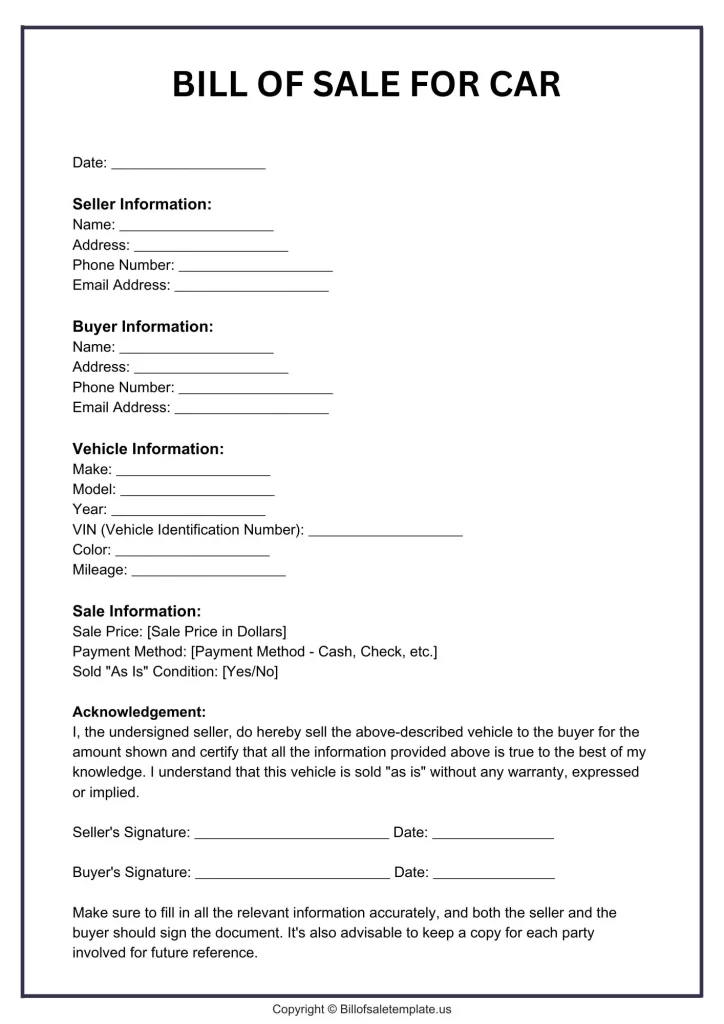
Bill of Sale for Car for the parts
- Focus on Individual Parts Instead of the Whole Vehicle
- Rather than entering a single VIN of a complete car, enter a specific identification of each part which may be in the form of serial numbers, part numbers or description.
- Helps does not confuse what it is selling.
- Include Condition and Usage Details
- Indicate, either, that every section is of a new kind, slightly used, or worn, or refurbished.
- Incident notes on wear, repairs or functionality problems to sell the piece.
- Quantity Specification
- Make it clear that a certain number of every part is being sold (i. e., 4 tires, 2 brake pads).
- Avoids conflict in case the customer does not get the same or more goods as are required.
- Separate Pricing for Each Part (Optional)
- Record list prices separately when there are several parts which are being sold.
- Accounting, tax and dispute resolution facilitating assistance.
- Purpose of Sale Statement
- Make clear whether the parts are being sold, repaired or used individually.
- Maybe helpful to liability and warranty issues.
- Shipping or Pickup Terms
- Clearly define the time of picking the parts among the buyer or shipping, who is paying the shipping fees, and the risk of breakage.
- Transfer of Ownership
- Included is a statement where the ownership of each part is transferred to the buyer upon payment or delivery.
- Helps in making it legally clear when the liability and responsibility change.
- Applicable Warranties or Guarantees
- In the event the seller provides warranty to some parts, then specify it.
- Otherwise, clearly indicate that the parts are sold on an as-is condition, though, part works better than the rest.
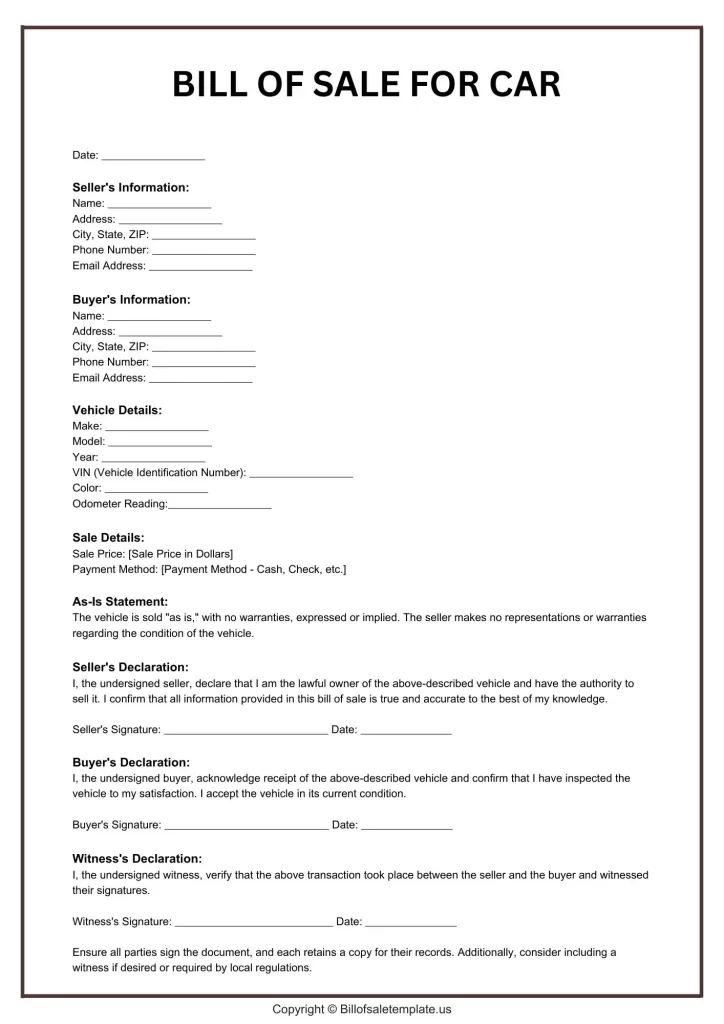
Legal Considerations
Ownership Verification
- Ensure that the parts are really owned by the seller and he has the right to sell them. Those parts removed out of a leased or financed vehicle can be limited.
Regulatory Compliance
- Certain components such as airbags or catalytic converters are controlled. Selling them unlawfully may result into fines or legal problems.
Disclosure of Condition
- In case the seller is accused of fraud, he or she should be truthful in explaining the state of the parts, as well as the damages or repairs.
Proof of Sale
- Store the evidence in the form of a signed Bill of Sale and receipts. This safeguards the two parties in the event of disagreements or warranty.
Tax Obligations
- The sale can be subject to reporting or payment of sales tax depending on the local laws. Compliance is achieved through proper documentation.
Liens or Warranties
- Determine whether any of the parts are on third-party warranty or liens. The disclosure of the sale of encumbered parts may lead to legal liability.
Shipping and Safety
- Shipping In case of shipment, follow the transport regulations, particularly those of hazardous materials such as batteries or liquids to avoid accidents or fines.
The considerations are a way of making sure that the sale or purchase of car parts using a Bill of Sale is both safe and pure in the law and minimizes the risks of buying and selling.
FAQs
Q1. How to write up a bill of sale for a car?
A car bill of sale should be written up and include the following information:
- The details of the buyer and seller (full names, addresses, and contacts numbers)
- Car specifications: make, model, year, VIN, color and mileage.
- Sale price and date of sale
- Mode of payment (cash, check, transfer, and so on)
- Statement of sale (“The seller sells and assigns ownership to the buyer…
- Buyer and Seller signatures.
It can be written by hand or typed but both sides must sign in order to provide legal evidence of the deal.
Q2. What does a bill of sale look like for a car?
A bill of sale of car resembles a form or one-page document that contains the following details:
- Buyer name, Seller name and address.
- The description of the vehicle (Make, model, VIN, mileage)
- The sale amount and date
- A signature and a notary seal section.
It can have the form of a contract or a printable form with blank fields to be filled in.
Q3. What is a bill of sale for a car?
A car bill of sale is a legal document that demonstrates that the assumption of a car has been sold to the buyer. It logs the sales information and it is applied in transferring titles, registration, and as evidence of purchase.
Q4. What to put on a bill of sale for a used car?
A used car bill of sale must contain:
- Contact information and name of buyer and seller.
- Car description (year, make, model, VIN, mileage, color)
- Price of sale and payment.
- Date of sale
- Signatures of both parties
Provide an as-is statement optionally in the case of no warranty.
Q5. Who keeps the bill of sale for a car?
Buyer and seller are recommended to have a duplicate of the bill of sale.
- It is used by the buyer to title and put the car on record
- The seller retains it as a personal record so that he can demonstrate that he sold the car and so that he can also avoid liability once the sale.

Ted Cruz is the founder and driving force behind BillofSaleTemplate.us, a comprehensive resource for free bill of sale templates tailored to meet a variety of needs. With a keen understanding of the importance of accurate and legally sound documentation, Ted has dedicated his expertise to providing accessible and user-friendly templates for all types of transactions, from vehicle sales to personal property exchanges.
Recognizing the diverse legal requirements across different states, Ted has meticulously crafted state-specific bill of sale templates to ensure compliance and ease of use for users nationwide. His commitment to simplifying the process of creating reliable and legally binding documents has made BillofSaleTemplate.us a trusted platform for individuals and businesses alike.